Latest News Archive
Please select Category, Year, and then Month to display items
02 July 2019
|
Story Eloise Calitz
|
Photo Keagan Nkwaira
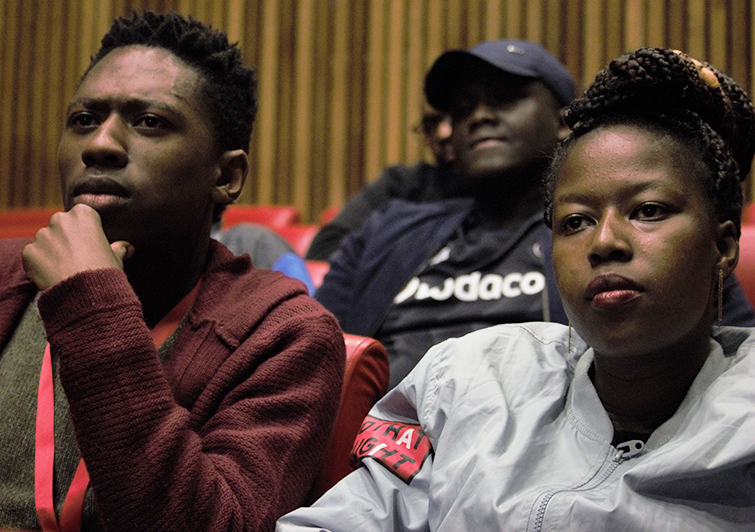 Audience members listening attentively to the presentations at the Entrepreneurship Inter-varsity on the Bloemfontein Campus.
The UFS continuously creates opportunities for students to develop and explore platforms where they can showcase their talents and share their innovative concepts. In the light of this, it is important for the institution to become a preferred academic knowledge partner that can conceptualise, develop, and successfully commercialise research activities, and through this foster an innovative and entrepreneurial culture that aligns to its Integrated Transformation Plan.
This is why opportunities such as the Entrepreneurship Intervarsity Competition are so important, since it encourages students to demonstrate their entrepreneurial talent, and through this connect with investors and industry leaders to start up a business.
The competition
Student entrepreneurs across the 26 public universities in South Africa were invited to submit their innovative ideas as part of a competition supported by Entrepreneurship Development in Higher Education (EDHE), in collaboration with the Allan Gray Orbis Foundation. The opportunities created through this initiative are twofold:
1. For student entrepreneurs to present their innovative ideas and businesses.
2. For universities to demonstrate their entrepreneurial talent and the ways in which they support and grow the next generation of business leaders.
The competition takes place in five stages. The process started with each student submitting their short videos and applications on the official competition site. Each institution also had the opportunity to select student entrepreneurs to take part in the competition. Fifteen students pitched their ideas during internal rounds at the UFS on 30 May 2019. Of these students, four were selected to represent the UFS at the regional rounds of the Entrepreneurship Intervarsity, where the finalists will be chosen.
The students were judged in four categories:
• Category 1: Innovative Ideas
• Category 2: Tech Businesses (existing businesses, formal or informal, undergrad or postgrad)
• Category 3: Social Impact Businesses (existing businesses, formal or informal, undergrad or postgrad)
• Category 4: General (existing businesses, formal or informal, undergrad or postgrad)
The following UFS entrants were selected to take part in the regional finals:
• Christopher Rothman for his liquid yeast culture that can be used in the fermentation of beer.
• Driaan-Lou Kemp for his patented water-saving device.
• Grace Mthembu for her electricity-saving system.
• Martin Clarke for his idea to use drone technology for the mining industry