News about UFS-DiMTEC
2026

NATIONAL FIRE SERVICES INDABA

Picture1


The National Disaster Management Centre (NDMC) hosted a well-attended fire services indaba from the 26th to the 27th of February 2026 at the President Hotel in Bloemfontein. The theme of the indaba was “Building Resilient Communities”, a theme aimed at promoting resilient communities through stronger fire risk reduction and municipal capacity. The Centre had the opportunity to exhibit, engage and promote its qualifications and research capabilities. The department was represented by Dr Olivia Kunguma and Ms Keketso Mokoaledi, who engaged with delegates throughout the Indaba


ERASMUS + PROGRAM TEACHING MOBILITY, ROMANIA

From 21 to 29 March, 2026, Dr Olivia Kunguma, Prof Johanes Belle, Prof Abiodun Ogundeji and Prof Alice Ncube were accepted for a teaching mobility held at Universitatea Babes-Bolyai, Romania. This was in the Faculty of Environmental Science and Engineering. The program included workshops, teachings and scientific engagements with various academics and learners. It also included cultural activities which are key to the Erasmus + program.


INTERNATIONAL WORKSHOP ON NATURE-BASED URBAN RESILIENCE IN KENYA

Prof Johanes Belle and Dr Raphela-Masuku were invited by the Deutsche Gesellschaft für Internationale Zusammenarbeit (GIZ) to the Sub-Saharan Connective Cities Workshop on Nature at the Heart of Municipal Resilience, held in Naivasha, Kenya, from 20 to 23 April 2026. The workshop brought together municipal practitioners, technical experts, and policymakers from across Sub-Saharan Africa and Germany to explore how nature-based solutions (NbS) can strengthen climate resilience in cities. Dr Raphela-Masuku served as workshop facilitator and moderator, guiding discussions and peer-learning sessions among participating municipalities. Prof Belle contributed as an expert and facilitator on NbS, unpacking the concept through the lens of ecosystem services, including flood regulation, water purification, and climate moderation and highlighting co-benefits such as improved well-being and job creation. Their participation reflects the Centre's growing role in shaping international dialogue on sustainable, climate-resilient urban development.


INTERNATIONAL WRITING WORKSHOP FOR EARLY-CAREER RESEARCHERS IN NAIROBI

Dr Tlou Raphela-Masuku attended the International Writing Workshop for Early Career Researchers in SADC and East Africa, held in Nairobi, Kenya, from 31 May to 6 June 2026. The workshop was funded by the British Academy and jointly organised by York St John University (UK), the University of the West of England (UWE Bristol), the University of Nairobi, and the University of Cape Town. The week-long programme brought together early-career researchers from Southern and Eastern Africa working on climate change adaptation, disaster risk reduction, resilience, sustainability, and governance. Sessions covered manuscript development, literature reviews, methodology writing, and navigating peer review and publishing pathways, alongside direct engagement with journal editors and publishers. A highlight for Dr Raphela-Masuku was mentorship from Prof Olelakan Adekola and Prof Minoo Esfehani (York St John University), which offered guidance on strengthening her publication outputs and expanding her international research network.


UNIVERSITY OF THE FREE STATE – NATURAL AND AGRICULTURAL SCIENCES CONFERENCE

Picture2


Mr Collins Okolie, a Research Assistant with DiMTEC, presented a paper titled, ‘Nature-Based Solutions for Climate Change and Disaster Risk Reduction: Perception-Based Empirical Evidence from Smallholder Farmers in the Free State’, at the annual 2026 NAS Conference. The conference was held from 22 to 24 June 2026. “Climate change continues to increase the risk of disasters such as droughts, wildfires, floods, and heatwaves across the globe. It is becoming increasingly evident that Nature-based Solutions (NbS) can play a critical role in reducing climate-related risks, including flooding, soil erosion, and water scarcity, while simultaneously enhancing agricultural productivity and strengthening the resilience of farming communities,” said Collins. His research examines how smallholder farmers in the Free State perceive Nature-based Solutions and the factors influencing their adoption as an effective strategy for climate change adaptation and disaster risk reduction. Understanding these perceptions is essential for designing evidence-based policies and interventions that promote sustainable agriculture and resilient livelihoods.

LIMPOPO FLOOD DISASTER, A CASE STUDY FOR THE 2026 MASTERS PRACTICAL EXAMINATION


Picture4

In June 2026, over the course of a week, the master's candidates were presented with a real-life scenario based on the 2025 – 2026 Limpopo floods, which destroyed several homes, infrastructure, and lives. Based on that scenario, they had to develop an Impact Assessment and Recovery Plan for the 2025–2026 Flood Disaster in Limpopo Province. They had to develop a practical, technical report that was presented to various officials for implementation. The officials were from the Mangaung Disaster Management Centre, the Free State Provincial Disaster Management Centre, the Capricorn District Disaster Management Centre, the Vembe District Disaster Management Centre, the Red Cross International, and several others. Students were split into four groups, each drawing on markedly different professional backgrounds to build their recovery plans. The cohort's combined expertise spanned land surveying, safety, health, and environmental (SHE) management, research, office administration, and emergency response, reflecting the multidisciplinary nature of disaster management. Ms Tengetile Khumalo, a SHE and Dangerous Goods Specialist, described feeling significant pressure under tight time constraints, but said she was pleased with the practical exposure and felt her postgraduate diploma had prepared her well for the task. “This was an eye-opening experience, we mastered a wide range of materials and applied them to the scenario under pressure”, said Mr Kudakwashe Nyakutya, a Land Surveyor. Despite the intensity of the exercise, every student who took part described it as a valuable learning experience. Confronting disaster management in its full real-world complexity and being required to respond to it under pressure is central to what DiMTEC's Masters programme aims to achieve. The Centre was honoured and expressed pride in its students' performance, officials who gave their time and expertise to help shape the next generation of disaster management professionals in South Africa.

DISASTER READINESS AT SAFER CITY INDABA

Mangaung Metropolitan Municipality hosted a Disaster Readiness Safer Cities Indaba in Bloemfontein on the 18 and 19th of February 2026. Prof Alice Ncube, an Associate Professor at the Centre, was invited to present at the Indaba, where she spoke under the title, "The State of Disaster Readiness and Responsiveness." She highlighted the importance of preparedness, coordinated response systems, and strengthening institutional capacity to manage risks effectively. Her address Mangaung Metropolitan Municipality hosted a Disaster Readiness Safer Cities Indaba in Bloemfontein on the 18 and 19th of February 2026. Prof Alice Ncube, an Associate Professor at the Centre, was invited to present at the Indaba, where she spoke under the title, "The State of Disaster Readiness and Responsiveness." She highlighted the importance of preparedness, coordinated response systems, and strengthening institutional capacity to manage risks effectively. Her address drew key stakeholders committed to building safer and more resilient cities. The Centre has the opportunity to exhibit, showcasing its offerings in training, education and research. Ms Keketso Mokoaledi, Ms Mantsoi Ramakoloi, and Ms Keitumetse Mohoje, interns at the Centre, engaged with stakeholders during the exhibition. The Indaba underscored a central message for the sector: that resilience in cities is built through collaboration, knowledge sharing, and proactive planning.


Picture5

Picture6


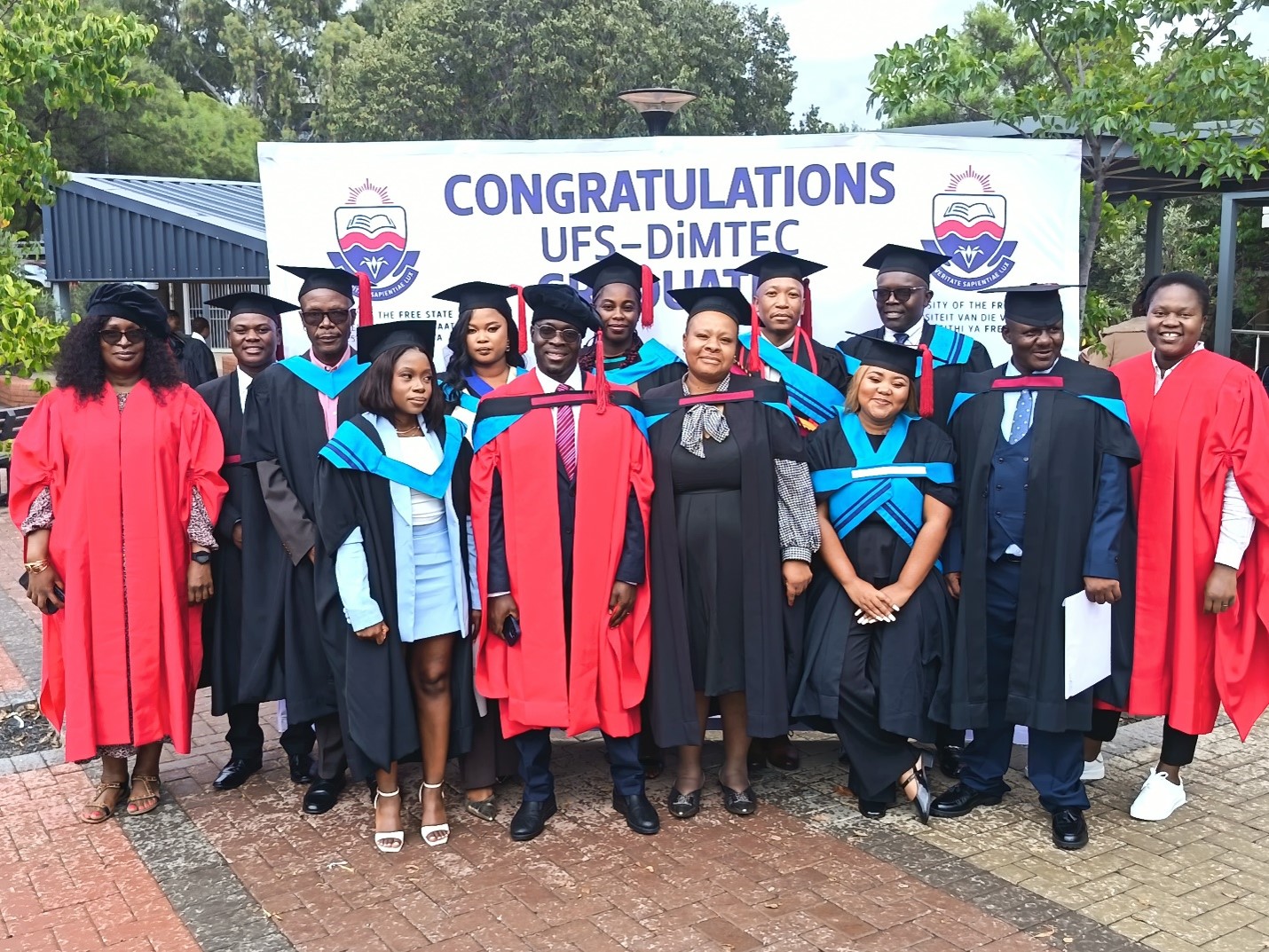
HARVEST TIME: DIMTEC CELEBRATES ITS 2026 DISASTER MANAGEMENT GRADUATES
Picture7
In April, the Centre celebrated another milestone by congratulating its latest cohort of PhD, Master's, and Postgraduate Diploma graduates in Disaster Management.

The centre says the achievement reflects years of hard work, resilience, and dedication, and marks the beginning of graduates' meaningful contribution toward building disaster-resilient communities across the region. Dr Tobias Ndlovu graduated with a PhD, with a thesis titled "Exploring the Capabilities of Informal Settlements: A Reflection on Poverty Reduction in Urban Zimbabwe." The following students graduated with a Master of Disaster Management:

  • Chauke, S. Shadreck
  • Manzi, A. Odwa
  • Mathonsi, B. Shadrack
  • Mongale, T. Winnie
  • Motlou, R. Precious
  • Mpshane, K. Muriel
  • Mthembu, A.N. Pearl
  • Olifant, Tebatso
  • Taljaard-Nilsen, Nadia

The following students obtained their Postgraduate Diploma in Disaster Management:

Adejinmi, A. Babajide; Bilibana, B. Ntsikelelo; Dlekedla, T. Phila; Fakude, N. Ncamsile; Fetsha, Lubabalo; Hamutenya, Abel; Heshu, Phakama; Hlela, Sabelo; Kamuninga, Rachel; Khan, M. Hussain; Khumalo, Tengetile; Lubbe, A. Jurgens; Luthuli, A. Sibusiso; Mabena, Moleboeng; Madikizela, S. Sandiso; Maleka, B. Christinah; Masoma, M. Elizabeth; Masondo, B. Lindokuhle; Memani, Lita; Mhlongo, V. Treasure; Mogafe, T. Claudina; Mokoena, Blessing; Mokoena, T. Johannes; Mokwena, M. Gopolang (graduating with distinction); Mpanza, B. Trinity; Mthembu, M. Njabulo; Ngo, B. Fatima; Nhlapo, S. Philani; Ntlama, Nwabisa; Rakgwale, Mamotshabo Malebogo Rachel; Ramakoloi, Mantsoi Alice; Ramaqele, Mathabo; Ramoshebi, Kekeletso; Rantsho, P.T. Theophillus; Raphiri, Tshepang Refilwe; Rasei, N. Evodia; Seboko, Palesa Julia; Seoka, Mahlodi Mmamosotse Mmabatho; Sihlobo, Zizipho; Singh, Malcolm; Sithole, Khulisiwe Faith; Tau, O. Gloria; Van der Horst, C. William; Xokwe, Madoda; and Xoseni, Olwethu.


WEATHER AND CLIMATE INFORMATION SERVICES (WISER) PROGRAM AND THE SOUTH AFRICAN WEATHER SERVICE (SAWS)

Picture8


UFS-DiMTEC colleagues had the opportunity to attend the WISER ActionFirs Workshop hosted by the South African Weather Services in Pretoria from 28 to 31 August 2026. There were stakeholders from meteorological services, disaster management centres, government departments, academia and several other stakeholders. The workshop focused on strengthening South Africa's approach to people-centred early warning systems. Throughout the four-day event, one message was reinforced repeatedly: an effective early warning system is not only about producing accurate forecasts. It is equally about ensuring that warning messages reach everyone in a way they can understand and act upon. Participants explored how clear language, multiple communication channels, and close engagement with local communities can help meteorological services better understand the specific needs and vulnerabilities of the people they serve. Among the most significant lessons to emerge from the workshop was the critical importance of inclusion, particularly for persons with disabilities. Discussions highlighted a persistent gap in current practice: disaster risk reduction and early warning systems often fail to adequately consider the diverse needs of people living with disabilities. Warning messages, participants noted, are not always accessible to individuals who are deaf, blind, have cognitive impairments, or have limited mobility. As a result, these individuals are frequently among the most vulnerable when disasters strike, a reality that challenges the sector to rethink how warnings are designed and delivered. This point resonated strongly with attendees, underscoring a simple but powerful principle: an early warning system cannot truly be described as people-centred if it excludes any segment of the population. Moving forward, workshop participants agreed that disaster management practitioners must actively promote inclusive early warning systems. Key recommendations included ensuring that warning information is made available in accessible formats such as, Sign language interpretation, Braille, Audio messages, Simplified language and Accessible digital platforms. Collaboration with organisations representing persons with disabilities was also identified as essential, ensuring that early warning systems are designed from the outset to meet the real needs of this community rather than retrofitted after the fact. The consensus from Pretoria was clear: inclusive planning does more than protect vulnerable populations; it strengthens the resilience of entire communities. As South Africa continues to refine its national approach to early warning systems, the lessons from the WISER ActionFirst workshop offer a timely reminder that true preparedness leaves no one behind.


NATIONAL DISASTER MANAGEMENT RESEARCH SEMINAR

Dr Tlou Raphela-Masuku and Prof Alice Ncube participated as panellists at the National Disaster Management Research Seminar held in Thohoyandou, Limpopo, on 06 August 2026. The Seminar is an initiative born out of the National Research Agenda, a repository for disaster risk management research in South Africa. The Seminar brought together policymakers, researchers, academics, development partners and disaster management practitioners from across the country, creating a platform for dialogue on the current state and future direction of disaster management research and practice in South Africa. Mr Clinton Amatebelle and Ms Keketso Mokoaledi represented UFS-DiMTEC as exhibitors, engaging with delegates and sharing insights into the centre's training, education and research initiatives in disaster management.


STAKEHOLDER ENGAGEMENTS, ZIMBABWE


Picture9


Dr Olivia Kunguma, a Senior Researcher with the department, had the opportunity to engage with some colleagues from Chitungwiza Municipality in Zimbabwe. The engagements held on the 24th of July in Harare included discussions on disaster risk, municipal governance, and benchmarking against the current status in South Africa. Among the participants was Mr Tongai Mukomondera, a Master's alumnus of the Centre, who currently heads the Environmental Services Section within Chitungwiza Municipality. The engagement provided a valuable platform for knowledge exchange and collaboration on key issues relating to disaster risk and local government governance. Dr Kunguma also had the opportunity to showcase the Department's academic qualifications to prospective students while highlighting the Centre's research capabilities and its contribution to advancing knowledge and practice in disaster risk management.


Links to published opinions and news about UFS-DiMTEC


1.      Disaster Management students tackle real-world flood recovery challenge

2.      A decade of Erasmus+ collaboration strengthens sustainable disaster risk  management

3.     From stroke to submission: Tobias Ndlovu completes his PhD

4.     From struggle to scholarship: the quiet strength of Dr Mariëtte van Straaten

5.     A gendered path to resilience: Celebrating women PhDs who transform disaster risk reduction in Africa

6.     Africa's path to resilience: time for Africa to invest in resilience to reduce disaster risks

7.     Planting the roots of disaster resilience: Honouring Nelson Mandela Day through nature-based solutions

8.     Teaching and learning: Bridging the gap between theory and practice

9.     #YouthMonth: Celebrating youth empowerment (Akani Baloyi)

10.     Jagersfontein dam burst: Understanding the disaster-declaration process

11.   Opinion: KZN floods: Each one help one

12.   Opinion: KZN floods expose significant socio-economic and environmental vulnerabilities

13.   Prof Abiodun Ogundeji appointed as Director: Disaster Management Training and Education Centre for Africa

14.   Dr Nyam to find solutions for 'food security, inequality, and disaster preparedness' as he joins the World Bank

15.   Dr Alice Ncube: 'I desire to make a difference'

16.   Fighting COVID-19: Here is how we are helping

17.   Gender-Based Violence: A slow-onset disaster requiring prevention, justice and healing

18.   South Africa's foot-and-mouth disease (FMD) disaster exposes deep socio-economic agricultural inequalities


BLOEMFONTEIN CAMPUS FACULTY CONTACT

Elfrieda van den Berg (Marketing Manager)
T: +27 51 401 2531
E:vdberge@ufs.ac.za

QWAQWA CAMPUS FACULTY CONTACT

Dilahlwane Mohono (Faculty Officer)
T: +27 58 718 5284
E:naturalscienceqq@ufs.ac.za

Home new

We use cookies to make interactions with our websites and services easy and meaningful, to better understand how they are used and to tailor advertising. You can read more and make your cookie choices here. By continuing to use this site you are giving us your consent to do this.

Accept