05 December 2025
|
Story Christelle du Toit
|
Photo RUFORUM - Supplied
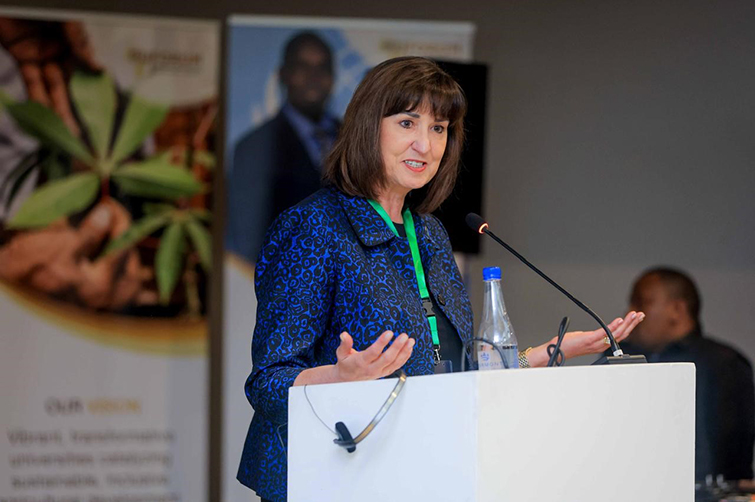 UFS Vice-Chancellor and Principal, Prof Hester C. Klopper, speaks at the RUFORUM Vice-Chancellors’ Forum, calling for stronger partnerships to turn research into real-world impact.
The University of the Free State (UFS) played a central role at the 21st RUFORUM Annual General Meeting in Gaborone, Botswana, where higher education leaders, policymakers, and agricultural experts gathered to chart new pathways for transforming African agriculture. With representation from the Vice-Chancellor and Principal, senior academic leaders, the Centre for Sustainable Agriculture, and the TAGDev Programme team, the UFS demonstrated its longstanding commitment to strengthening science-industry transitions, advancing entrepreneurship, and building inclusive, future-focused food systems.
Prof Hester C. Klopper, UFS Vice-Chancellor and Principal, addressed the Vice-Chancellors’ Forum on the theme of building capacity for science-industry transitions. She emphasised the urgent need for universities to move beyond knowledge creation alone and catalyse innovation that reaches communities, industries, and markets.
“We are producing excellent research, but too little of it reaches the people who need it most,” she said. “Our laboratories are busy, our researchers are publishing, our students are graduating – yet the distance between our campus gates and genuine economic transformation remains stubbornly wide. We need to close that gap through new academic programmes that build bridges between science and industry.”
Prof Klopper challenged African universities to embrace models that equip graduates to convert knowledge into tangible development impact. Highlighting global evidence from professional doctorate programmes, she stressed the relevance of the Doctor of Engineering (EngD) and similar industry-embedded models for African agriculture, water security, and climate adaptation.
“The EngD model asks not only what knowledge can be generated, but what problem industry needs solved,” she noted. “It gives us a pathway to train not just researchers, but innovators; not just PhD holders, but problem solvers; not just academics, but entrepreneurs.”
Showcasing TAGDev 2.0 as a continental success story
The UFS’ contribution to the Transforming African Agricultural Universities to Meaningfully Contribute to Africa’s Growth and Development (TAGDev 2.0) programme was a key focal point during the forum. As the leading South African partner in the Mastercard Foundation-funded initiative, the university has demonstrated over several years how academic excellence, industry partnerships, and community engagement can accelerate agricultural transformation.
Prof Klopper highlighted the institution’s progress:
She added that strong partnerships across government, commodity organisations, the private sector, and academia were key to delivering this impact. “Every partner is buying into this project at different levels and across different value chains. This is what meaningful collaboration looks like.”
UFS leads inclusion and safeguarding efforts across TAGDev institutions
TAGDev 2.0 represents a significant transformative investment by the Mastercard Foundation in partnership with RUFORUM, GCHERA, and a consortium of 15 leading African universities across the continent. The programme aims to substantially enhance the capacity of universities, agricultural colleges, and TVET institutions to drive inclusive, equitable, and climate-resilient transformations within the agriculture and agrifood systems. As one of the core implementing universities, the UFS holds a prominent leadership position in the consortium under the coordination of Prof Jan Swanepoel, Director of the Centre for Sustainable Agriculture, Rural Development and Extension.
Prof Swanepoel's leadership has been instrumental in establishing the UFS as a continental reference point for industry partnerships and value chain development. Under his coordination, the university has pioneered collaborative models with commodity organisations such as GrainSA and the National Wool Growers' Association, government departments, and TVET institutions – demonstrating how higher education can serve as a catalyst for agricultural transformation while creating meaningful livelihood opportunities for young people.
A shared vision for African higher education
Prof Klopper called on African universities to collaborate more intentionally across borders and disciplines. “No single university can successfully and sustainably accomplish science-industry transitions on its own. The challenges are too big, the resource requirements too substantial, and the expertise too specialised. What we require now is the collective will to act – to invest, to collaborate, and to take risks.”
Her message resonated strongly with representatives from the Centre for Sustainable Agriculture and other UFS units attending the AGM, who engaged in technical sessions on curriculum transformation, entrepreneurial ecosystems, and sustainable agricultural systems.
During the AGM, the university presented its leadership of the TAGDev 2.0 Committee on Inclusion, Safeguarding, and People. The UFS-led consortium has developed a continent-wide safeguarding and inclusion framework that establishes shared standards, reporting mechanisms, institutional reviews, and capacity-building processes for all 12 TAGDev-implementing universities.
The newly approved Terms of Reference outlines a comprehensive framework designed to ensure safe, inclusive, and equitable environments for all programme participants, particularly women, persons with disabilities, refugees, and other marginalised groups.
Looking ahead
For the UFS, the RUFORUM AGM underscored the importance of continental partnerships in achieving transformative, inclusive, and sustainable development. As Prof Klopper concluded, “At the University of the Free State, our North Star is the creation of responsible societal futures. And we firmly believe that connection and collaboration with like-minded partners is the only way to get there.”