14 July 2026
|
Story Martinette Brits
|
Photo Supplied
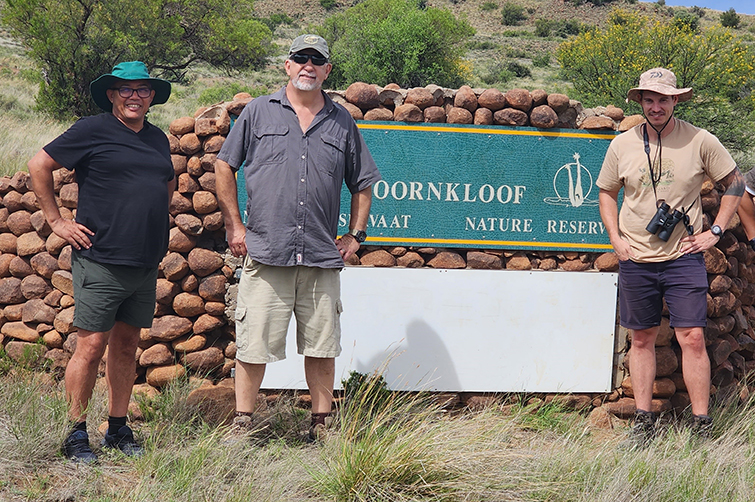 Ruan Jacobs (right) with supervisor Prof Paul Grobler (second from left) and co-supervisor Dr Morne du Plessis (left) at Doornkloof Nature Reserve where the study was conducted.
How do you count wildlife without ever seeing it?
Knowing how many animals live in a game reserve is one of the foundations of effective conservation. Yet, accurately counting species that spend most of their lives hidden in dense vegetation – or emerge only after dark – has long been a challenge for wildlife researchers.
Researchers from the University of the Free State (UFS) believe they have demonstrated a promising new solution – one that starts with something that every animal leaves behind.
In what is believed to be the first South African study of its kind, researchers have successfully estimated the size of a greater kudu population using DNA extracted from dung samples. The proof-of-concept study, led by PhD student Ruan Jacobs in the Department of Genetics, shows that wildlife populations can be monitored without capturing, handling, or even seeing the animals. The findings were recently published in the African Journal of Wildlife Research.
While the study focused on greater kudu, its significance extends far beyond a single species. The researchers believe the approach could one day help conservationists monitor elusive and threatened animals that are difficult to count using conventional methods, including species such as aardvarks, brown hyenas, riverine rabbits, bat-eared foxes, and small wildcats.
“Research and innovation are at the heart of the UFS mission. The work of Ruan Jacobs and his su-pervisors exemplifies how cutting-edge genetics can address complex environmental challenges while supporting biodiversity conservation. Responsible societal futures require evidence-based decision-making. This breakthrough research provides conservation managers with more accurate, ethical, and sustainable methods to understand and protect vulnerable wildlife populations,” observes Prof Vasu Reddy, Deputy Vice-Chancellor: Research, Innovation and Postgraduate Studies.
Every animal leaves a signature behind
Rather than trying to find the animals themselves, the researchers searched for the DNA they left behind.
“Instead of finding the animal, find its DNA,” says Jacobs. “Droppings, hair, and other traces left behind contain enough DNA to identify the species, the individual, and even its sex – all without ever disturbing the animal.”
Every animal carries a unique genetic ‘fingerprint’. By repeatedly collecting fresh dung samples and matching those fingerprints, the researchers could identify when the same kudu had effectively been ‘re-sampled’. This enabled them to estimate the total number of animals in the reserve without physically capturing, tagging, or even seeing them.
The approach also offers far more than just a population estimate. The same dung sample can reveal an animal's sex and provide valuable information about the health of a population.
“Once you have the faecal samples, you can also study additional parameters other than counting. You can, for example, start looking at what animals eat and what parasites they carry,” says Prof Paul Grobler, Professor in the UFS Department of Genetics and Jacobs’ PhD supervisor.
Prof Reddy agrees: “Every animal leaves a signature trace in the environment. This research shows how science can read those signatures to better understand, protect, and sustain biodiversity for future generations.”
A South African first
DNA extracted from faecal samples has previously been used in South Africa to determine which animal species occur in a particular area. This study is the first local research to repeatedly sample the same wildlife population and use the animals’ own DNA to estimate how many individuals are present.
“We used a built-in marker – the animals’ own DNA – to identify individual animals and see how often they are re-sampled,” says Prof Grobler. “We could also determine the sex of each animal counted.”
The research was conducted at Doornkloof Nature Reserve in the Northern Cape, where existing kudu population estimates provided an ideal opportunity to test whether the new DNA-based approach produced reliable results. The genetic estimate closely matched the reserve’s existing population count, demonstrating the potential of the technique as a practical conservation tool.
Better information for better conservation
Accurate population estimates enable reserve managers to make informed decisions about habitat management, carrying capacity, and the long-term conservation of wildlife. For elusive species, however, obtaining those estimates has often been one of conservation's greatest challenges.
“It allows for the accurate counting of elusive animals, i.e. animals that live in dense vegetation where aerial surveys do not work, or animals that are mostly active at night,” says Prof Grobler.
The technique also reduces disturbance to wildlife during surveys.
“When working with animals, it is important to minimise disturbance from an ethical perspective. Collecting dung samples when the animals have moved off is as non-invasive as you can get.”
Although similar DNA-based approaches have already been used for species such as deer and elk elsewhere in the world, Jacobs says this type of research is still new in African wildlife management and has enormous potential as conservation pressures continue to grow.
From one species to many
The proof-of-concept study marks only the beginning.
“The goal is to develop a technique that can be used to help reserve and wildlife managers study and manage their elusive animal populations, which are often also key indicator and/or endangered species – often species that we know very little about,” says Jacobs.
The team has already completed a larger sampling study across the entire reserve and is currently analysing the results. Beyond kudu, they hope to validate the technique across additional species and habitats before it can be applied more broadly in wildlife management.
For Jacobs, however, the project is about more than scientific discovery.
“I have enjoyed every moment spent on the reserve and will always cherish the relationships built with the reserve managers and staff,” he says. “For a lot of us, our research is often referred to as our ‘babies’, and as the saying goes – it takes a village. This is no different, and their willingness to assist and the friendships built over time will always stay with me.”
The study formed part of Jacobs' PhD research, which was supervised by Prof Paul Grobler, together with co-supervisors Dr Morné du Plessis (Senior Lecturer, Department of Genetics, UFS), Prof Brian Reilly (Research Fellow, Department of Genetics, UFS), and Prof Frank Zachos (Natural History Museum Vienna and affiliated Professor, UFS).
According to Prof Reddy, the study illustrates how innovative research can contribute to responsible societal futures. “At the University of the Free State, we are advancing responsible societal futures through research that matters. This pioneering DNA-based conservation approach demonstrates how innovation can help protect biodiversity while minimising human impact on wildlife. The future of conservation lies in innovative, non-invasive approaches that respect both science and nature. We are so inspired by our students and staff, whose dedicated work reflects the UFS aspiration to shape responsible societal futures through discovery, collaboration, and impact.”