02 July 2026
|
Story Michelle Nöthling
|
Photo Stephen Collett
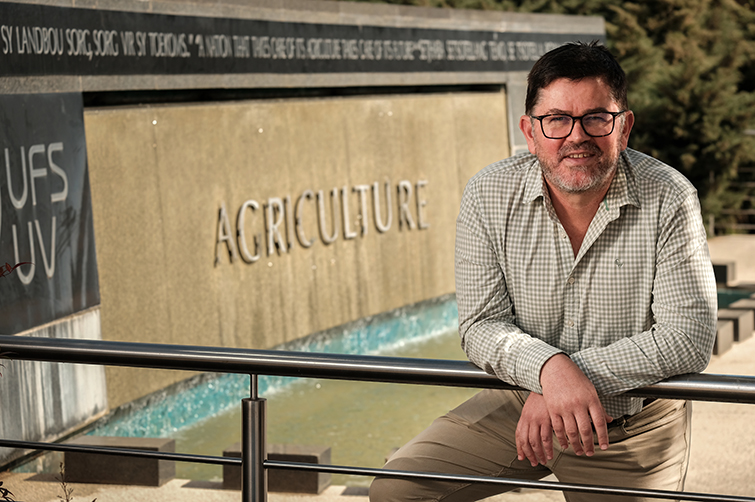 Prof Johan van Niekerk is leading change from the ground up by strengthening agricultural research, advancing veterinary science, and driving sustainability on the university’s experimental farm.
There is something tremendously compelling about the way
Prof Johan van Niekerk speaks about his work. It is not filled with grand declarations, but rather with a steady sense of purpose – of knowing where things are going, and how to bring people along. When he stepped into his role as Vice-Dean of Agriculture at the University of the Free State, he made three promises: to strengthen agricultural research, to drive the development of veterinary science, and to ensure that the university’s experimental farm becomes financially sustainable. His promises did not remain ideas on paper.
His first promise – an injection into agricultural research – has taken shape through the establishment of seven
Agricultural Research Council (ARC) Chairs in collaboration with the Department of Agriculture (DoA), spanning the entire agricultural value chain. What makes this different is the way they work together. “Where one person’s research ends, the next person’s begins,” he says. It is a simple shift, but a powerful one. Instead of working in isolation, researchers are building on each other’s work, making the outcomes more relevant, more connected, and ultimately more impactful.
He furthermore spearheaded the development of South Africa’s only degree in Food Systems – the first cohort of students completing their studies at the end of 2026. Built from the integration of multiple disciplines, the programme is shifting how we think about agriculture. It moves beyond the farm, tracing the journey of food all the way to the consumer. “The discipline of Food Systems is not something we simply made up,” he explains, pointing to its grounding in global trends and United Nations directives. Closer to home, its impact feels immediate. It is preparing students for roles that did not previously exist.
The second promise, to drive veterinary science, is unfolding through the development of a new School of Veterinary Science – set to become only the second of its kind in South Africa. It is a big step, but also a necessary one. In a country where animal health, food safety, and rural livelihoods are so closely linked, this kind of investment speaks directly to the future.
Then there is the third kept promise: turning the experimental farm into a financially sustainable endeavour. This reflects a broader way of thinking – one where sustainability is not only environmental, but also economic and institutional. Across all of this, there is a consistent thread. A willingness to break down barriers and rethink how things are done – collaboratively. And perhaps that is what makes his leadership feel different.
In the end, his impact is not only in the programmes he has built, but also in the way they open up new possibilities – for students, for the university, and for more sustainable futures.