14 July 2026
|
Story Andre Damons
|
Photo Andre Damons and Kaleidoscope Studios
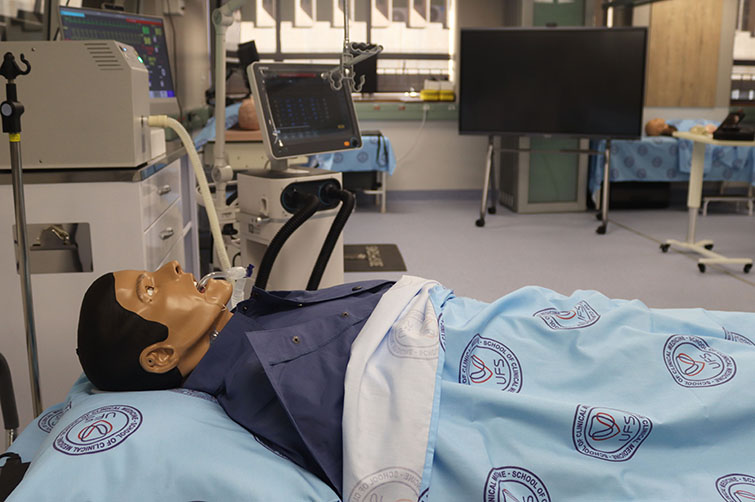 One of the SimMan essential manikins with the ASL5000 breathing simulator.
The
Faculty of Health Sciences (FHS) at the University of the Free State (UFS) is marking a major milestone in healthcare innovation and the advancement of postgraduate medical education with the official launch of its cutting-edge Postgraduate Simulation Unit (PGSU).
This transformative, R35 million investment, housed within the
School of Clinical Medicine (SoCM), is set to redefine postgraduate medical training in the Free State and beyond. The unit was developed through the collective support of institutional and governmental partners and positions the university at the forefront of clinical skills education and development, simulation-based training, and healthcare innovation. Designed to replicate real-world clinical and medical environments, the PGSU creates an immersive space where postgraduate medical students and specialist trainees can develop advanced clinical skills in a safe, technologically sophisticated, and innovative setting.
According to
Prof Nicholas Pearce, Head of SoCM, the unit responds directly to a critical and growing need for a dedicated, highly specialised, and safe medical training space to prepare healthcare professionals for the increasingly complex realities of modern clinical practice.
“The PGSU represents a transformative step forward for postgraduate medical education and clinical skills development. It provides healthcare professionals, particularly Registrars, with the opportunity to refine critical clinical and procedural competencies within an environment that closely mirrors authentic healthcare settings.
“In addition to technical training, the unit fosters confidence, innovation, collaboration, and excellence in clinical practice. By creating a space where healthcare professionals can learn, practise, and grow without compromising patient safety, the PGSU has the potential to significantly strengthen the quality of healthcare delivery and shape the future of patient care for generations to come,” says Prof Pearce.
Beyond its educational value, the unit represents a forward-looking platform for sustainable third-stream income generation, strengthening the university’s long-term sustainability strategy through collaboration, specialised training programmes, and strategic partnerships.
A world-class clinical training environment
Some features of the unit include a modern lecture venue accommodating up to 40 participants, multifunctional and highly adaptable simulation areas purpose-built to replicate intensive care units, operating theatres, medical wards, and procedural training environments, standardised patient consultation rooms, and virtual and augmented reality training spaces.
A key feature of the unit is its fully equipped wet/tissue laboratory, which includes a decontamination shower, enabling hands-on exposure to advanced anatomical and procedural training through human cadaveric and animal tissue simulation.
Prof Pearce says a unique feature of the unit is a dedicated innovation room equipped with advanced technologies such as the
Formlabs 4BL Biomedical printer, one of the first of its kind to be housed at a South African university, as well as resin printing systems.
These in-house technologies have already demonstrated meaningful clinical impact through the successful creation of patient-specific anatomical models used by surgeons postoperatively to research similarities in anatomical structures related to the cardiac CT scan. This integration of simulation, biomedical technology, and clinical innovation creates exciting opportunities for interdisciplinary collaboration, research advancement, and improved patient care outcomes.
George Muller, PGSU Manager, says: “We are incredibly excited about what the unit represents for the future of healthcare education and innovation. Beyond postgraduate teaching and learning, there are opportunities for meaningful industry collaboration and the development of new technologies that can fundamentally impact the future of patient care. We have already successfully hosted a number of industry-related engagements, and the enthusiasm for and interest in the PGSU from external stakeholders have been exceptional.”
Investing in the future of medicine
The establishment of this unit closely aligns with the university’s commitment to pursuing responsible societal futures through responsible innovation, social responsibility, and sustainable development. The unit further reinforces the UFS’ strategic priorities of systemic sustainability and strategic investment by supporting long-term institutional viability through income diversification, strategic partnerships, and optimised resource utilisation. The unit additionally advances collaborative innovation and global integration by breaking down artificial barriers between disciplines, institutions, and sectors.
More than simply a new facility, the Postgraduate Simulation Unit is a bold statement of intent: the UFS is making a deliberate investment in the future of medicine to empower the next generation of clinicians with the confidence, adaptability, and technical expertise required to lead within an evolving healthcare landscape. Although the unit is already being utilised for training and engagement activities, its official opening ceremony will take place in August.
- For any inquiries regarding the PGSU, interested individuals and organisations are encouraged to contact the team directly on PGSU@ufs.ac.za or 051 401 7722 to explore opportunities for collaboration, engagement, and innovation.