07 July 2026
|
Story Leonie Bolleurs
|
Photo Stephen Collett
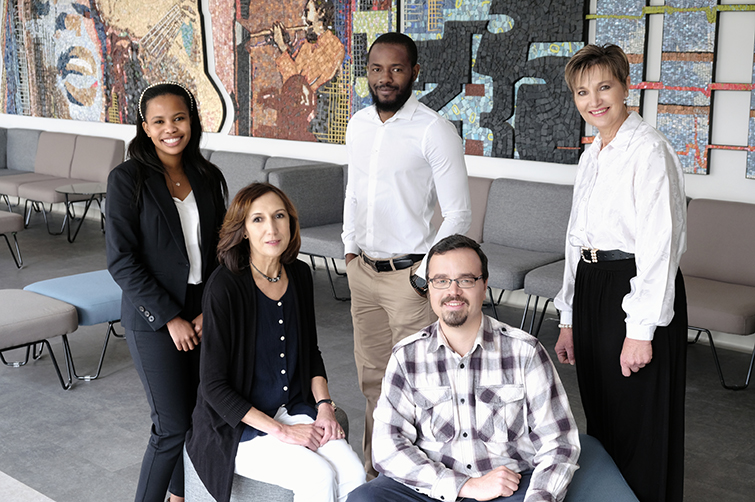 Maricel van Rooyen (seated on the left), whose work with the RIMS team supports reliable, integrated research management across the UFS.
Behind every published article, successful grant, and completed thesis lies a layer of work that few people ever see. It runs quietly in the background, connecting people, processes, and information. For
Maricel van Rooyen, Project Manager: RIMS and Ethics in the
Directorate Research Development, the work centres on a collective effort that enables research to run smoothly across the institution. “When I explain InfoEd – our service provider – and RIMS to colleagues outside the research environment, I usually describe it as the digital backbone that supports the full research life cycle at the university,” Van Rooyen says. “But it only works because of the people behind it.”
Prof Vasu Reddy, Deputy Vice-Chancellor: Research, Innovation and Postgraduate Studies, says, “Excellent research doesn’t happen by chance. It is sustained by people, trustworthy systems, and a culture of shared responsibility working quietly behind the scenes.” The Research Information Management System (RIMS) brings together funding opportunities, ethics approvals, publications, and reporting into one trusted, integrated environment. This has real impact. Researchers spend less time on administration. Managers have access to accurate, real-time insights, and the institution can meet national reporting requirements.
According to Prof Reddy, “RIMS is more than a platform; it is the digital backbone that protects the integrity, credibility, and continuity of research at our university.”
“The maturity of RIMS did not happen by accident; it is the result of sustained attention to detail, strong governance, and continuous improvement and support from my Senior Director,
Dr Glen Taylor, at DRD, as well as my RIMS team,” Van Rooyen notes. A team that extends far beyond a single office. Collaboration links research administration, IT, finance, libraries, and compliance, ensuring that the system remains stable and continues to serve researchers without disruption. This shared ownership is also what protects the integrity of the university’s research data. Stability is important, particularly when it comes to national reporting and funding. “A stable system ensures that our data is traceable, auditable, and consistent over time,” says Van Rooyen, adding that it also builds trust.
At a time when many institutions are facing continuous system disruptions, the UFS approach stands out for its consistency and long-term commitment. Rather than chasing quick fixes, the focus has remained on strengthening a single, integrated platform, with InfoEd playing a key role as the university’s service provider. “We committed early on to InfoEd and invested in fully embedding it into the research environment. That consistency and long-term commitment is what allows the system to support the university effectively,” she notes. Looking ahead, the team is exploring how thoughtful innovation, including AI, can further strengthen data quality, reduce administrative burden, and support better decision making. Van Rooyen says, “The future is about careful evolution. We want to enhance what we have without compromising the stability that people rely on.”
Prof Reddy adds, “RIMS, strengthened by thoughtful use of AI, works best because of the people behind it – professionals who safeguard quality, ethics, and continuity in our research enterprise. Our focus remains clear: technology must amplify human expertise, reduce burden, and always serve the researcher with integrity.”