23 June 2026
|
Story Leonie Bolleurs
|
Photo Supplied
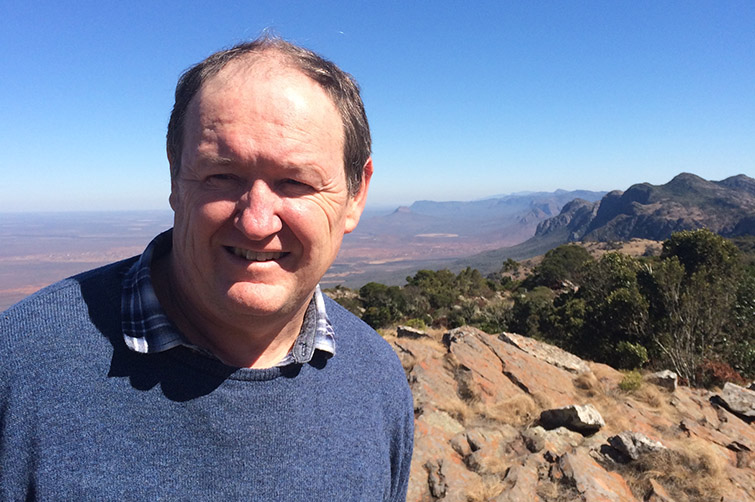 Prof Peter Taylor, ARU Professor in Residence, working with communities and researchers to restore rangelands and strengthen conservation in the Maloti-Drakensberg.
What does it take to restore a landscape, strengthen communities, and protect biodiversity at the same time? In the Maloti-Drakensberg, researchers, conservation partners, and local communities are working together to do exactly that.
The NatuRA project, developed with partners in Norway and South Africa, focuses on the sustainable use of natural resources in alpine and mountain grassland ecosystems. In Qwaqwa, this means co-working with custodians such as the Royal Houses and Witsieshoek Mountain Lodge to understand how climate and environmental pressures affect communal rangelands. By combining ecological data with traditional knowledge, researchers are strengthening the health and sustainability of rangelands. The ARU’s alpine lease area at Witsieshoek has already hosted pioneering experiments under the RangeX project, and NatuRA extends this work with new infrastructure and long term monitoring.
Prof Taylor, PI of the Hans Hoheisen Charitable Trust project and lead of a NatuRA work package on rangeland biodiversity, explained: “The Hans Hoheisen Charitable Trust – a Nedbank legacy trust – provides about R1,83 million to the ARU through a three year performance based partnership.” According to him, the agreement defines clear objectives, such as restoring degraded rangelands, supporting rewilding, protecting vulnerable grasslands, and strengthening community based conservation capacity, while requiring strict financial controls and measurable ecological and social outcomes.
“Responsible societal futures are built where science, communities, and nature meet. Prof Peter Taylor and the Afromontane Research Unit demonstrate how research can restore landscapes while creating tangible benefits for local livelihoods. The Maloti-Drakensberg projects remind us that impactful research is not only about generating knowledge. It is in fact much more. It is about co-creating solutions that strengthen biodiversity, resilience, and community well-being,” remarked Prof Vasu Reddy, Deputy Vice-Chancellor: Research, Innovation and Postgraduate Studies.
Restoring landscapes through research and community partnerships
At least 1 000 ha of degraded rangelands in this area will be restored. This restoration project will guide and hopefully promote efforts to rewild the Witsieshoek Community Conservation Area with larger game species such as the iconic eland.
The Hans Hoheisen Charitable Trust is supporting research that tracks the movement of eland across fragmented mountain landscapes. PhD candidate Blessing Hlongwana – working under Prof Taylor’s supervision – is documenting how these animals influence vegetation patterns and seed dispersal, and how their movement is constrained by land use and climate variability. The project includes a citizen science component, training community members to log sightings through platforms such as
iNaturalist. This participatory approach reflects a broader shift in research: recognising that landscapes cannot be separated from the people who live in them. By reconnecting conservation areas with neighbouring parks, the project aims to restore wildlife corridors that support biodiversity and strengthen ecological resilience.
The partnership with Meat Naturally Africa, a highly successful NGO, adds a dynamic community centred dimension. In the Witsieshoek Community Conservation Area, researchers and students are working with local livestock owners to monitor grazing practices and veld health. Insects such as dung beetles and grasshoppers are being used as ecological indicators, providing practical tools for farmers to assess rangeland condition. Over three years, the project aims to restore more than 800 hectares of degraded rangelands and 400 hectares of alpine habitat, while training at least 30 local livestock owners as eco rangers. Prof Taylor explained that Meat Naturally Africa will provide trained small scale livestock owners with access to livestock markets and carbon credit finance linked to measured improvement in their pasture and soil.
He said that separate subcontractor agreements have been signed between MNA and the ARU for both projects.
Reflecting on the partnership, Prof Taylor noted: “Walking through six month rested pastures bursting with flowers and insects, guided by the new Rangeland Management Association Chairperson and local community representatives, was an inspiring experience for me, my colleagues, and students. To see how community partnership and the MNA model can already yield tangible ecological and social benefits bodes well for our research, which will measure the ecological and socioeconomic benefits of the restoration programme over the next three years.”
This will be Meat Naturally Africa’s first project in the Free State. In similar initiatives across other provinces, they have shown clear success, raising household incomes for local herder communities, restoring rangelands, and improving livestock productivity. “However, this success story needs to be documented and published in both popular and scientific media, and this is where UFS/ARU researchers and students will play a vital role,” said Prof Taylor.
The ARU’s success in securing international grants and building strong partnerships reflects the University of the Free State’s commitment to research that matters. These projects are creating models for sustainable livelihoods, conservation, and resilience in mountain ecosystems. They remind us that research is at its most powerful when it inspires action, connects communities, and opens pathways to futures where people and nature thrive together.
Prof Reddy echoed these views, observing: “Restoring degraded rangelands, strengthening conservation capacity, and supporting local livestock owners are powerful examples of how research universities can deliver meaningful societal impact beyond the campus. Prof Peter Taylor’s leadership highlights the value of transdisciplinary, engaged research in addressing complex environmental challenges and safeguarding mountain ecosystems for future generations. The ARU continues to exemplify research excellence intentionally by bringing together traditional knowledge, biodiversity science, and community partnerships to shape sustainable futures.”