24 June 2026
|
Story Martinette Brits
|
Photo Stephen Collett
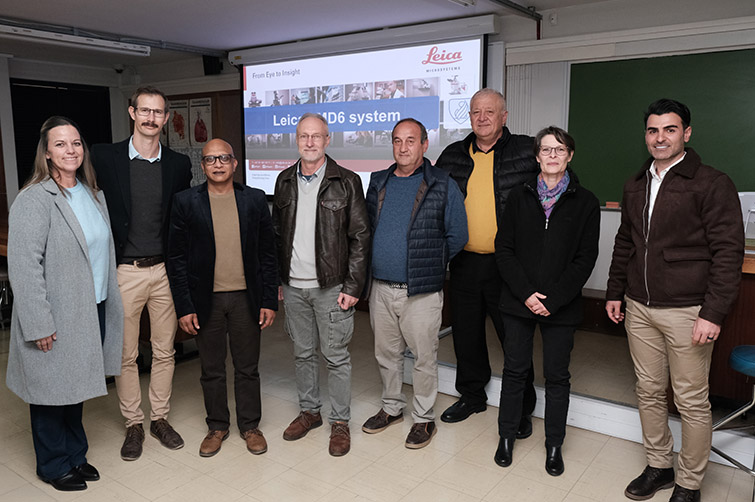 Attendees at the official opening of the upgraded Nematology Laboratory and the unveiling of the Leica LMD6 laser microdissection microscope in the Department of Zoology and Entomology.
The University of the Free State Department of Zoology and Entomology has strengthened its research infrastructure through the development of an upgraded Nematology Laboratory and the acquisition of Africa's first Leica laser microdissection microscope. The laboratory was officially opened and the microscope unveiled on Thursday 18 June 2026, expanding opportunities for agricultural, biological, and molecular research while supporting postgraduate training and interdisciplinary collaboration.
Prof Vasu Reddy, Deputy Vice-Chancellor: Research, Innovation and Postgraduate Studies, said: “By connecting advanced infrastructure with postgraduate talent, we are building a generation of researchers equipped to solve complex challenges across society, industry, and the environment. From agricultural resilience to biodiversity stewardship, these facilities demonstrate how world-class science can address local realities while contributing to global knowledge.”
The Nematology Laboratory supports agricultural research
The upgraded Nematology Laboratory has been transformed into a modern, purpose-built facility designed to support advanced nematology research, diagnostic services, and industry collaboration. The renovations included dedicated workspaces for nematode extraction, processing, and enumeration, as well as a cold room for sample storage. The facility has also been equipped with modern laboratory infrastructure and specialised research equipment to support advanced research, diagnostic services, and efficacy trials.
According to Dr Milad Rashidifard, Senior Lecturer in the Department of Zoology and Entomology, the facility provides an important platform for research and postgraduate development.
“The upgraded laboratory significantly strengthens the Department of Zoology and Entomology’s research capacity by providing researchers and postgraduate students with access to a modern, well-equipped research environment. This facility offers students hands-on experience through advanced research projects, practical training, and diagnostic activities. They work in an industry-aligned lab, preparing them for real-world applications. This creates valuable opportunities for postgraduate training while helping to develop the next generation of nematologists and research scientists."
The facility supports research on sustainable nematode management in agriculture, including non-chemical control strategies and the application of innovative biological products for managing plant-parasitic nematodes. It will also support research projects such as Dr Candice Jansen van Rensburg’s NRF-funded work on the DNA barcoding of predatory nematodes from selected Free State nature reserves.
Beyond research, the laboratory provides diagnostic services, nematicide efficacy trials, and broader plant nematology research aimed at addressing challenges faced by farmers and industry stakeholders. Since becoming operational in November 2025, the Nematology Diagnostic Laboratory has processed nearly 3 000 soil and root samples, demonstrating the growing demand for its services and expertise.
The upgraded facility has also strengthened opportunities for collaboration between the University of the Free State, industry, and research partners, contributing practical solutions to agricultural production systems in the Central Free State and beyond.
Dr Jansen van Rensburg, Senior Lecturer in the Department of Zoology and Entomology, highlighted the broader significance of the investment.
“The upgraded laboratory represents a strategic investment in research excellence, industry engagement, and postgraduate development, further positioning the University of the Free State as a leading hub for applied nematology research in South Africa.”
“Laboratories are where curiosity becomes capability; this investment ensures that discovery at the UFS translates into solutions that shape responsible societal futures,” remarked Prof Reddy.
Africa’s first laser microdissection platform
The event also marked the unveiling of the Leica LMD6 laser microdissection microscope, housed in a newly upgraded microscopy laboratory within the Department of Zoology and Entomology.
The acquisition was made possible through a R4,5 million National Research Foundation (NRF) National Equipment Programme grant awarded to Prof Edward Netherlands, together with matching support from the UFS Large Equipment Fund and the Directorate Research Development. The combined investment totalled R7,4 million.
The Leica LMD6 combines advanced microscopy with precision ultraviolet laser technology, enabling researchers to identify, isolate, and collect specific cells, tissues, and microscopic structures directly from a specimen for downstream molecular analyses. Unlike conventional microscopes used primarily for imaging, the system allows researchers to physically isolate individual cells or regions of interest for advanced investigations such as DNA sequencing and genomics.
For Prof Netherlands and his research team, the technology addresses a longstanding challenge in wildlife parasitology research.
“The Leica LMD6 allows us to isolate individual parasite-infected blood cells, enabling the generation of parasite-specific genomic data sets that were previously impossible to obtain.”
The microscope will be used in research focusing on the diversity, evolution, ecology, and life cycles of blood parasites that infect wildlife, particularly amphibians, reptiles, and birds. It will also support future research in areas such as veterinary diagnostics, pathology, biodiversity research, and single-cell molecular biology.
In addition, the instrument will support a broad range of disciplines across the UFS, including wildlife parasitology, infectious disease research, molecular ecology and genetics, biodiversity and conservation science, veterinary science, cell biology, histology, and pathology.
The microscope will also play an important role in postgraduate training by providing honours, master’s, doctoral, and postdoctoral researchers with hands-on experience in advanced microscopy, molecular biology workflows, and single-cell research approaches.
Prof Netherlands emphasised the significance of the acquisition for both the university and the continent.
“The Leica LMD6 is the first laser microdissection platform of its kind in Africa, making it a landmark addition to the UFS' research infrastructure. It represents a significant enhancement of the university's advanced imaging and molecular research capabilities and positions the UFS as a regional leader in single-cell and microdissection-based research.”
Prof Reddy added: “The microscope is more than an instrument of observation. It is a platform for reimagining what the UFS can achieve through research, innovation, and scientific excellence. The Leica LMD6 enables us to see the previously unseen, unlocking new knowledge at the cellular level while advancing the public value of science.”
Advancing interdisciplinary research
The upgraded Nematology Laboratory contributes practical solutions to challenges facing farmers and industry stakeholders, while the Leica LMD6 expands opportunities for advanced research in fields ranging from wildlife parasitology and biodiversity science to genetics, pathology, and veterinary science.
Together, these investments enhance the UFS' research infrastructure, strengthen collaboration with industry and research partners, and reinforce the university's commitment to research excellence and innovation.
Echoing the sentiments expressed by colleagues in the department, Prof Reddy said: “Research infrastructure is not merely about technology; it is about creating ecosystems of innovation that generate sustainable impact for communities, economies, and future generations. As the home of the UFS’ first laser microdissection platform, we are advancing a research culture where precision, collaboration, and innovation converge to create responsible societal futures.”