12 June 2026
|
Story Sociology honours and postgraduate students, Department of Sociology
|
Photo Supplied
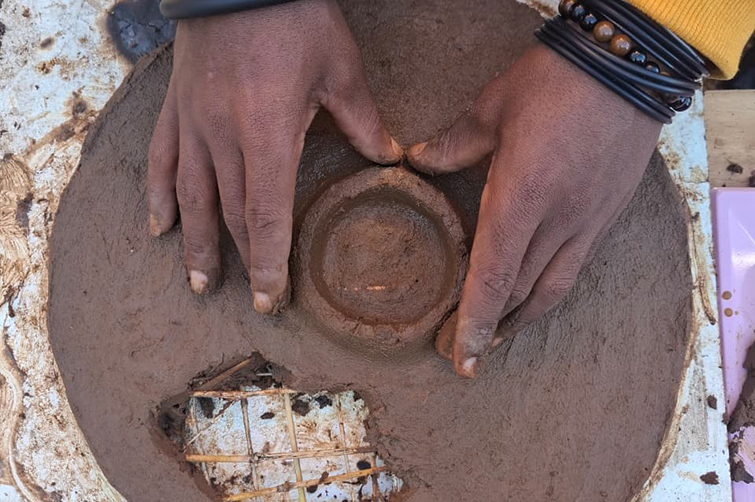 Hands-on engagement with natural building materials helped UFS Sociology honours and postgraduate students explore indigenous knowledge systems, sustainability, and the connections between people, place, and community.
A group of honours and postgraduate students in Sociology at the University of the Free State reflect on home, identity, community, and indigenous knowledge after an immersive learning experience at the Sekoele Holistic Living Arts Centre in Bloemfontein.
Mud under their fingernails, bare feet on the ground, and conversations that stretched beyond the boundaries of the classroom. For a group of honours and postgraduate students in Sociology at the University of the Free State (UFS), a recent learning experience at the Sekoele Holistic Living Arts Centre in Bloemfontein became an opportunity to reflect on home, identity, belonging, and humanity's relationship with the natural world.
While the workshop introduced students to indigenous knowledge systems, natural building techniques, and sustainable living practices, their reflections reveal that the most lasting lessons extended far beyond the practical activities themselves.
Home is more than a place
For Bakhe Mxolwana, Lizemari Lourens, and Oyama Mpepanduku, the experience prompted a rethinking of what it means to feel at home.
Their reflections challenged conventional understandings of home as merely a physical structure. Instead, they described home as something created through relationships, shared experiences, memory, and community. Working alongside classmates, community members, and knowledge practitioners transformed a group of individuals into a connected community, demonstrating how belonging can emerge in unexpected spaces.
The students also reflected on the Earth as humanity's first home. Engaging directly with natural materials such as mud, grass, and recycled resources highlighted the interconnectedness between people and the environment and encouraged a deeper appreciation for sustainable ways of living.
Questions about culture, identity, and development emerged throughout the experience.
Sanelisiwe Khumalo and Nompumelelo Motaung reflected on the tension between modern development and cultural continuity. Their observations focused on how indigenous architecture, spiritual practices, and communal traditions have often been marginalised in favour of imported models of progress.
Rather than suggesting a return to the past, they argued for a future in which development and indigenous knowledge can coexist. Their reflections highlighted the importance of preserving cultural practices and recognising the value of knowledge systems that have sustained communities for generations.
Remembering what connects us
For several students, the experience sparked reflection on everyday practices that shape identity and belonging.
Siphiwayinkosi Dlamini, Nokwazi Nkala, Thapelo Lesapo, Tshiamo Tadi, and Xichavo Subuyi focused on the social significance of food and communal spaces. Drawing on both personal experience and sociological insight, they reflected on how kitchens and shared meals have historically created opportunities for storytelling, care, and connection.
Their reflections questioned what is lost when communal practices are replaced by increasingly individualised lifestyles. In a society shaped by convenience and speed, they argued that shared spaces remain important sites for building relationships and maintaining cultural memory.
The workshop also encouraged students to think about identity in new ways. Reflections on language, ancestry, and cultural heritage highlighted the importance of remaining connected to one's roots while navigating contemporary realities. Students described identity not as something fixed, but as something that evolves while remaining grounded in culture, community, and history.
For Tlotliso Ntsielo and Thurstan Philander, one of the most significant lessons centred on knowledge itself. Their reflections explored how learning through practice challenged conventional assumptions about education. Working with natural and recycled materials transformed concepts such as sustainability, environmental responsibility, and indigenous knowledge from theoretical ideas into lived experiences.
They noted that some forms of knowledge are carried not only through books and lectures, but also through practice, observation, storytelling, and community participation.
Collectively, the students' reflections point to a common theme: meaningful learning often happens when theory meets lived experience.
The visit to Sekoele introduced students to indigenous knowledge systems and sustainable practices, but it also encouraged them to ask deeper questions about belonging, identity, culture, and community. In the process, many found themselves reflecting not only on what previous generations knew, but also on what contemporary society may have forgotten.
Whether they were thinking about home, food, language, spirituality, or sustainability, the students arrived at a similar conclusion: some of the most important lessons about the future can emerge when people reconnect with the knowledge, practices, and relationships that have sustained communities for generations.