26 June 2026
|
Story Martinette Brits
|
Photo Stephen Collett
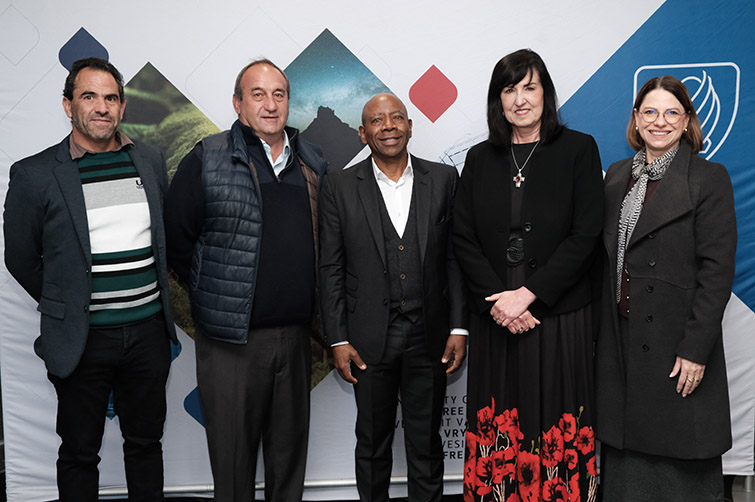 Pictured at the Faculty of Natural and Agricultural Sciences' second annual Research Conference are Prof Daryl Codron (Chair of the Conference), Prof Paul Oberholster (Dean of the Faculty of Natural and Agricultural Sciences), Prof Bonang Mohale (UFS Chancellor), Prof Hester C. Klopper (Vice-Chancellor and Principal), and Prof Alba du Toit (ARC-DoA-UFS Research Chair: Innovative Agro-Processing for Climate-Smart Food Systems and Vice-Chair of the Conference).
One year after introducing the Green Futures Hub and Complex Systems Hub, the conference returned from 22 to 24 June 2026 with almost double the number of delegates, expanded research themes, and a programme reflecting growing collaboration across disciplines, institutions, industry, and government.
According to Prof Daryl Codron, Chair of the Conference, registrations increased from approximately 180 delegates in 2025 to around 350 this year, while paper and poster submissions grew from about 130 to roughly 240.
Building on a shared vision
A recurring theme throughout the conference was that society’s most pressing challenges – including food security, water sustainability, climate change, biodiversity loss, public health, energy resilience, and technological advancement – can no longer be addressed through isolated fields of expertise.
Prof Hester C. Klopper, Vice-Chancellor and Principal of the University of the Free State, described the conference as part of a growing community of scholars united by a shared purpose: advancing science that serves society while helping to shape responsible futures.
Reflecting on the role of universities in addressing complex societal challenges, she said: “The true value of science is not measured solely in publications and citations and research output, but it is measured by its capacity to improve lives, address societal challenges, and contribute to a future that is more just, more sustainable, and more humane.”
She also encouraged researchers to embrace interdisciplinary, transdisciplinary, and convergent science.
Prof Vasu Reddy, Deputy Vice-Chancellor: Research, Innovation and Postgraduate Studies, expanded on this by situating the conference within the university’s broader research strategy, describing collaboration as “the new currency of scientific success”. He linked many of the conference presentations to the university’s research themes of Systems for Societal Advancement, Sustainable Futures, Planetary Health and Well-being, and Flourishing Life.
From ambition to implementation
For Prof Paul Oberholster, Dean of the Faculty of Natural and Agricultural Sciences, the conference reflected the momentum generated since the launch of the Green Futures Hub and Complex Systems Hub in 2025. He pointed to growing collaboration between researchers in agriculture, natural sciences, engineering, computer science, environmental science, and the built environment, as well as increasing postgraduate participation, research outputs, and international partnerships.
The faculty has also expanded its research ecosystem through new research chairs, specialised programmes, and infrastructure development. Over the past year, the number of ARC-UFS research chairs increased from three to seven, while new initiatives in ecological engineering, environmental rehabilitation science, climate-smart agriculture, circular economy research, and greenhouse technologies continue to broaden the faculty’s research footprint.
“The challenges facing our world do not exist in isolation,” said Prof Oberholster. “Addressing these challenges requires integrated thinking, innovative solutions, and collaboration across disciplines.”
Building on the hubs launched in 2025, this year’s programme expanded to include One Health and Sustainable Communities themes, creating additional opportunities for engagement across research areas.
Research that reaches beyond academia
The conference also highlighted the importance of research that responds to national priorities and delivers practical solutions beyond academia.
“Our research should not just end on the shelf, not just in a thesis, not just in publications, but it must address society’s needs,” he said.
He explained that the research chair model brings together government, universities, industry, and research councils to align scientific knowledge with national priorities while building postgraduate capacity and strengthening South Africa’s agricultural research system.
New ways of thinking about the future
In a keynote address on planetary health, Prof Robert Bragg, Emeritus Professor in the UFS Centre for Mineral Biogeochemistry, explored the links between human health, animal health, environmental sustainability, climate change, food production, and antimicrobial resistance.
“We’re not going to survive if the planet is not healthy,” he said.
His presentation showed how challenges such as disease control, biosecurity, water quality, and antimicrobial resistance extend beyond individual disciplines.
Drawing on examples from creative doctoral research in architecture, Prof Noble demonstrated how new knowledge can emerge through creative practice, reflection, and experimentation – a reminder that solving complex challenges often requires not only technical expertise, but also new ways of seeing and thinking.
The opening day also included an innovative ideas showcase, highlighting developments in stable light isotope ratio mass spectrometry, instrumentation and electronics, and innovative giraffe conservation research.
Developing future researchers
Beyond the keynote presentations, poster sessions and oral presentations provided a platform for researchers at every stage of their careers to share ideas, build networks, and explore opportunities for collaboration. Research presented at the conference spanned agriculture, biodiversity, climate change, environmental rehabilitation, advanced materials, water resources, nutrition, microbial resistance, artificial intelligence, machine learning, modelling, and human and environmental health.
The strong presence of postgraduate students and postdoctoral fellows was another notable feature of the conference. Addressing delegates on the final day, Prof Prince Ngobeni, Principal of the UFS Qwaqwa Campus, encouraged researchers to consider how their work influences communities, industries, and public decision-making.
“The impact of research should not be confined to journals, conferences, or academic debates,” he said. “When research contributes to solving real problems, its value becomes visible.”
He also encouraged postgraduate students and emerging researchers to remain curious and resilient, reminding them that unexpected findings often create opportunities for discovery.
A faculty on the move
Reflecting on South Africa’s broader developmental challenges, Prof Bonang Mohale, UFS Chancellor, emphasised the importance of using scientific knowledge and innovation to strengthen food security, unlock opportunity, and contribute practical solutions to societal needs.
This message echoed a theme that resonated throughout the conference: research matters most when it improves lives. Through expanding partnerships, growing research capacity, strategic investment in emerging fields, and a strong focus on postgraduate development, the Faculty of Natural and Agricultural Sciences is building on the momentum created by its inaugural conference – strengthening a research community focused not only on generating new knowledge, but on ensuring that knowledge contributes to sustainable and responsible futures.