03 June 2026
|
Story Martinette Brits
|
Photo Stephen Collett
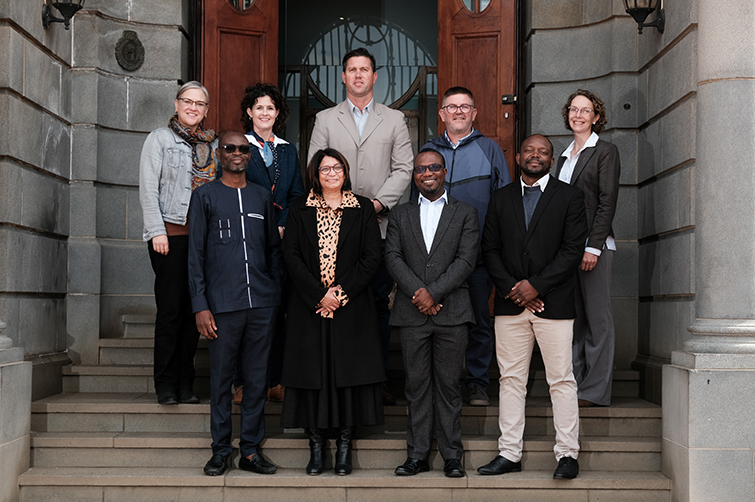 Delegates from the University of Zambia’s School of Veterinary Medicine and representatives from the University of the Free State during the recent academic collaboration visit aimed at supporting the UFS’ continued planning towards a proposed School of Veterinary Sciences.
The University of the Free State (UFS) recently hosted a delegation from the University of Zambia’s (UNZA) School of Veterinary Medicine as part of the university’s continued planning towards a proposed School of Veterinary Sciences. The four-day academic collaboration visit focused on curriculum development, clinical training models, veterinary hospital planning, infrastructure development, community-responsive training approaches, and regional veterinary science partnerships.
The visit brought together expertise in academic planning, infrastructure development, and clinical training from both institutions, and included engagements on the UFS South Campus and Experimental Farm, where existing infrastructure and proposed development areas for future veterinary science training were discussed.
According to Dr Nalize Scheepers from Strategic and Academic Planning: Sustainable Food Systems and Development, the engagement provided the university with valuable operational insight from an institution with an established veterinary programme operating within an African context.
“The primary objectives were to benchmark the proposed UFS clinical training model against UNZA’s operational experience and to validate the curriculum framework, student intake projections, and throughput planning,” she said.
The delegation also engaged with proposed designs for anatomy, pathology, and necropsy facilities, as well as the envisioned Veterinary Academic Hospital and broader infrastructure planning considerations.
Prof Johan van Niekerk, Vice-Dean: Agriculture in the Faculty of Natural and Agricultural Sciences, said the visit formed part of the university’s broader planning and infrastructure development processes relating to the proposed School of Veterinary Sciences. He said engagements of this nature provide valuable practical insight that can help inform infrastructure and clinical training planning.
Focus on clinical training and community engagement
A major focus of the visit was the proposed clinical training model and the role of community engagement within veterinary education.
Dr Scheepers explained that the proposed UFS model is structured as a progressive continuum that gradually prepares students for independent veterinary practice.
“The UFS model introduces observation and skills-based learning from Year 1,” she said.
During the first two years, students would participate in observation-based placements, including SPCA volunteer work, farm visits, mobile clinic observation, and exposure to registered veterinary practices, while simultaneously developing foundational practical skills in a veterinary skills laboratory.
In Year 3, students would move on to intensive campus-based practical training focused on surgical techniques, clinical procedures, and diagnostic methods in controlled environments.
Formal supervised clinical training would begin in Year 4 through rotations within the proposed UFS Veterinary Academic Hospital across companion animal, production animal, wildlife, and diagnostic disciplines, while Year 5 would expand clinical exposure through structured external placements.
The final year would consist of a full 12-month work-integrated learning placement in private practices, state veterinary services, community clinics, and rural settings, where students would gain progressively greater responsibility under professional supervision.
According to Dr Scheepers, community engagement and outreach-based training models form a critical part of contemporary veterinary education.
“Mobile clinics and outreach-based training models have become essential components of contemporary veterinary education,” she said.
She explained that mobile and outreach models help address veterinary service gaps in underserved communities while simultaneously creating valuable training opportunities for students.
“In South Africa, many smallholder livestock keepers, emerging farmers, and peri-urban communities have limited access to veterinary care,” she said. She said mobile clinics enable the provision of primary animal health-care services while exposing students to veterinary medicine in resource-constrained environments.
Dr Scheepers added that these environments expose students to the broader realities shaping animal health, including livestock management systems, food security challenges, biosecurity practices, and the social and economic factors influencing access to veterinary care.
“Community settings offer invaluable training opportunities that hospital environments cannot replicate,” she said.
The discussions also explored how veterinary science training increasingly intersects with broader One Health and public health priorities, including zoonotic disease surveillance, antimicrobial stewardship, food safety, and the impact of climate pressures on agricultural systems.
Strengthening veterinary science capacity through African partnerships
The visit further created an opportunity to explore future collaboration between the two institutions, including student and staff exchanges, joint research initiatives, and participation in regional veterinary education networks.
Dr Scheepers noted that collaboration between African universities is becoming increasingly important in addressing veterinary science and agricultural challenges unique to the continent.
“Regional collaboration between African universities addresses veterinary education and research challenges through South-South cooperation grounded in shared African realities,” she said.
She explained that African institutions often face similar challenges relating to transboundary animal diseases, livestock production systems, food security, climate pressures, and access to veterinary services, making regional collaboration particularly valuable.
“Regional collaboration enables universities to develop curriculum frameworks, research agendas, and training models responsive to African realities rather than simply adapting imported approaches,” she said.
According to Dr Scheepers, partnerships of this nature create opportunities for joint research on transboundary animal diseases, One Health challenges, antimicrobial resistance, and climate-related animal health issues, while simultaneously strengthening veterinary science capacity across the continent.
Prof Anthea Rhoda, Deputy Vice-Chancellor: Academic, said the engagement also created opportunities beyond the immediate planning process.
“The engagement also provided an opportunity to explore collaborative research and learning and teaching activities, as well as opportunities for student and staff exchanges. Collectively, we can respond to important veterinary science needs across the continent,” Prof Rhoda said.
Dr Scheepers added that student and staff exchanges are also creating opportunities for comparative learning and exposure to different disease profiles, production systems, and veterinary practice environments across Africa.
The collaboration further supports broader continental goals relating to agricultural development, food security, public health, and veterinary workforce development.
Prof Van Niekerk said the engagement also highlighted the strategic value of partnerships between African institutions, particularly in relation to knowledge-sharing, capacity development, and the strengthening of veterinary science education within African contexts.
The establishment of the proposed School of Veterinary Sciences at the UFS remains subject to the professional requirements of the South African Veterinary Council (SAVC) and national higher education regulatory processes. Once all accreditation and regulatory requirements have been met, the programme will be formally advertised and opened for applications.