23 June 2026
|
Story Thembani Nosipho Hoho and Mbali Moiketsi
|
Photo Supplied
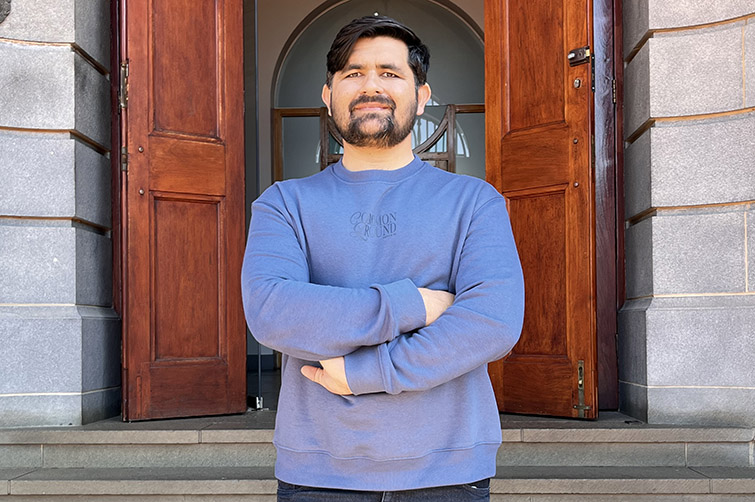 Yahya Khan, the University of the Free State’s first Queen Elizabeth Commonwealth Scholar, is pursuing a Master of Public Health (Research) degree while contributing to globally relevant research on water quality, antimicrobial resistance, and community health.
The University of the Free State (UFS) has welcomed its first Queen Elizabeth Commonwealth Scholar (QECS), further strengthening the institution's growing international postgraduate and research profile in global health. The scholarship programme brings talented students from across the Commonwealth to leading universities, fostering academic collaboration, cultural exchange, and knowledge-sharing on issues of global significance.
For Yahya Khan, education has become a journey across borders, cultures, and scientific disciplines, shaped by a commitment to improving public health and contributing to meaningful societal change. His registration at the UFS marks both a personal academic milestone and an important step in advancing the University’s international partnerships in health sciences.
Reflecting on his decision to study abroad, Khan says the experience has strengthened his confidence and independence as a researcher while encouraging him to pursue further international opportunities. “I was drawn to the programme for two reasons,” he explains. “First, it offered the chance to immerse myself in a new culture and experience the world on a shared international platform, learning alongside people from very different backgrounds. Second, it gave me the academic support, practical opportunities, and financial security needed to pursue research meaningfully.”
A milestone for UFS and the Division of Public Health
Within the Division of Public Health, Khan’s enrolment is regarded as a significant asset that enriches both academic scholarship and cultural diversity. His background in microbiology and biomedical sciences, combined with academic experience in Pakistan and the United Kingdom, contributes valuable comparative perspectives on health systems and research approaches.
According to Dr Percy Kekana, Senior Lecturer and Khan’s supervisor in the Division of Public Health, international students play an important role in strengthening both teaching and research within the division. “Khan’s inclusion in the Division of Public Health is welcomed. He contributes cultural diversity, which supports the growth of the division academically and professionally. He brings a different perspective on healthcare systems from his country, as well as valuable knowledge gained through international travel, collaboration, and academic engagement. This contributes to the ongoing internationalisation of the division,” says Dr Kekana.
He adds that the division remains committed to developing skilled public health professionals capable of addressing diverse population health needs and responding to the evolving burden of disease in South Africa, across Africa, and globally. In this context, international students contribute significantly to comparative learning and applied research.
Strengthening global partnerships and academic access
As the division continues to grow, there is a strong commitment to attracting more international students to its Master of Public Health and doctoral programmes. The division therefore recognises the importance of initiatives such as the QECS programme in supporting equitable access to postgraduate education and strengthening global academic participation.
Administered by the Association of Commonwealth Universities (ACU), the QECS programme creates opportunities for scholars across the Commonwealth to pursue postgraduate studies in other member countries, promoting academic mobility and international collaboration.
Although Khan is the first QECS scholar hosted by the UFS, South Africa has become an increasingly attractive destination within the programme. According to Nathan Haigh, Senior Programme Manager at the ACU, more than 31 QECS scholars have been placed at South African institutions to date, reflecting growing interest from prospective students.
“This experience not only broadens scholars’ global outlook but also fosters lasting cross-cultural networks and mutual understanding,” says Haigh. “The QECS represents one of the most powerful expressions of Commonwealth collaboration at the civil society level, building global networks of colleagues and collaborators that transcend national and disciplinary boundaries.”
Advancing public health research across borders
At the UFS, Khan’s research focuses on drinking water contaminants and their potential effects on the human gut microbiota in selected rural communities in the Free State. His work lies at the intersection of antimicrobial resistance, environmental health, and the One Health approach, which recognises the interconnectedness of human, animal, and environmental wellbeing.
While studying in a new country can often be challenging, Khan describes his transition to the UFS as welcoming and remarkably smooth. “From the beginning, I never felt like I was living in a foreign country. It has felt like home,” he says.
A shared commitment to excellence and inclusion
The Faculty of Health Sciences positions itself as a globally competitive leader in health sciences education, research, and societal impact. The inclusion of international scholars such as Khan strengthens this vision by advancing academic excellence, research collaboration, and global engagement.
Hosting Khan reflects not only a commitment to international academic collaboration, but also the University’s dedication to fostering a sense of belonging for international students while advancing high-impact research and global partnerships.
Looking ahead, Khan hopes to use the knowledge and international experience gained through his studies to contribute meaningfully to public health, particularly in the fields of antimicrobial resistance and the One Health approach. His ambition is to ensure that scientific research translates into practical solutions that benefit communities and inform policy.
Khan’s journey - from Pakistan to the United Kingdom and now South Africa - demonstrates how international scholarship opportunities can broaden perspectives, strengthen research capacity, and build meaningful global partnerships that extend far beyond the classroom.
His work, together with the support provided through programmes such as the Queen Elizabeth Commonwealth Scholarship, positions the UFS as an emerging hub for globally connected, socially responsive research that addresses complex challenges and transcends borders.