06 March 2026
|
Story Christelle du Toit
|
Photo Keith Armstrong
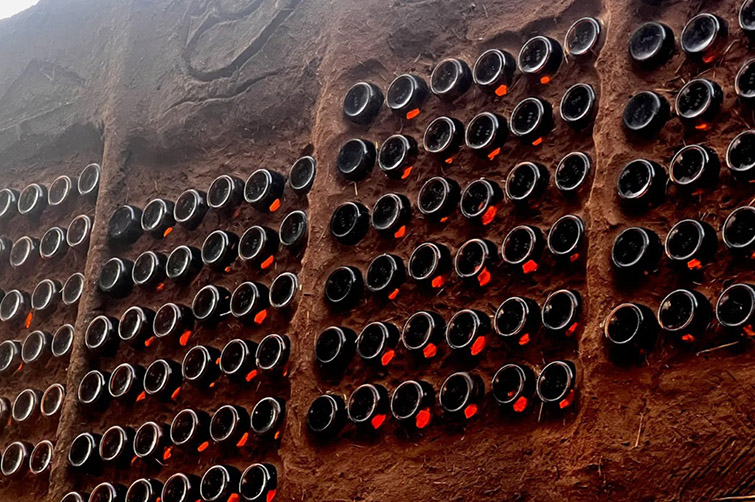 Prof Keith Armstrong’s work, Radiant Walls, frames itself as a process of ‘un-learning and re-learning’.
A professor of the Arts appointed to the Faculty of Economic and Management Sciences (EMS) may seem unexpected. Mudbrick walls embedded with poetry in glass bottles even more so. Yet at the University of the Free State (UFS), this is precisely the point.
When the UFS Faculty of Economic and Management Sciences appointed Prof Keith Armstrong from the Queensland University of Technology (QUT) as a visiting professor in the Centre for Development Support, his presence signalled more than just academic collaboration. It reflected a deliberate commitment to rethinking how we understand economics, development, and the futures we are working to build.
Deputy Vice-Chancellor: Research, Innovation and Postgraduate Studies, Prof Vasu Reddy, says: “Art and innovation are inseparable. At the UFS, we recognise that imagination is not a luxury; it is a strategic resource for building responsible and sustainable futures. Transdisciplinary creativity is reshaping how we approach societal challenges. Bringing art into economic enquiry expands the possibilities for regenerative, future focused solutions.”
Prof Philippe Burger, Dean of EMS, explains that economics is fundamentally about human behaviour and is therefore part of the human sciences. “We do not want to practise our subsection of the human sciences in isolation from other human sciences. Indeed, we do not even want to practise our sciences in isolation from any of the sciences, including the natural sciences. Transdisciplinary work gives us a better understanding of humanity,” he says.
For the faculty, creativity is not ornamental. It is foundational. “Art is fundamental to human creativity. In our students’ education, creativity is a key graduate attribute. It is the foundation of innovation and entrepreneurship. Through entrepreneurship, people create livelihoods and live out their creative dreams,” Prof Burger adds.
Prof Reddy situates the appointment within the university’s broader research vision. He says, “Innovation demands more than technical skill; it requires the courage to imagine differently. Our collaboration with Prof Armstrong embodies the UFS’ commitment to knowledge that transforms society. Sustainable development must be human centred, relational, and culturally grounded. Art brings these dimensions into sharper focus, enabling new forms of societal resilience.”
For Prof Armstrong, the relationship between art and economics is neither symbolic nor decorative. It is necessary. Sustainable development, he argues, is not only a technical or financial challenge, but a cultural one.
“My role as a researcher-artist in an economics faculty can, through practical projects we’ve undertaken in South Africa with Dr Anita Venter and teams, and through our writing, bring the human, imaginative, and relational dimensions that traditional economic models may overlook,” he explains. “Art helps us feel and understand the deeper social, historical, and ecological forces shaping our world. It can open space for new ways of imagining the future, challenge inherited power structures, and reconnect us with materials, communities, and place.”
Dr Anita Venter, a lecturer in the Centre for Development Support, has worked closely with Prof Armstrong. She emphasises that economics does not stand apart from culture, history, or lived experience. “Art makes visible what spreadsheets cannot: the relational, embodied, and emotional dimensions of how people survive, adapt, and imagine futures under conditions of inequality. If sustainable development is truly about people, not just GDP, then the arts must sit at the economics table.”
Community voices are central to Prof Armstrong’s work, alongside what he describes as ‘more-than-human’ perspectives that foreground ecological relationships. For more than three decades, his practice has focused on social and ecological justice, using creative and interactive processes to explore collective pathways to sustainable futures.
“We cannot build futures we cannot first envision,” says Dr Venter. “Art allows communities to rehearse alternative ways of living. It cultivates the relational and regenerative thinking that sustainability demands. It teaches us to sit with uncertainty, to let communities lead, and to resist the urge for premature closure. These are precisely the capacities required to navigate ecological and social complexity.”
Prof Armstrong agrees. Art, he says, helps audiences imagine differently, feel differently, and relate differently. “It reconnects people with materials and communities, brings marginalised voices to the centre, and slows us down enough to notice what truly matters.”
In the Faculty of Economic and Management Sciences at the UFS, mudbrick walls and poetry-filled bottles are not curiosities. They are provocations. They ask what kind of economy we are shaping, whose voices are heard, and what futures we dare to imagine.
Prof Reddy emphasised, “At the UFS, we champion research that is ethically anchored and socially responsive. Integrating the arts into our research ecosystem strengthens our capacity to design futures that are equitable and enduring.”
By bringing art into the heart of economic enquiry, the university affirms that responsible and sustainable societal futures require more than calculation. They require imagination.