24 March 2026
|
Story Blessing Hlongwana and Precious Shamase
|
Photo Supplied
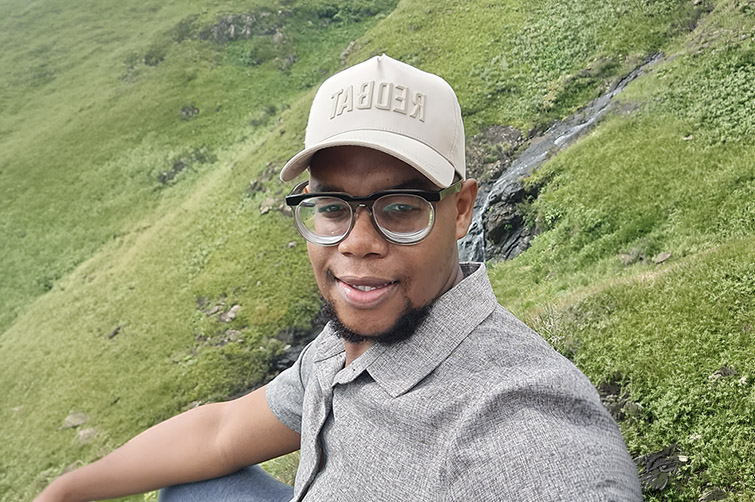 Blessing Hlongwana, a PhD candidate at the University of the Free State (UFS), is studying how eland move through fragmented mountain landscapes, and what this means for how we manage and sustain these ecosystems into the future.
On the steep slopes of the Northern Drakensberg, long before most hikers reach the ridge, Blessing Hlongwana is already at work. Moving across high-altitude grasslands, he tracks one of Africa’s least understood giants – the common eland.
Hlongwana, a PhD candidate at the University of the Free State (UFS), is studying how these animals move through fragmented mountain landscapes, and what this means for how we manage and sustain these ecosystems into the future.
His research, led through the
Afromontane Research Unit (ARU), focuses on areas including the Golden Gate Highlands National Park, the Witsieshoek Community Conservation Area, and the Royal Natal National Park. These landscapes, once more connected, now reflect the pressures of land use, climate variability, and human activity.
“We are trying to understand how eland use these landscapes and how their movement changes over time,” says Hlongwana. “That knowledge helps us plan for systems that can support both biodiversity and the communities who depend on these environments.”
Prof Vasu Reddy, Deputy Vice-Chancellor: Research, Innovation and Postgraduate Studies, agrees, “Tracking the eland shows how science can reconnect fragmented ecosystems while working with the communities who live there. For us, research is not simply confined to laboratories, it moves across landscapes.”
Following a quiet giant
Despite being the largest antelope in Africa, the common eland remains understudied in high-altitude regions. Yet its role in maintaining the balance of mountain ecosystems is significant.
As eland move across these landscapes, they influence vegetation patterns, disperse seeds, and contribute to the resilience of grassland systems. In environments already under pressure, these processes support ecological stability that extends beyond conservation boundaries.
Hlongwana’s fieldwork, often conducted in remote and physically demanding conditions, is building a clearer picture of how wildlife adapts to changing environments – and where those adaptations are being constrained.
For Prof Reddy, “Understanding how species like the eland adapt to environmental pressure gives us actionable insight, not only for conservation, but also for shaping sustainable futures in a changing climate.”
Research shaped by people and place
A defining feature of the project is its focus on shared knowledge and participation.
Supported by the
Hans Hoheisen Charitable Trust, the study includes a citizen science component that will train at least 30 community members to contribute to data collection. Through platforms such as iNaturalist, hikers, local residents, and conservation partners can log sightings that directly support the research.
For Hlongwana, this is central to how conservation must evolve.
“You cannot separate the landscape from the people who live in it,” he says. “If we want to sustain these systems, we need approaches that include local knowledge and everyday observation.”
This model reflects a broader shift towards more inclusive, responsive research – where scientific insight and community experience work together to address complex environmental challenges.
Reconnecting a fragmented landscape
The long-term aim of the project is to support the restoration of historical wildlife corridors across the Northern Drakensberg. By understanding how eland respond to environmental pressures, researchers can identify pathways that would allow species to move more freely between protected areas.
Reconnecting the Witsieshoek Community Conservation Area with neighbouring national parks would not only support biodiversity but also strengthen the resilience of the broader landscape in the face of climate change.
“Research that restores connections – both ecologically and socially – lies at the heart of our commitment to building responsible societal futures through innovation, inclusion, and postgraduate excellence,” remarks Prof Reddy.
At the UFS, this kind of research speaks directly to the institution’s commitment to building responsible societal futures – where knowledge is used to respond to real-world challenges, support sustainable development, and enable more equitable relationships between people and the natural environment.
A shared responsibility for the future
Back in the mountains, the work continues, one sighting at a time. A photograph uploaded by a hiker, or a report from a local resident, becomes part of a larger effort to understand and sustain these ecosystems.
Each contribution helps build a more complete picture of how species move, adapt, and survive – and how those systems can be supported for generations to come.
In this way, the project moves beyond studying a single species. It is about restoring connections between ecosystems, strengthening collaboration between science and society, and shaping a more sustainable future for the region.