27 May 2026
|
Story Tshepo Tsotetsi
|
Photo Ian van Straaten
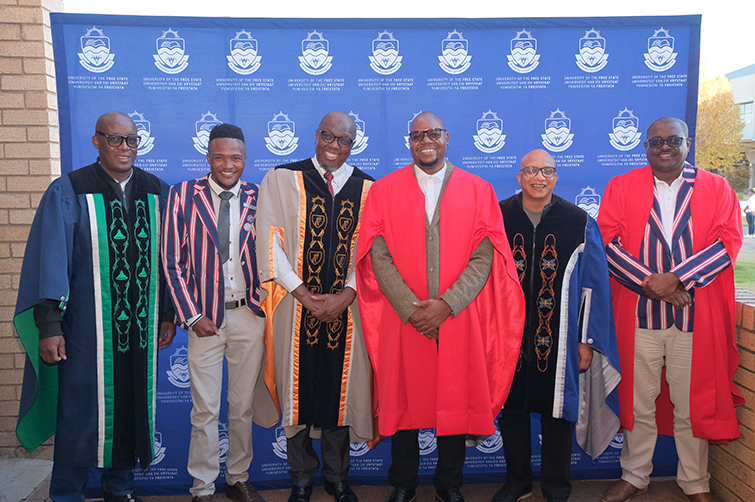 From the left are Prof Prince Ngobeni, UFS Qwaqwa Campus Principal; Mcebo Hlatsi, President of the Qwaqwa CSRC; Prof Mogomme Masoga, Dean of the Faculty of The Humanities; Prof Oliver Nyambi, Professor in the Department of English; Prof Vasu Reddy, Deputy Vice-Chancellor: Research, Innovation and Postgraduate Studies; and Prof Kudzayi Ngara, Head of the Department of English.
When economies collapse, when political violence becomes routine, and when survival begins to matter more than dignity – what happens to people’s sense of humanity? What happens to memory, identity, belonging, and hope in societies shaped by fear, hunger, and uncertainty?
These were some of the questions explored by Prof Oliver Nyambi during his inaugural lecture, Finding the Human(e): The Poethics of Literature. Prof Nyambi, from the Department of English in the Faculty of The Humanities on the Qwaqwa Campus, also marked a historic milestone as the first full professor in the faculty on the campus.
Drawing from Zimbabwean literature, migration narratives, prison writings, and his own experiences during Zimbabwe’s economic crisis, Prof Nyambi reflected on how literature captures the emotional realities of crisis in ways that statistics and political discourse often cannot. While economics may measure collapse and politics may debate it, literature records what it feels like to live through it.
Prof Vasu Reddy, Deputy Vice-Chancellor: Research, Innovation and Postgraduate Studies, who oversaw this inaugural lecture, said: “Prof Nyambi reminds us that where crisis fractures the human spirit, literature gathers the fragments and restores meaning. His scholarship calls us to build responsible societal futures grounded not only in knowledge, but also in compassion, imagination, and the courage to remember.”
Literature as a record of human experience
Central to Prof Nyambi’s lecture was the argument that crises not only damage economies and political systems. They also alter people’s emotional worlds and sense of self.
“It is hard to imagine this bottom, and that’s not least because it occupies an inhuman and even anti-human place,” he said, reflecting on Zimbabwe’s economic collapse.
For Prof Nyambi, the effects of the crisis do not disappear once the moment has passed. They remain present in memory, language, and everyday life.
“This bottom is haunting. It is in our languages, in our nightmares, in our subconscious, in our stories.”
Throughout the lecture, Prof Nyambi returned to the metaphor of the ‘black goat’, which he used to describe memories and trauma that continue to follow people long after the crisis has ended.
“My PhD, my postdocs, and my current research became a lifetime of searching for the black goat, of negotiating its spells and exorcising the time it binds, the time it haunts.”
Prof Nyambi explained that literature creates space to confront these difficult memories while also restoring dignity to people whose lives are often reduced to statistics or stereotypes.
“I’ve been fascinated by the artistic recovery of crisis subjects,” he said. “I’ve explored the method of literature in this recovery.”
The lecture also challenged the way African stories about suffering are sometimes dismissed as ‘poverty porn’. Referring to Zimbabwean author NoViolet Bulawayo’s novel We Need New Names, Prof Nyambi argued that literature about hardship is often misunderstood. Rather than reducing people to victims, he explained that humour in crisis narratives can become a way for characters to preserve dignity, identity, and humanity even in difficult circumstances.
Prof Nyambi further explored how migration and displacement reshape people’s identities, particularly when they are separated from familiar spaces, languages, and communities.
“Part of what structures the humane is familiarity – the familiarity of space, faces, languages, relations, and relationalities.”
He also reflected on prison writings by Zimbabwean political activists, describing writing as a way for people to reclaim voice and dignity in environments designed to silence them.
“Letter writing becomes a technology of the self in an act of reasserting voice.”
During the lecture, Prof Nyambi positioned literature as more than just storytelling. He described it as an important archive of human experience – one that preserves the emotional truths of crisis while insisting on the humanity of those living through it.
“It is to follow the lure of poethics in acts of world-making dignity,” Prof Nyambi said, “especially in situations where dignity is denied.”
“The University of the Free State is committed to a future where innovation is anchored in empathy. Literature as an archive of lived realities and a guide for humane, inclusive futures is in deep synergy when storytelling and scholarship together advance justice, dignity, and belonging. In building responsible societal futures, we recognise that data also tells us what happened, and the arts and humanities reveal what it meant to be human within it,” according to Prof Reddy.