26 May 2026
|
Story Lunga Luthuli
|
Photo Stephen Collett
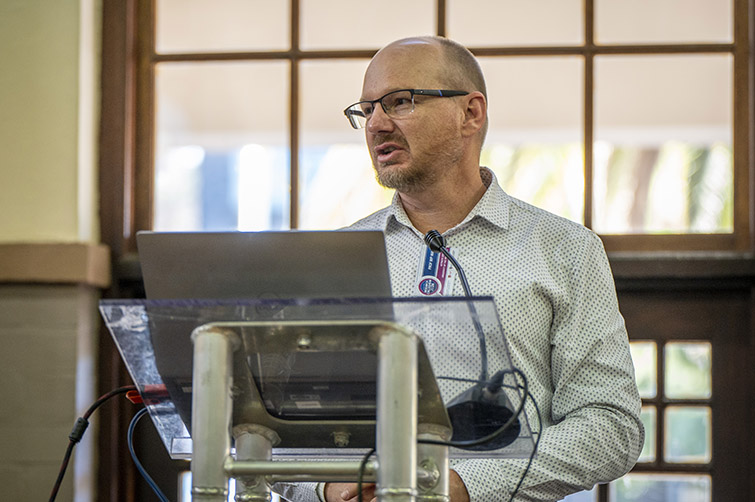 Prof Wp Wahl, Associate Professor in the UFS Department of Curriculum Studies and Higher Education, delivers the keynote address at the 2026 Student Affairs Research Colloquium, highlighting the importance of remaining on the cutting edge of student affairs practice.
Now in its eighth year, the annual colloquium brought together higher education practitioners, researchers, academics, and student support professionals to engage on pressing issues affecting student development in the Global South.
Held under the theme, Transforming student development and support in context: Evidence, justice, and praxis in the Global South, the colloquium created a platform for critical dialogue on the role of student affairs in advancing inclusive, responsive, and student-centred support systems within higher education institutions.
Addressing student wellbeing and support
The programme featured a range of presentations and discussions focusing on student wellbeing, transformation, leadership development, mental health, academic support, and the importance of evidence-based practices in student affairs. Participants reflected on the evolving needs of students and the importance of contextual approaches to support within diverse university environments.
In his opening remarks,
Dr Temba Hlasho, Executive Director: Student Affairs, Sports, Arts and Culture, highlighted the important role student affairs divisions play in supporting student development beyond the classroom environment.
“Student Affairs remains central to the university’s academic project. The division provides various platforms for student development aimed at producing well-rounded graduates. DSA-SAC ensures that graduate attributes are calibrated to develop globally competitive students,” said Dr Hlasho.
Advancing social justice and sustainability
Dr Hlasho also reflected on the role of student affairs in advancing the
United Nations Sustainable Development Goals (SDGs), noting that student affairs practitioners are strategically positioned to influence students towards a commitment to social justice and sustainable development.
The colloquium further highlighted the significance of collaboration between academic and support divisions in shaping holistic student experiences. Through research presentations and panel engagements, delegates explored practical interventions aimed at improving student success and strengthening institutional responsiveness.
The event reinforced the university’s commitment to social justice, transformation, and the development of student-centred support structures that respond to contemporary challenges facing higher education institutions in South Africa and beyond.
Spotlight on belonging and institutional culture
Addressing issues of inclusion and belonging within higher education institutions, Dr Hlasho said: “Student Affairs exists to widen participation and belonging. The paradox is that the very structures meant to include can re-inscribe exclusion if we do not examine assumptions, design, and power.”
He further emphasised the importance of reviewing institutional systems and policies to ensure that they support student success rather than frustrate progress. Areas highlighted included orientation programmes, residence culture, wellness services, grievance processes, and the impact of overregulation on student autonomy.
Repositioning student affairs in African universities
Reflecting on his previous experience within the division, Prof Wahl said: “I cared deeply about seeing students come to campus to create hope for themselves, their families, and their communities, and to break the cycle of poverty. It is important to give our students the best support and opportunities to develop themselves.”
He added that professionalising student affairs goes beyond theory.
“It is about touching the real lives of real students in meaningful ways through the work we do every day. We need to continue sharpening our sword to remain on the cutting edge of student support and development,” he said.
Reflecting on South Africa’s higher education landscape
Dr Hlasho also reflected on the importance of social justice within the South African higher education context.
“Acknowledging and understanding the past will help us move forward. South Africa has a past of unequal societies in all respects. Post-1994, the democratic order was obligated to redress ills of the past. Restoration of human dignity is non-negotiable,” he said.
The future of student support
The colloquium also explored the future of student support in an increasingly digital environment, with discussions focusing on artificial intelligence, digitalisation, preventative support models, and the use of real-time data to identify and support at-risk students.
Since its establishment, the Student Affairs Research Colloquium has continued to provide a valuable platform for knowledge-sharing and professional engagement among student affairs practitioners. The 2026 gathering once again demonstrated the importance of research-informed dialogue in strengthening student support and development within the higher education sector.