27 May 2026
|
Story Dr Zikhona Dlaza
|
Photo Supplied
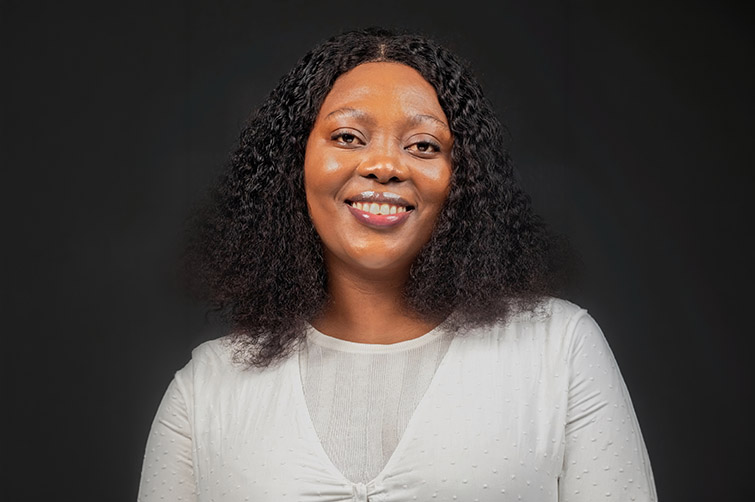 Dr Zikhona Dlaza is a lecturer in the Department of Industrial Psychology, University of the Free State.
I will never forget the look on their faces.
It was an ordinary Saturday morning at our university’s open day. Learners from schools in and around Qwaqwa had made the trip, some of them travelling for the first time to a university campus. They walked in clutching brochures, whispering to each other, pointing at buildings. A few were shy. Others asked questions with the kind of confidence that makes you smile, because you can already see who they are going to become. I stood there feeling genuinely proud. These young people had shown up. They wanted to know about their futures.
Then the questions turned to entry requirements. And something shifted.
“Miss, I want to do BCom. I am doing Business Studies and Maths Literacy, do I qualify?”
The answer, for most of our programmes, was no. Pure Mathematics was required. One by one, the same realisation crossed their faces. Not anger. Not even frustration. Just a quiet, heavy kind of disappointment, the kind that comes when you understand that a door has been closed, and you are only hearing about it now, when it is too late to do anything about it. That moment has stayed with me. And it has made me ask a question I cannot stop thinking about: whose job was it to tell them sooner?
An important decision of their young lives
In Grade 9, learners across South Africa must choose the subjects they will carry through to matric. It is one of the most important decisions of their young lives, and most of them make it with very little guidance. For a 14-year-old in a rural community like Qwaqwa, Mathematics Literacy often feels like the safer road. It is less intimidating. And if no one explains that this choice will close the door to university programmes in health sciences, industrial psychology, and many others, why would you think twice? The problem is not that these learners made the wrong choice. The problem is that they were never properly shown what the choice meant.
Here is something we do not talk about enough: parents. Many of the parents of these learners have never set foot at the university. They do not know the difference between Mathematics and Mathematics Literacy. They trust that the school is guiding their children well. This is not a criticism. It is an acknowledgement that they have been left out of a conversation that directly affects their children’s futures. Career guidance must reach into homes and communities, in local languages, in ways that make sense to families navigating all of this for the first time. Imagine if, in Grade 7 or 8, parents received a simple guide explaining what subject choices lie ahead and what each one opens or closes. That kind of early, inclusive conversation could change everything.
Every child deserves to know their options
South Africa’s unemployment rate sits above 32%. Among young people, it exceeds 60%. Behind every statistic is a sequence of events, and for many young South Africans, that sequence begins with a subject choice made at age 14, without adequate guidance. The link between poor career guidance and unemployment is not always direct, but it is real. When learners are not guided toward subjects that open university doors, they are quietly steered away from qualifications that lead to decent work. The crisis we see at the end has quiet roots at the beginning. And one of those roots is the absence of meaningful career guidance in the communities that need it most.
None of this is impossible to fix. Schools in rural communities need trained people who can guide learners through career decisions before Grade 9, not after. Universities need to go to the communities that cannot come to them, hold outreach events in local schools and community spaces while there is still time to make different choices. Government needs to invest in career guidance as something every child deserves. And most importantly, we need to include parents. They are not the problem. They are one of the most powerful forces we have, if only we give them the information they need to walk alongside their children.
Every child deserves to know what their options are, early, clearly, and kindly. That is not too much to ask. It is the very least we owe them.
- Dr Dlaza is a lecturer in the Department of Industrial Psychology, with research interests in employability, decent working conditions, and career development.