02 November 2026
|
Story Queen Sigebedu
|
Photo Supplied
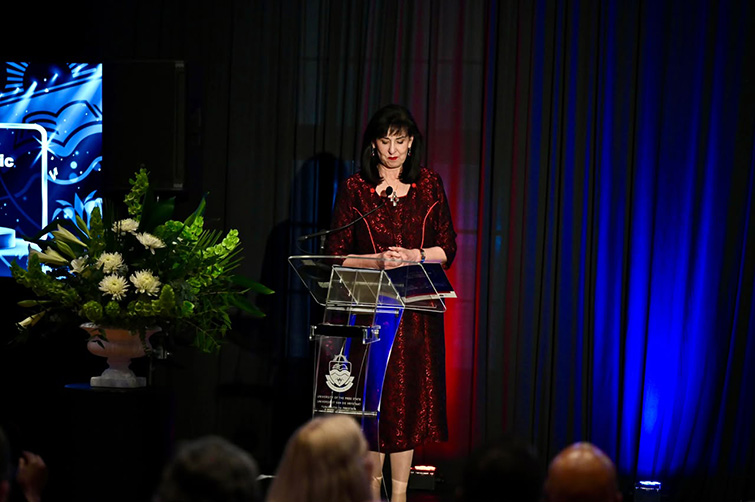 Prof Hester C. Klopper opens the UFS 2026 Exceptional Academic Achievers Awards, held on 27 October at the Bloemfontein Campus.
The future of higher education will be shaped by how universities develop critical thinkers, advance knowledge, embrace innovation, and translate research into meaningful societal impact. At the University of the Free State (UFS), these priorities were reflected in the 2026 Exceptional Academic Achievers Awards, held on 27 October at the Centenary Complex on the Bloemfontein Campus.
The ceremony recognised academics, researchers, and professional staff whose contributions to teaching and learning, research, innovation, and academic leadership are helping to shape the future of the University and the communities it serves. The event recognised achievements across learning and teaching, research, and special recognition categories.
Addressing the gathering, Prof Hester C. Klopper, Vice-Chancellor and Principal of the UFS, emphasised that academic achievement is a collective endeavour. “Academic achievement rarely happens in isolation,” she said, highlighting the importance of the people, partnerships, and support structures that enable academic excellence to flourish.
Her message reflects a broader imperative for higher education to create environments in which individuals can excel, knowledge can advance, and academic work can contribute to a more sustainable and inclusive future.
Tiana van der Merwe, Director of the Centre for Teaching and Learning, emphasised the importance of recognising excellence across the University’s core academic functions.
“The Academic Achievers Awards provide an opportunity for teaching and learning, and research, to be showcased on the same podium, highlighting the importance and value of excellence in both these core areas of the UFS. We congratulate all nominees and winners across the award categories,” she said.
Preparing students for a changing world
As higher education responds to changing student needs, emerging technologies, and increasingly complex societal challenges, teaching and learning must equip graduates with more than disciplinary knowledge. Critical thinking, sound judgement, adaptability, and the ability to apply knowledge in unfamiliar contexts are becoming increasingly important.
The teaching and learning awards highlighted innovative approaches to assessment, interdisciplinary collaboration, module redesign, classroom practices, technology-enabled learning, and teaching support.
Dr Alison Stander, recognised in the Technology and Digital Transformation and Best Conference Paper (Bloemfontein) categories, said: “I believe technology offers us exciting opportunities to rethink how we teach and how students learn. For me, innovation is about finding new ways to engage students, encourage independent learning, and develop critical thinking. It is about more than preparing students for the world as it is today; it is about developing graduates who are not afraid of change, who can think for themselves, use technology responsibly, and apply their skills and knowledge to challenges beyond the university environment.”
These areas of innovation demonstrate the importance of continuously evolving academic practice to meet the needs of a changing student population and a rapidly developing knowledge landscape. They also reinforce the need to evaluate how teaching methods, assessment practices, and learning environments prepare graduates to engage thoughtfully with the world around them.
Advancing research from knowledge to societal impact
Research plays a critical role in addressing complex challenges, informing policy and practice, and expanding the possibilities for innovation. The awards highlighted the importance of emerging and established researchers, postgraduate supervision, collaborative research, scholarly publications, and the generation of research-linked income.
Beyond individual achievements, the ceremony emphasised the value of connecting academic expertise with real-world needs. UFS research spans areas such as healthcare, agriculture, food security, sustainability, and social development, demonstrating the potential of interdisciplinary knowledge to inform solutions to pressing challenges.
Prof Melanie Walker, recognised as the Exceptional Established Researcher Achiever, emphasised that academic excellence is not achieved in isolation. “Academic excellence and knowledge creation are always relational. Those of us fortunate enough to receive recognition have been accompanied along the way by many others, both professionally and personally. In this way, academic excellence indirectly has an impact on the lives of those many others who learn with us along the way and can contribute substantially to building African scholarship, itself a significant form of societal impact,” she said.
Prof Walker further stressed the importance of directing research towards addressing inequality and ill-being in South Africa, across the African continent, and beyond. She highlighted the need for research that is meaningful, critical, and conceptually innovative, advancing understanding of how societies can work towards greater justice, equitable well-being, and agency.
Her perspective reinforces the importance of research that not only advances knowledge but also challenges existing thinking and contributes to more just and equitable societies.
Prof Klopper highlighted collaboration between the UFS and Universitas Academic Hospital in integrating an artificial intelligence-employing radiation planning assistant into patient care. She also pointed to the establishment of Southern Africa’s first interstitial brachytherapy programme for cervical cancer.
These developments illustrate how collaboration between universities and healthcare institutions can help translate research and technological advances into improved clinical practice and patient care.
The launch of the UFS Research Review 2022–2024, led by the portfolio of Prof Vasu Reddy, Deputy Vice-Chancellor: Research, Innovation and Postgraduate Studies, further showcased the University’s research activity and its contribution to addressing challenges across Africa.
As the demands on higher education continue to evolve, the ability to connect research, innovation, partnerships, and societal needs will remain essential to ensuring that knowledge creates value beyond the university environment.
Sustaining research excellence and building future knowledge
The awards also highlighted the importance of sustained research leadership, institutional research capacity, and the development of specialised knowledge across disciplines. Recognition through the National Research Foundation rating system and the South African Research Chairs Initiative reflects the role of established researchers and research chairs in strengthening the country’s knowledge base and supporting long-term research development.
At the UFS, research chairs contribute to areas including disease resistance in field crops, vector-borne and zoonotic pathogens, trophic ecology, biodiversity restoration, fungal research, poverty and democracy, and genomic surveillance of respiratory and enteric pathogens in children in South Africa.
These areas of expertise demonstrate how sustained investment in research can support scientific advancement, strengthen interdisciplinary collaboration, and generate knowledge relevant to South Africa and the broader region. Research chairs and rated researchers contribute to more than individual academic distinction. They help sustain research capacity, develop emerging scholars, strengthen collaboration, and create the conditions for future discoveries.
Dr Opeoluwa Israel Akinradewo, recognised in the Exceptional Young Achievers category, highlighted the opportunities and challenges facing the next generation of researchers in South Africa.
“Emerging researchers in South Africa are at a vantage position, being close to the problems that matter, from infrastructure and housing to skills and sustainability. However, we are faced with challenges such as limited funding, heavy teaching loads, and uneven access to mentorship and networks. I believe what can help is sustained seed funding, protected time for research, and partnership opportunities that connect young academics locally and internationally,” he said.
His perspective underscores the importance of creating an enabling research environment in which emerging academics can develop their expertise, build collaborative networks, and contribute to addressing the country’s pressing challenges. By investing in research leadership and recognising sustained contributions to knowledge, the UFS reinforces the importance of building an academic environment capable of responding to both current and emerging societal needs.
Shaping responsible societal futures
Academic excellence is sustained through the combined efforts of individuals, teams, institutional structures, and external partners. Recognising these contributions is an important part of creating a culture in which teaching, learning, research, and innovation can continue to develop.
The 2026 Exceptional Academic Achievers Awards recognised more than individual accomplishments. They highlighted the role of the UFS in preparing graduates to navigate uncertainty, advancing research that responds to real-world challenges, and creating knowledge that can inform decisions and improve lives.
“As universities look towards the future, academic excellence will increasingly be measured not only by achievements within their institutions, but also by their ability to contribute to society through relevant teaching, impactful research, meaningful partnerships, and responsible innovation,” said Prof Reddy.
Prof Klopper’s message on responsible societal futures speaks to this responsibility. The future is shaped by the questions researchers pursue, the graduates universities prepare, and the knowledge they make available to address the challenges of their time. By recognising the people advancing teaching, learning, research, and academic leadership, the UFS reaffirms its commitment to an academic environment that looks beyond present achievements towards future possibilities.
Through continued collaboration, innovation, and the pursuit of knowledge, the University is helping to shape responsible societal futures in which academic excellence translates into meaningful and lasting contributions to society.
2026 Award Winners
UFS EXCEPTIONAL ACADEMIC ACHIEVERS AWARDS 2026
| No. | Award | Place | Title | Name | Faculty | Job Title |
|---|
| Learning & Teaching Awards |
|---|
| 1 | Vice-Chancellor and Principal's Award in Learning and Teaching | 1st place | Dr | Annelize Oosthuizen | Faculty of Economic and Management Sciences | Senior Lecturer, Subject Head of Taxation, Programme Coordinator, BCom Honours in Taxation (Chartered Accountant SA) |
| 2 | Vice-Chancellor and Principal's Award in Learning and Teaching | 2nd place | | Lindie Coetzee | Faculty of the Humanities | Junior Lecturer, Department of Criminology |
| 3 | Research in Learning and Teaching: Emerging | 1st place | Dr | Rouxan Fouché | Faculty of Natural and Agricultural Sciences | Lecturer, Department of Computer Science and Informatics |
| 4 | Research in Learning and Teaching: Advanced | 1st place | Dr | Benjamin Botha | Faculty of Natural and Agricultural Sciences | Lecturer, Computer Science and Informatics |
| 5 | Excellence in Learning and Teaching Support | 1st place (group) | Prof | Cobus Rossouw | Faculty of Economic and Management Sciences | Associate Professor in Financial Accounting, PGCA Academic Coordinator, School of Accountancy |
| 6 | Excellence in Learning and Teaching Support | 1st place (group) | | Tobias van den Bergh | Support Services | Senior Counselling Psychologist, Health and Wellness Centre (SCD), PASS Programme Manager |
| 7 | Excellence in Learning and Teaching Support | 1st place (group) | | Mieke Fletcher | Support Services | Ad Hoc Counselling Psychologist, Student Counselling and Development (SCD) |
| 8 | Excellence in Learning and Teaching Support | 1st place (group) | | Lerato Dhlamini | Support Services | Counselling Psychologist, Student Counselling and Development (SCD) |
| 9 | Kovsie Phahamisa Short Learning Programme Award | 1st place | | Lee Goliath | Support Services | Assistant Director, Library and Information Services |
| 10 | Innovation through Interdisciplinary Collaboration in Learning and Teaching | 1st place (group) | Prof | Corlia Janse van Vuuren | Faculty of Health Sciences | Vice-Dean: Teaching and Learning |
| 11 | Innovation through Interdisciplinary Collaboration in Learning and Teaching | 1st place (group) | Prof | Diana Breshears | Faculty of the Humanities | Associate Professor and Subject Head of Communication Science, Qwaqwa Campus |
| 12 | Innovation through a Redesign or Renewal of a Module | 1st place | | Jana Lamprecht | Faculty of Economic and Management Sciences | Senior Lecturer, School of Accountancy (Chartered Accountant) |
| 13 | Innovation through Assessment | 1st place (tie) | Dr | Angela Stott | Faculty of Education | Senior Lecturer, Science Education |
| 14 | Innovation through Assessment | 1st place (tie) | Dr | Arnelle Mostert | Faculty of Health Sciences | Lecturer / Medical Officer, Department of Basic Medical Sciences |
| 15 | Innovation through Classroom Practices to Enhance Student Engagement and Participation | 1st place | Prof | Hendrik Auret | Faculty of Natural and Agricultural Sciences | Associate Professor, Department of Architecture (registered professional architect) |
| 16 | Innovation through Technology and Digital Transformation | 1st place | Dr | Alison Stander | Faculty of the Humanities | Lecturer, Department of Afrikaans and Dutch, German and French |
| 17 | Best Conference Paper: Bloemfontein | | Dr | Alison Stander | Faculty of the Humanities | Lecturer, Department of Afrikaans and Dutch, German and French |
| 18 | Best Conference Paper: Qwaqwa | | Dr | Ruth Wario | Faculty of Natural and Agricultural Sciences | Senior Lecturer, Computer Science and Informatics, Qwaqwa Campus |
| Research Awards |
|---|
| 1 | Vice-Chancellor and Principal's Book Prize Award | 1st place | Prof | Christian Williams | Faculty of the Humanities | Associate Professor, Anthropology |
| 2 | Vice-Chancellor and Principal's Book Prize Award | 2nd place | Prof | Oliver Nyambi | Faculty of the Humanities | Professor, Department of English, Qwaqwa Campus |
| 3 | Exceptional Young Achievers’ Award | 1st place (tie) | Prof | Christian Budde | Faculty of Natural and Agricultural Sciences | Associate Professor, Department of Mathematics and Applied Mathematics |
| 4 | Exceptional Young Achievers’ Award | 1st place (tie) | Dr | Opeoluwa Israel Akinradewo | Faculty of Natural and Agricultural Sciences | Senior Lecturer, Department of Quantity Surveying and Construction Management |
| 5 | Exceptional Established Researcher Achievers’ Award | 1st place | Prof | Melanie Walker | Faculty of Economic and Management Sciences | Distinguished Professor, Centre for Development Support |
| 6 | Exceptional Award for Research-aligned Third-stream Income Generation | 1st place | Prof | Corli Witthuhn | Faculty of Natural and Agricultural Sciences | Professor, Department of Sustainable Food Systems and Development |
| 7 | Innovation and Societal Impact Award | 1st place | Prof | Andreas Scheba | Faculty of Economic and Management Sciences | Associate Professor, Centre for Development Support |
| 8 | Exceptional Supervisors’ Awards | 1st place | Prof | Corinna Walsh | Faculty of Health Sciences | Professor, Department of Nutrition and Dietetics |
| 9 | Exceptional Academic Achievement for Team Research | 1st place | Prof | Vincent Ralph Clark | Faculty of Natural and Agricultural Sciences | Director, Afromontane Research Unit (ARU) |