02 November 2026
|
Story Tshepo Tsotetsi
|
Photo Stephen Collett
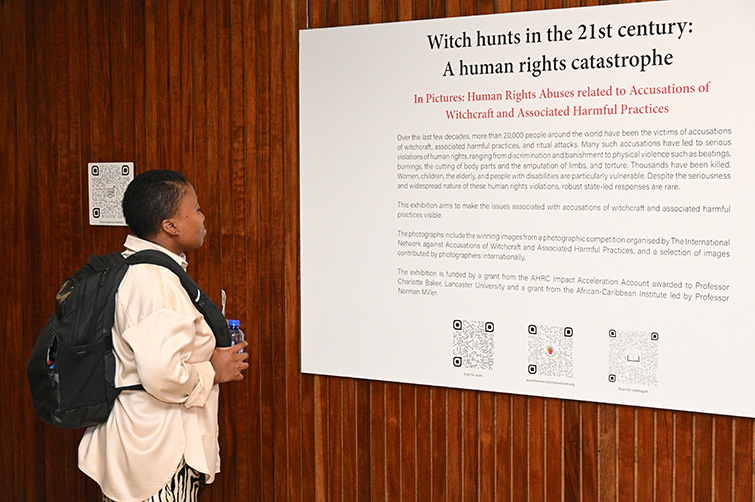 The University of the Free State has brought Witch Hunts in the 21st Century: A Human Rights Catastrophe to South Africa for the first time, using photography to highlight the human rights violations associated with accusations of witchcraft.
Being accused of witchcraft can cost a person far more than their reputation. Across different parts of the world, accusations rooted in beliefs about witchcraft and supernatural forces have resulted in people being ostracised, driven from their homes, subjected to violence and, in some cases, killed. Women, children, older people, persons with disabilities, and persons with albinism are among those particularly vulnerable to these harmful practices. What begins as an accusation can become a justification for discrimination, exclusion, and the denial of fundamental human rights.
The local launch is also an outcome of international collaborations established through the UFS’ research and initiatives relating to albinism since 2024. These collaborations have created opportunities for broader engagement with interconnected human rights concerns, demonstrating how research partnerships can extend beyond academia to promote awareness and societal impact.
Yet the photographs tell only part of the story. The launch brought together researchers and human rights advocates to examine why accusations arise, who becomes vulnerable, and how beliefs can be turned into instruments of discrimination and violence.
Prof Vasu Reddy, Deputy Vice-Chancellor: Research, Innovation and Postgraduate Studies, captured the human significance of the conversation in his opening remarks: “Human dignity is not conditional. This exhibition reminds us that every person deserves recognition, protection, and belonging, regardless of difference or circumstance. Being launched in the space of a university is relevant, because universities do more than generate knowledge. They are also spaces where difficult conversations advance justice, empathy, and social change. The images invite us to look and listen more carefully to voices that have been overlooked, marginalised, even erased.”
When belief becomes a weapon
The discussion challenged the tendency to regard witchcraft accusations as isolated incidents of violence, drawing attention instead to the processes of exclusion and discrimination that often precede physical harm.
Prof Narnia Bohler-Muller, leader of the UFS Flourishing Life Research Theme, argued that an accusation can effectively become a verdict delivered without a trial, legal representation, or an opportunity to appeal.
She described this as a denial of flourishing, in which an individual’s relationships, sense of belonging, and ability to participate in society are progressively dismantled. The accused may first lose the right to be believed, then be driven from their homes and communities, before facing physical violence. Women and widows, children, older people, persons with albinism, and persons with disabilities are among those who may be targeted because they are perceived as different or vulnerable.
“The problem is not belief. The problem is the moment belief is turned into a weapon and pointed at another person,” Prof Bohler-Muller said, distinguishing between the constitutional protection of freedom of religion and belief and practices that use those beliefs to justify harm against others.
This distinction is particularly important in understanding the experiences of persons with albinism, whose physical characteristics have, in some communities, been surrounded by misconceptions and harmful beliefs.
Prof Charlotte Baker of Lancaster University’s School of Global Affairs, who is also Co-Director of INAWARA, highlighted how these misconceptions contribute to stigma, discrimination, and social exclusion, sometimes escalating into attacks and killings. Her research examines the intersections of disability, witchcraft accusations, and ritual attacks.
Research compiled by the Canadian organisation
Under the Same Sun has documented nearly 850 reports of attacks against persons with albinism in 28 countries, including more than 260 killings. Prof Baker cautioned that these figures are widely considered an underestimate.
Her presentation also traced the international advocacy that culminated in the adoption of United Nations Human Rights Council Resolution 47/8 on 12 July 2021. The resolution recognises the serious human rights concerns associated with accusations of witchcraft and ritual attacks, calling on states to protect vulnerable groups, strengthen accountability, and support education and community engagement. However, as Prof Baker cautioned, international recognition alone is insufficient. “The UN resolution will only make a difference if people respond to it, if it’s implemented.”
From recognition to protection
The consequences of accusations also extend beyond those directly targeted. Drawing on his safeguarding experience in the United Kingdom,
Dr Leethen Bartholomew examined how family pressures, illness, disability, neurodivergence, and perceived differences can contribute to circumstances in which children become targets. He cautioned against attributing these practices to particular cultures or communities, calling instead for a more informed understanding of the social and family dynamics involved.
His presentation highlighted the consequences for children, including physical and emotional harm, disrupted education, and the often-overlooked experiences of siblings who witness or become involved in abuse. He also emphasised the importance of professional awareness, appropriate investigations, and coordinated responses between child protection, social services, healthcare, and law enforcement structures.
He presented a practical six-step safeguarding framework: recognising warning signs, exploring concerns through non-judgemental questions, protecting those at risk, coordinating support, investigating allegations appropriately, and providing ongoing support and review. The approach places immediate safety at the centre of intervention, rather than allowing attempts to establish spiritual explanations to delay protective action.
For Prof Bohler-Muller, addressing these violations also requires restoring the dignity and belonging that accusations seek to destroy. She called on legal institutions, faith communities, traditional leadership structures, universities, and researchers to confront the issue through education, accountability, and meaningful engagement.
Although universities cannot undo the harm caused by an accusation, they can create spaces for conversations that challenge assumptions and make overlooked experiences visible. The UFS Art Gallery, under the curatorial leadership of Angela de Jesus, played an instrumental role in installing the exhibition and transforming the Equitas Auditorium into a space for visual storytelling and reflection. Prof Reddy described the exhibition as an opportunity to bring scholarship, creative expression, and public engagement together in service of a more just and inclusive society. He emphasised that the University’s responsibility extends beyond producing knowledge to considering the difference that knowledge makes in people’s lives.
“Let these images challenge our assumptions and deepen our sense of a shared humanity,” he urged.
The exhibition is open to students, staff, and members of the public until 2027 at the Equitas Auditorium on the UFS Bloemfontein Campus.