09 November 2026
|
Story Leonie Bolleurs
|
Photo Leonie Bolleurs
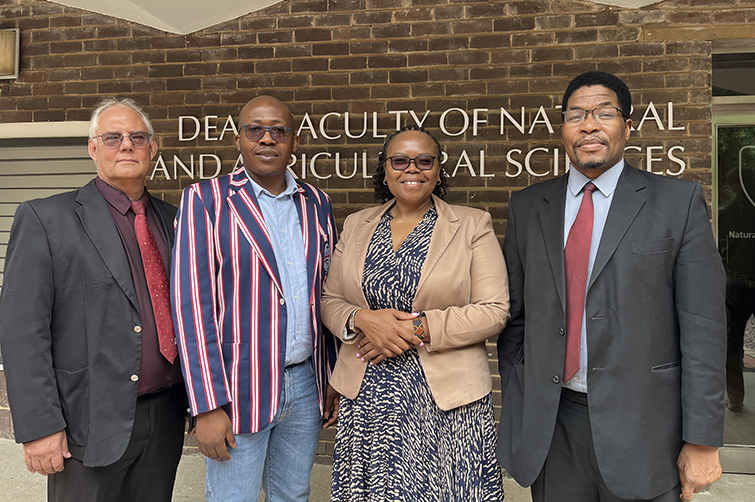 Pictured during an accreditation visit from the South African Council for Planners are, from the left: Prof Martin Lewis, Dr Kgosi Mocwagae, Nontsundu Ndonga, and Prof Mfaniseni Sihlongonyane.
When a city grows, new housing developments emerge, roads are expanded, or land is set aside for future development, town planners are often part of the conversation.
Preparing graduates for those responsibilities is one of the reasons why the Department of Urban and Regional Planning at the University of the Free State (UFS) recently underwent a formal accreditation review by the South African Council for Planners (SACPLAN) – a process that takes place every five years.
For two days, classrooms, curricula, research projects, and industry partnerships came under close scrutiny when a group of planning professionals, academics, and industry stakeholders visited the university to assess whether the department's accredited programmes continue to meet the standards required by the profession.
The review resulted in a positive outcome, with SACPLAN verbally confirming the accreditation of the Bachelor of Spatial Planning (Honours) and the Master of Urban and Regional Planning (Professional), allowing the UFS to continue offering professionally recognised planning qualifications.
Preparing students for employment
According to Dr Kgosi Mocwagae, Head of the Department of Urban and Regional Planning, the process represents years of preparation.
The department has been accredited ever since the introduction of the Planning Profession Act in 2002. Its history stretches back even further through the South African Council for Town and Regional Planners, which preceded SACPLAN. “Every five years, the department undergoes a detailed review of its programmes, curriculum, teaching, research, and professional relevance,” says Prof Mocwagae.
The work begins long before a review panel arrives on campus. "The role of the Head of Department is to prepare the Self-Evaluation Report and convene all relevant stakeholders from the institution," he explains.
That report serves as a portfolio of evidence covering the department's activities over the previous five years. It is followed by a site visit during which a panel engages with staff, students, university leadership, professional planners, and industry representatives before making its recommendations.
For students, the outcome matters.
According to Dr Mocwagae, accreditation ensures that graduates meet professional and industry requirements. Without it, graduates would not be able to enter a profession that is regulated through the Spatial Planning and Land Use Management Act.
"Accreditation is quality assurance of our course offerings to determine whether our graduates align with market requirements," he explains.
What stood out during the accreditation visit was the way in which the department is positioned within a much broader academic environment. Speaking to the visiting panel, Prof Paul Oberholster, Dean of the Faculty of Natural and Agricultural Sciences, described Urban and Regional Planning as part of a larger ecosystem of teaching, research, and industry engagement.
The department forms part of the faculty's Built Environment cluster alongside Architecture and Quantity Surveying. Through initiatives such as the Green Futures Hub and the Complex Systems Hub, academics increasingly work across disciplinary boundaries, bringing together expertise from different fields to tackle complex challenges. “That is the way forward," says Prof Oberholster.
Those partnerships matter because they expose both staff and students to industry and real-world challenges. "We've got industry partners that work with us, that improve your employability," he says. "It doesn't help if you've got a certificate on the table. You need to be employable."
This focus on preparing graduates for the realities of the profession is echoed by Prof Vasu Reddy, Deputy Vice-Chancellor: Research, Innovation and Postgraduate Studies.
He sees accreditation as an opportunity to strengthen and improve programmes. “From the professional side of SACPLAN, it is also about the relevance of planning education, because we know the field is changing," he notes.
Prof Reddy believes planning education must equip graduates to respond to increasingly complex societal challenges. "While there is a core set of elements in terms of training, the question is: how do you strengthen that training, not only for students but also for scholars, so that they can address complex societal challenges through socially responsive research across disciplines?"
Alignment with national development priorities
That question speaks directly to the role that planners play in South Africa. Issues such as sustainable human settlements, spatial justice, infrastructure, and economic development cannot be solved in isolation. They require professionals who understand how communities function and how different systems connect.
"We see the accreditation process as critical around quality, professional standards, and alignment with national development priorities," says Prof Reddy. "We are not an island. We might be in the central heartland, but we are training people who will work across the country, and some will go beyond South Africa."
During the feedback session, SACPLAN confirmed the continued accreditation of the department's two professional programmes and provided recommendations for further strengthening the academic offering.
"Our planning programme was accredited with some conditions, which the department, with the support of the university, has to address," says Dr Mocwagae. He believes the conditions are achievable and views them as constructive feedback that will further strengthen the programmes and the student experience.
The verbal feedback session was attended by the SACPLAN Accreditation Panel, the Deputy Vice-Chancellor: Academic, Prof Anthea Rhoda, and the deanery of the Faculty of Natural and Agricultural Sciences.
The successful accreditation outcome enables the UFS to continue offering professionally recognised planning qualifications while exploring future opportunities, including the possibility of an undergraduate programme focused on rural planning on the Qwaqwa Campus.