06 November 2026
|
Story Siqhamo Jama
|
Photo Vuyelwa Mbebe
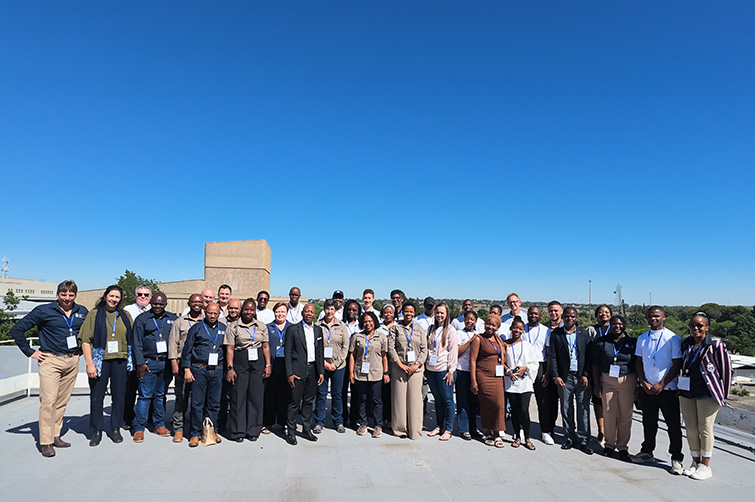 UFS Chancellor Prof Bonang Mohale joins postgraduate students, staff members, industry representatives and other delegates at the Department of Soil, Crop and Climate Sciences’ Postgraduate Symposium.
South Africa's agricultural future will depend on more than scientific discoveries. It will depend on the ability to translate research into practical solutions that improve lives, strengthen food security and create opportunities for communities.
This was the central message at the annual Postgraduate Symposium hosted by the University of the Free State’s (UFS)
Department of Soil, Crop and Climate Sciences. First launched in 2023, the symposium brings together postgraduate students, academics, industry partners and government representatives to explore how scientific research can address pressing agricultural challenges.
Over the years, the event has established a platform for emerging scientists to showcase their research, engage with experienced professionals and explore opportunities to contribute to a more sustainable and resilient agricultural sector.
The programme featured postgraduate research presentations in soil science and agronomy, as well as discussions on strengthening collaboration between universities, industry and government. Delivering the keynote address, UFS Chancellor Prof Bonang Mohale challenged participants to consider the broader societal value of their research and the responsibility that comes with scientific knowledge.
Research with purpose
Reflecting on South Africa's challenges and opportunities, Prof Mohale urged researchers to remain committed to the greater good. "Our forebears taught us this notion of common purpose and greater good, that you can't just do things for yourself, but you have to do it for others," he observed.
He emphasised that universities have a responsibility to develop knowledge and solutions that help society address poverty, inequality and economic challenges. Meaningful change, he explained, requires deliberate action and collaboration across sectors.
Addressing the postgraduate students, Prof Mohale reminded them that their research has the potential to make a meaningful contribution not only to South Africa but to the African continent.
Bridging the gap between research and practice
The importance of collaboration between researchers and agricultural stakeholders emerged as a recurring theme throughout the symposium.
During a presentation on developments within the department, participants were introduced to new research initiatives and facilities aimed at advancing agricultural innovation and strengthening practical training. These include developments in horticultural research, climate-smart agriculture studies, climate-controlled growth facilities, and expanded opportunities for student training and industry partnerships.
The presentations also highlighted how investment in agricultural research infrastructure is creating opportunities for students and researchers to work alongside farmers and industry partners through collaborative and practical learning experiences.
The underlying message was clear: agricultural research cannot take place in isolation. Developing sustainable solutions requires meaningful partnerships between scientists, industry experts and farming communities to ensure that research responds to real-world needs.
From knowledge to impact
Representing the
Free State Department of Agriculture, Siegfried van der Merwe challenged researchers to focus on outcomes that make a tangible difference on farms and in communities. "If we are not making an impact on farms, what we are doing as scientists is of no use," he maintained.
He highlighted the valuable analytical and problem-solving skills that postgraduate researchers bring to addressing complex agricultural challenges. However, he stressed that research can achieve its full value only when findings are effectively communicated, applied, and translated into improved agricultural practices.
According to van der Merwe, impactful research requires an integrated understanding of soil, crops, climate, management practices and economics to support informed decision-making and promote long-term sustainability.
Developing the next generation of agricultural leaders
For postgraduate students, the symposium offered an important opportunity to present their research, engage with experts and explore possibilities for future collaboration.
In her opening address, the department’s academic head, Prof Elmarie Kotze, acknowledged the dedication and commitment required to undertake postgraduate research. She encouraged students to embrace the symposium as an opportunity to learn from different perspectives, exchange ideas and strengthen their development as emerging researchers.
By bringing together postgraduate students, academics, industry leaders and government representatives, the symposium highlighted the value of collaborative research in addressing agricultural challenges and contributing to a more sustainable and food-secure future.
It also reaffirmed the University of the Free State's commitment to developing the next generation of researchers and agricultural leaders - graduates equipped to generate knowledge, translate scientific discoveries into practical solutions and make a lasting contribution to society.