22 October 2026
|
Story Andre Damons
|
Photo Andre Damons
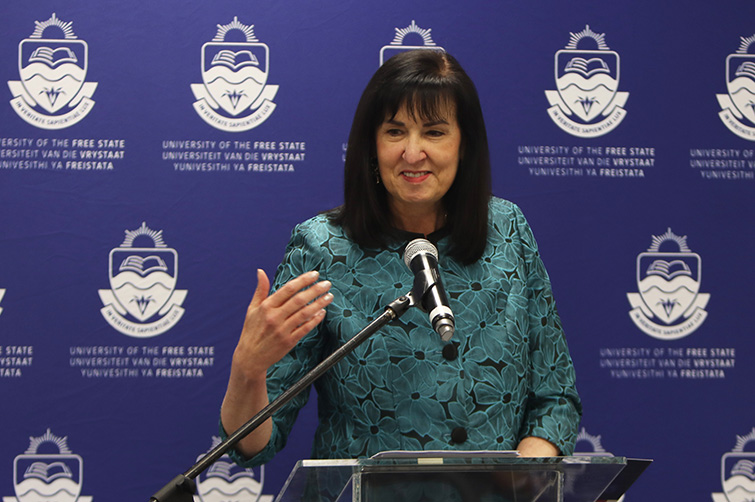 Prof Hester C Klopper, UFS Vice-Chancellor and Principal, addressing the first recipients of the scholarship from the UFS and the Carl and Emily Fuchs Foundation.
The University of the Free State (UFS) Faculty of Health Sciences and the Carl and Emily Fuchs Foundation (CEFF) have launched a four-year, R4 million scholarship partnership to support postgraduate students pursuing master’s and doctoral degrees. This is a major boost for postgraduate health sciences students from the so-called missing middle category, which is often overlooked when funding opportunities arise.
Launched at the Faculty of Health Sciences on 20 October, the initiative aims to ease the financial pressures faced by postgraduate students, enabling them to focus on their studies and research while developing solutions to health-care challenges. The first 10 recipients were selected from a pool of 44 applications received, with 18 candidates shortlisted for interviews. The total grant for year 1 will amount to R1 000 000. This will ensure recipients’ financial needs are met, including, but not limited to, tuition and research expenses.
The first cohort of the scholarship, together with their supervisors, was present at the event, as well as Prof Deliwe Phetlhu, Dean of the Faculty of Health Sciences; Profs Vasu Reddy, Deputy Vice-Chancellor: Research, Innovation and Postgraduate Studies; Bulelwa Nguza-Mduba, Deputy Vice-Chancellor: People and Operations; and Ylva Rodny-Gumede, Executive Director: Advancement and Stakeholder Relations. David Marupen, Head: Fundraising and Alumni Relations at the UFS, and executive management from the Faculty of Health Sciences were also present.
Investing in researchers who can make a difference
Congratulating the recipients, Prof Hester C Klopper, UFS Vice-Chancellor and Principal, emphasised that the value of the partnership extends beyond financial assistance. It is about creating the conditions in which students can succeed and use their knowledge to benefit society. She highlighted the recipients’ determination and commitment to giving back, noting that their ambitions reflect the University's values.
Prof Klopper read some of the recipients’ personal reflections on what the bursary means to them. “Mulalo Maluta wrote about the difference this scholarship will make to a family managing considerable financial responsibilities. Mulalo spoke about being able to continue studying with greater peace of mind and, one day, giving back to family and society.
“Reitumetse Seeco shared a similar ambition: to make the most of this opportunity and eventually help create opportunities for others. This is such a beautiful character trait, if once we receive, we give back. And then there is Fatima Siddique, whose reflection stayed with me. Fatima shared how, earlier this year, uncertainty about funding threatened her ability to continue studying. She faced the possibility of having to defer her studies, but financial assistance helped her continue. She also wrote about her younger brother, who has watched her persevere through these difficulties and seen what becomes possible when someone receives support at the right time.”
Prof Klopper also referred to a 2024 study by MacGregor and Ross involving 388 health sciences students from rural communities who received financial assistance and wraparound support. The results showed a success rate of 91%: these students completed their qualifications within the prescribed time or within one additional year.
Building a pathway for future health-care researchers
Dr Riaan Els, CEO of the Carl and Emily Fuchs Foundation, outlined the foundation’s approach to grant-making and its commitment to creating opportunities for people with the ability to succeed but who need financial support to realise their potential. He indicated that the partnership could expand beyond its initial 10 recipients and outlined the foundation’s interest in exploring an undergraduate wraparound support programme in Health Sciences. He also mentioned plans for a national programme in paediatric care.
Drawing on his own experience as one of the foundation’s first bursary recipients, he recalled the vision of founder Carl Fuchs that fellow South Africans should be given an equal opportunity to succeed. “Why a postgraduate bursary programme here at the university? In his early days in business, Carl Fuchs said fellow South Africans should be given an even chance. You got what it takes, you just need one chance. I am evidence of that lucky break.”
Dr Els explained that the scholarship selection process considers academic performance, applicants’ financial circumstances – including those in the so-called missing middle – and their proposed research. The programme also includes a coaching component to help prepare students for the world of work.
Research with real-world impact
Earlier, Prof Klopper said the intention of this partnership is to help students succeed. “This is not just about the money; it’s about the additional support and how we make it possible for you to be successful. South Africa faces considerable health-care challenges, and we need researchers to address these problems in a systemic way,” she said.
She encouraged the recipients to consider how their research could translate into improved clinical practice, better health-care approaches, and impact policy. She also stressed the importance of basic research in advancing scientific knowledge. She is inspired by the research of some of the bursary recipients, like Anna Willers, who is completing her PhD in Haematology, investigating the role of extracellular vesicles in blood coagulation among patients with haemophilia; Lwazi Mashinini, who is pursuing a master’s degree in pharmacology, exploring the therapeutic potential of aptamers in prostate cancer; and Hlavutelo Ringani, whose research focuses on strengthening community-based rehabilitation within primary health care, and he hopes to contribute to the communities he will serve.
Use of all the opportunities of the scholarship
Marupen congratulated the first cohort of this partnership, saying this is much more than just the awarding of scholarships, the financial value, or the contribution; it is about recognising potential, opening doors, and affirming that financial circumstances should not be the only factor determining how far talented and committed students can go.
“For some of our beneficiaries, postgraduation studies mean balancing academic responsibility with family expectations, navigating financial uncertainty or trying to remain focused on research while worrying about the practical cost of everyday life. To our beneficiaries, I hope that you recognise the value of this opportunity – not because you feel indebted or for receiving it, but because you understand what it makes possible for your future,” said Marupen.
He encouraged the beneficiaries to make use of all the opportunities of the scholarship, including preparing them for work, mentoring opportunities, investing in their research skills, building relationships with their supervisor and fellow scholars, asking questions, exchanging ideas, and remaining open to constructive feedback.
“Wherever your career in health sciences may take you, the knowledge you gain could help improve the health outcomes in strengthened communities. The work you do today might help answer questions, improve professional practices, inform decisions or contribute to solutions for challenges affecting people’s lives.”
Woghuwah Makena, who is pursuing a PhD, and Siyabonga Mahlangu, an MMedSc student, gave brief feedback on how the scholarship will impact their studies and lives, and how they will use this opportunity to affect society and give back.