“This invitation by the University of the Free State (UFS) comes at a critical moment when we begin to roll up our sleeves in an attempt to transform the lives of our people, and in efforts to modernise our cities and towns to attain sustainable livelihoods.” This was the words of the
MEC for Public Works, Infrastructure and Human Settlements, Tshidi Koloi, on attending the first National Student Conference for Human Settlement.
“The urban population of the world has grown rapidly – from 751 million in 1950 to 8 billion in 2018. How do we plan for rapid urbanisation?” Koloi asked.
“We turn to the academic world for continuous research in various fields related to the development of human settlements. The role of the university and of this department cannot be overestimated. Clearly, we need to forge partnerships where our department can benefit from ongoing research towards the improvement of its value chain and programmes. In return, government could offer bursaries and internship opportunities for students.”
Integrate communitiesMore than 130 students from the
Nelson Mandela University, the U
University of KwaZulu-Natal, the
University of the Witwatersrand, and the UFS attended the conference to gain a better understanding of the challenges, policies, and practices of human settlements. The conference also allowed students the opportunity to not only engage with key members of government, but also with each other and delegates from the private sector.
Head of the
Department of Human Settlements,
Tim Mokhesi, said his department’s objective with housing for the future is to integrate communities; not to separate them because they are poor. If we separate communities, our next struggle will be a class struggle.
“South Africa is in a crisis in terms of human settlement. In the past years, there was an exponential growth in informal settlements – 300 to 3 000 (with 143 in the Free State); the housing budget shrank, and local authorities do not have the capacity to deal with informal settlements. Can the few of us make a sufficient and significant contribution? Seeing your commitment as students is what gives us hope for a better future for all,” Thomas Stewart, Lecturer in the
UFS Department of Urban and Regional Planning, said.
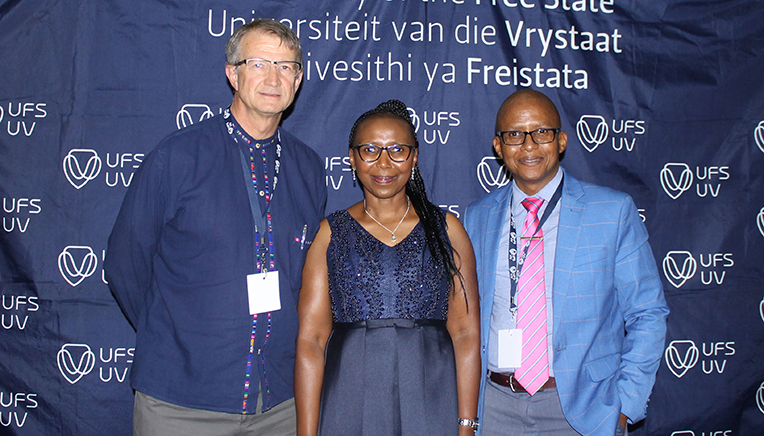 Attending the launch of the new Bachelor of Spatial Planning Honours with specialisation in Human Settlements were, from the left: Thomas
Stewart, Lecturer in the UFS Department of Urban and Re-gional Planning; Tshidi Koloi, MEC of Public Works, Infrastructure and
Human Settlements; and Pura Mgolombane (Dean of Student Affairs at the UFS). (Photo: Leonie Bolleurs)
Innovative and inclusive re-housingStudents experienced two fieldtrips, one to the Hillside View Development Project, where the focus was on mixed housing. This project is part of the
Mangaung Metro Municipality’s five-year integrated human settlements plan. According to developer
Freddie Kenney, the project needs to be a development model for South Africa to change the picture of social housing.
The second site visited was the Innovative Housing Building Project: Qala Phelang Tala, where peo-ple are trained to build their own houses. “It is a very easy process,” said
Dr Anita Venter, Lecturer in the
Centre for Development Support, who is lecturing Human Settlements Theory in the Department of Urban and Regional Planning. Since 2013, she was involved in the building of five houses.
The latest building project at the
Meraka Cultural Village in Roodewal, outside Bloemfontein, is a stu-dent-led project where they learn to develop a basic shelter suitable for survival in a future, post-natural, and climate-crisis world that will become between 2 and 4 degrees Celsius warmer within the next century. “It is important for people to build in climate-friendly ways,” Dr Venter said.
She continues: “The project seeks to also renew, restore, and revitalise communities.” Sebabatso Mofama, who now helps with training, built this house similar to the one where she comes from in the Eastern Cape. “It is where I feel at home,” she said.
The human aspect Dean of Student Affairs,Pura Mgolombane, touched on the human aspect of human settlements. “We first need to see the human in human settlements. ‘Yebo’, meaning I see you. See the human and develop quality houses.”
The event coincided with the launch of the new Bachelor of Spatial Planning Honours with specialisation in Human Settlements. The first two students graduated in April this year.
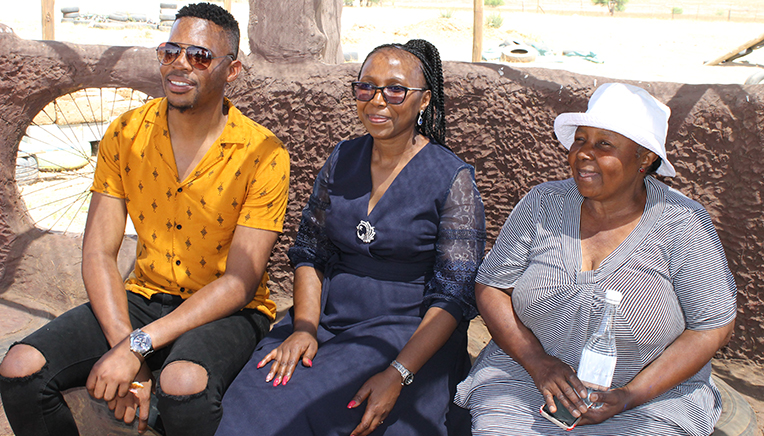 Thapelo Chacha, master’s student in Urban and Regional Planning at the UFS, MEC Tshidi Koloi, and Sebabatso Mofama, mentor in the
Innovative Housing Building Project: Qala Phelang Tala. (Photo: Leonie Bolleurs)