Latest News Archive
Please select Category, Year, and then Month to display items
20 December 2020
|
Story Thabo Kessah
|
Photo Thabo Kessah
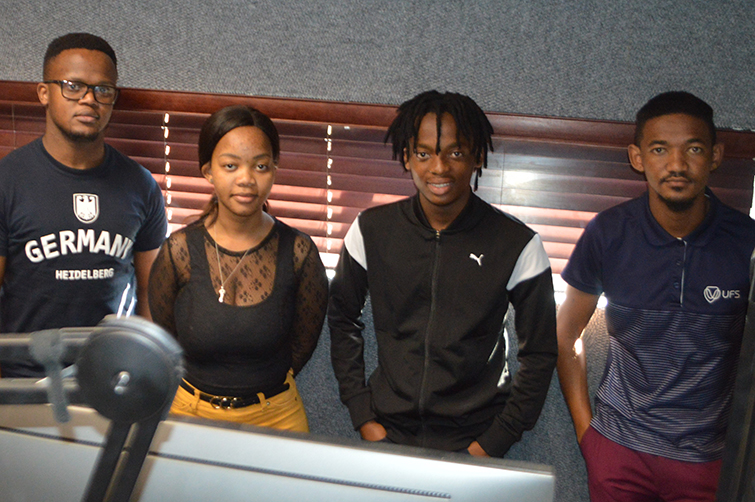 Mbuyiselwa Moloi with student volunteers, Keamogetswe Mooketsi (presenter), Tshumelo Phaladi (producer), and Siphamandla Shabangu (SRC member – Social Justice and Universal Access).
The month of October 2020 marked the first anniversary of the Qwaqwa Campus online student radio, Q-Lit. “It has been a rocky road of sleepless nights, tears, and a lot of challenges. However, we have grown from strength to strength. We have made dreams of ordinary students possible. We have influenced change and inspired students to tap into their talents and potential,” said an elated station manager, Mbuyiselwa Moloi.
The station came in handy during the worst lockdown period of the COVID-19 pandemic when it bridged the communication gap between students and the university to integrate teaching and learning into the programming to ensure that no student was left behind. “With all of the regulations and online learning, Q-Lit had to be reinvented. While it was not an easy journey, we have grown more than ever before. Our August 2020 report shows that we have pulled in more than 1 600 listeners, even amid the learning, unlearning, and relearning processes. It was during this month that we also ran a series highlighting strategic offices led by women on campus as part of our Women’s Month celebration,” Mbuyiselwa revealed.
Looking to the future, the station hopes to obtain a full broadcasting licence from the regulatory body, the Independent Communication Authority of South Africa (ICASA), soon.
Photo manipulation in journalism: evil, crutch or lifebuoy?
2017-09-04
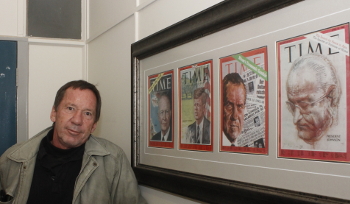
Albe Grobbelaar, veteran journalist and lecturer in the
Department of Communication Science at the UFS.
Photo: Rulanzen Martin
Since the 1800s the manipulation of photographs has been common practice, and who can forget the OJ Simpson Time magazine cover in 1994? Albe Grobbelaar, lecturer in the Department of Communication Science at the University of the Free State (UFS), asked in a special lecture on 18 August 2017 whether “Photo manipulation in Journalism” was an evil habit, a crutch or a lifebuoy.
“As a journalist I have always been interested in photography. And the principle of photo manipulation or tampering with photos, as we call it, is something that has interested me ever since,” Grobbelaar said. Photo manipulation is an area that has garnered many academic interest and is not a new trend but a practice that started in the 1830s when photos came into popular use. “It is not always done with ulterior motives, artists played with photographs to get unique effects.” Photo manipulation is not only to create fake news, but is sometimes used to convey novelty and create shock to news readers.
Different viewpoints for different circumstances
He talked about the spectrum of viewpoints on photo manipulation. Some conservative journalism schools say photos should never be retouched while other feel it is fine to tamper with pictures. “What I tried to convey in the lecture was that one should consider different circumstances differently,” Grobbelaar said. As a journalist he believes that news photos should never be manipulated.
He mentioned the example of the mugshot of OJ Simpson that the Los Angeles Police Department released to the media. “Newsweek and Time both used the photo on their front pages, but Time deliberately darkened the picture so that OJ, a black man, would appear more sinister,” Grobbelaar said. It is, however, common practice in the fashion industry to retouch images that are used in fashion magazines.
Use own judgment to validate photos
In the age of social media it has become easy to manipulate photos and which has been labelled fake news. “I would advise people to use their own judgment when validating the authenticity of photos,” Grobbelaar said. It is important to verify whether they are from a reliable news outlet.