‘Miratho’ seeks to drive policy-changing research through international collaboration
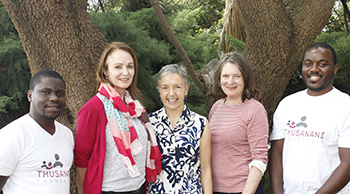
From the left: Phathu Mudau (Thusanani Foundation),
Prof Melanie Walker (UFS), Prof Ann-Marie Bathmaker
(University of Birmingham), Prof Monica McLean
(University of Nottingham), and Fulu Ratshisusu
(Thusanani Foundation).
Photo: Eugene Seegers
Miratho is a TshiVenda word that refers to informal, self-made bridges, which are usually built by rural community members during floods or other natural disasters. These are usually dangerous, unstable constructions, and only the brave tend to use them. When community members build miratho, though, they create opportunities for stranded students to attend school. Miratho symbolise the determination to access education even in the face of danger, and working with others to make progress.
The Miratho Research Project is led by the Centre for Research on Higher Education and Development (CRHED) at the University of the Free State (UFS), in partnership with the Universities of Birmingham and Nottingham in the UK, and the Thusanani Foundation. The project is jointly funded by the Economic and Social Research Council and the Department for International Development in the UK, as well as the National Research Foundation in South Africa. The project research team consists of Prof Melanie Walker, Prof Merridy Wilson-Strydom and Dr Mikateko Höppener from CRHED at the UFS, Prof Monica McLean from the University of Nottingham, and Prof Ann-Marie Bathmaker from the University of Birmingham.
Miratho is a four-year project, stretching until August 2020, which seeks to investigate multidimensional dynamics shaping or inhibiting disadvantaged students’ capabilities to access higher education, participate and succeed in it, as well as move from higher education to work. By means of a systematic, integrated and longitudinal mixed-methods investigation, Prof Walker and her team, in close collaboration with the Thusanani Foundation, aim to develop an inclusive, capabilities-based higher education Index, which in turn would serve to inform policy and practice interventions that challenge inequalities that have an impact on learning outcomes.