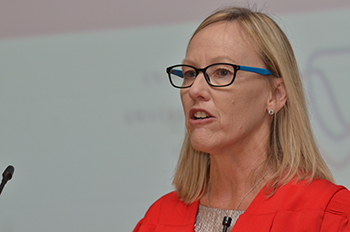
Prof Felicity Burt delivering her inaugural lecture,
Catching a Virus
Photo: Stephen Collett
“Preparing and presenting an inaugural lecture is an opportunity to look back at one’s career and to enjoy previous highlights and achievements; to share these, not only with colleagues, but also with family and friends.”
This is according to Prof Felicity Burt, who recently presented her inaugural lecture, Catching a Virus. Prof Burt is a professor in medical virology in the Faculty of Health Sciences at the University of the Free State (UFS). It may sound ominous, but it is a story about identifying viruses, and finding and stopping them in their tracks in nature.
Research focus on arbo- and zoonotic viruses
“My research focuses on arboviruses and zoonotic viruses,” said Prof Burt. “Arboviruses are viruses that are transmitted by insect vectors, such as mosquitoes, ticks, midges or sandflies, whereas zoonotic viruses are naturally transmitted from animals to humans. However, there is a considerable overlap between these two groups.” The research looks at host responses, virus discovery and surveillance in order to identify which of the viruses in circulation have the potential to cause human diseases.
“Emerging and re-emerging viruses have significant implications for public health,” said Prof Burt at the start of her lecture. She also stated that there have been disease outbreaks of unprecedented magnitude, which have spread and established in distinct geographic regions. “Many of these emerging viruses are transmitted by vectors or are spread to humans from animals. These viruses can cause significant diseases in humans,” said Prof Burt.
There are many reasons why these viruses re-emerge, such as global warming, human invasion in forested areas, changes in agricultural practices, international travel, as well as the illegal movement of animals. Prof Burt used the Zika virus as an example of a recent emerging virus.
More than 20 years’ experience
With more than 20 years’ experience and a PhD in medical virology from the University of the Witwatersrand, Prof Burt is a renowned specialist. She has worked in the Special Pathogens Unit at the National Institute for Communicable Diseases, and was a member of various teams responding to outbreaks of Ebola and Rift Valley fever in Africa and Saudi Arabia, respectively. She is co-author of more than 51 articles in international scientific journals, as well as six chapters on arboviruses. In 2016, she was awarded a SARChl research chair by the South African Research Chair Initiative for her research on vector-borne and zoonotic diseases.