Latest News Archive
Please select Category, Year, and then Month to display items
20 December 2020
|
Story Thabo Kessah
|
Photo Thabo Kessah
 Mbuyiselwa Moloi with student volunteers, Keamogetswe Mooketsi (presenter), Tshumelo Phaladi (producer), and Siphamandla Shabangu (SRC member – Social Justice and Universal Access).
The month of October 2020 marked the first anniversary of the Qwaqwa Campus online student radio, Q-Lit. “It has been a rocky road of sleepless nights, tears, and a lot of challenges. However, we have grown from strength to strength. We have made dreams of ordinary students possible. We have influenced change and inspired students to tap into their talents and potential,” said an elated station manager, Mbuyiselwa Moloi.
The station came in handy during the worst lockdown period of the COVID-19 pandemic when it bridged the communication gap between students and the university to integrate teaching and learning into the programming to ensure that no student was left behind. “With all of the regulations and online learning, Q-Lit had to be reinvented. While it was not an easy journey, we have grown more than ever before. Our August 2020 report shows that we have pulled in more than 1 600 listeners, even amid the learning, unlearning, and relearning processes. It was during this month that we also ran a series highlighting strategic offices led by women on campus as part of our Women’s Month celebration,” Mbuyiselwa revealed.
Looking to the future, the station hopes to obtain a full broadcasting licence from the regulatory body, the Independent Communication Authority of South Africa (ICASA), soon.
Using sugar to make the world a sweeter place
2017-10-13
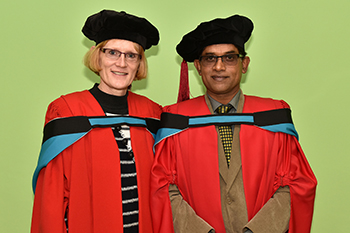
Dr Deepack Santchurn, former PhD student in the
Department of Plant Sciences at the UFS,
and plant breeder in the Mauritius Sugar Industry
Research Institute, with Prof Maryke Labuschagne, left,
Dr Santchurn’s study leader.
Photo: Charl Devenish
Besides it mainly being used for sugar production, sugarcane has emerged as an important alternative for providing clean renewable energy. Dr Deepack Santchurn, who works in the sugarcane breeding department of the Mauritius Sugar Industry Research Institute (MSIRI), believes if he could contribute towards a more environment-friendly and renewable energy through the use of sugarcane biomass, he would consider himself having made a great leap towards a better world.
Sugarcane is mostly known and exploited for the sugar in its cane stem. According to Dr Santchurn it is not the only thing the crop does well. “Together with certain grasses, it is the finest living collector of sunlight energy and a producer of biomass in unit time. Sugarcane is now recognised worldwide as a potential renewable and environment-friendly bioenergy crop.”
Significantly more bioenergy can be produced from sugarcane if the production system is not focused on the production and recovery of sucrose alone but on the maximum use to the total above-ground biomass. Diversification within the sugarcane industry is of paramount importance.
He has been able to identify a few high biomass varieties that can be exploited industrially. One of the varieties is a commercial type with relatively high sugar and low fibre in the cane stem. Dr Santchurn explains: “Its sucrose content is about 0.5% less than the most cultivated commercial variety in Mauritius. Nevertheless, its sugar yield and above-ground biomass yield surpass those of the commercial varieties by more than 24%. The genetic gains compared to commercial varieties were around +50% for total biomass yield and +100% for fibre yield. Its cultivation is strictly related to bio-energy production and the extracted juice can be used as a feed-stock for ethanol and other high-value products.”
Dr Santchurn received his PhD at the UFS’s Department of Plant Sciences during the Winter Graduation Ceremonies in June this year. His study leader was Prof Maryke Labuschagne from the Department of Plant Sciences.