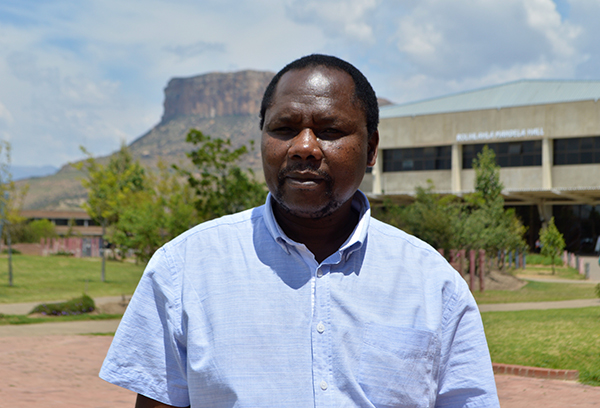
Prof Geofrey Mukwada
The Afromontane Research Unit (ARU) has recently made inroads in climate-change research. This has been achieved through work published by Professor Geofrey Mukwada and Professor Desmond Manatsa, whose research could make it possible to predict El Nino Southern Oscillation (ENSO) several months before its occurrence.
Professor Manatsa is an ARU postdoctoral fellow currently collaborating with Professor Mukwada on an ongoing climate-change research project. The two experts noted that ENSO is one of the most important climate phenomena on earth, due to its ability to change the global atmospheric circulation, which in turn, influences temperature and precipitation across the world.
Climate change scientific breakthrough
“This is a tremendous breakthrough, because humanity as a whole has been looking for answers regarding the origins of climate-related hazards which are worsening, yet becoming more frequent and difficult to predict. In some cases, floods and droughts occur in the same season, and within the same geographical area. These extreme climate events are becoming more frequent, often leading to loss of life and threatening national economies and livelihoods,” said Professor Mukwada, coordinator of the ARU sub-theme on Living and Doing Business In Afromontane Environments.
During an interview with the Southern Times, Professor Manatsa revealed that the El Nino Southern Oscillation (ENSO) is initiated and sustained in the tropical Pacific, a fact that has eluded climate scientists for years. “It was an unresolved puzzle which limited the successful prediction of ENSO events with reasonable lead time. Climate scientists were only able to know with some degree of certainty that the event would occur once it had started, just a few months before its impacts were felt,” Professor Manatsa said.
Prof Manatsa is upbeat that a lot of headway has now been made towards unravelling the mystery of ENSO’s origin. “The necessity of the inclusion of the solar energy changes due to ozone alterations in the upper atmosphere should significantly impact on the realistic version of ENSO in climate models. This in turn should not only provide more accurate ENSO forecasts for the region, but a longer lead time for users to prepare for the event,” he said.
ENSO is a climate phenomenon based in the tropical Pacific Ocean. Its events bring good rains and even floods over most parts of the world in some years and droughts in others, depending on whether the phenomenon is in a warm or cold phase. The warm phase is referred to as El Nino, when the waters over the tropical east Pacific are heated up, but when cooled, it is termed La Nina. La Nina was responsible for the favourable rains over much of Southern Africa, including Zimbabwe, during the 2016/17 rainfall season. The El Nino occurrence a year before had devastating drought effects that was characterised by scorching heat and widespread water shortages. This work was published in a high-profile journal, Nature Scientific Reports.
ARU is a flagship inter- and trans-disciplinary research programme focusing on the under-researched area of montane communities. It was launched in June 2015 and is based on the Qwaqwa Campus.