Latest News Archive
Please select Category, Year, and then Month to display items
20 December 2020
|
Story Thabo Kessah
|
Photo Thabo Kessah
 Mbuyiselwa Moloi with student volunteers, Keamogetswe Mooketsi (presenter), Tshumelo Phaladi (producer), and Siphamandla Shabangu (SRC member – Social Justice and Universal Access).
The month of October 2020 marked the first anniversary of the Qwaqwa Campus online student radio, Q-Lit. “It has been a rocky road of sleepless nights, tears, and a lot of challenges. However, we have grown from strength to strength. We have made dreams of ordinary students possible. We have influenced change and inspired students to tap into their talents and potential,” said an elated station manager, Mbuyiselwa Moloi.
The station came in handy during the worst lockdown period of the COVID-19 pandemic when it bridged the communication gap between students and the university to integrate teaching and learning into the programming to ensure that no student was left behind. “With all of the regulations and online learning, Q-Lit had to be reinvented. While it was not an easy journey, we have grown more than ever before. Our August 2020 report shows that we have pulled in more than 1 600 listeners, even amid the learning, unlearning, and relearning processes. It was during this month that we also ran a series highlighting strategic offices led by women on campus as part of our Women’s Month celebration,” Mbuyiselwa revealed.
Looking to the future, the station hopes to obtain a full broadcasting licence from the regulatory body, the Independent Communication Authority of South Africa (ICASA), soon.
Haemophilia home infusion workshop
2017-12-17
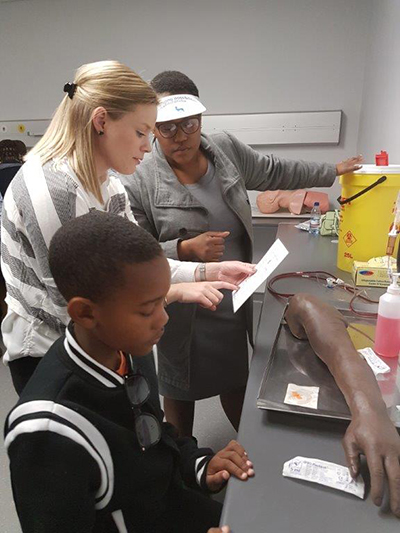
Parents receive training for homecare of their children with haemophilia.
Photo Supplied
Caregivers for haemophilia patients, and patients themselves from around the Free State and Northern Cape attended a home infusion workshop held by the Clinical Skills unit in the Faculty of Health Sciences in July 2017. “It felt liberating and I feel confident to give the factor to my son correctly,” said Amanda Chaba-Okeke, the mother of a young patient, at the workshop. Her son, also at the workshop, agreed. “It felt lovely and good to learn how to administer factor VIII.”
Clinical skills to empower parents and communities
There were two concurrent sessions: one attended by doctors from the Haemophilia Treatment Centre, and the other attended by community members including factor VIII and XI recipients, caregivers and parents. The doctors’ meeting was shown informative videos and demonstrations on how to administer the newly devised factor VII and XI kit, and discussed the pressing need for trained nurses at local clinics. Dr Jaco Joubert, a haematologist, made an educational presentation to the community members.
The South African Haemophilia Foundation was represented by Mahlomola Sewolane, who gave a brief talk about the role of the organisation in relation to the condition. Meanwhile, procedural training in the simulation laboratory involved doctors and nurses helping participants to learn the procedures by using mannequins and even some volunteers from among the patients.
A medical condition causing serious complications
Haemophilia is a medical condition in which the ability of the blood to clot is severely impaired, even from a slight injury. The condition is typically caused by a hereditary lack of a coagulation factor, most often factor VIII. Usually patients must go through replacement therapy in which concentrates of clotting factor VIII (for haemophilia A) or clotting factor IX (for haemophilia B) are slowly dripped or injected into the vein, to help replace the clotting factor that is missing or low. Patients have to receive this treatment in hospital.