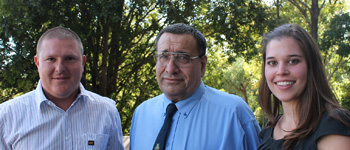
Forensic science is about the truth. At the presentation delivered by Dr David Klatzow, were, from the left: Tinus Viljoen, lecturer in Forensic Genetics, Dr Klatzow and Laura Heathfield, also a lecturer in Forensic Genetics.
Photo: Leonie Bolleurs |
It is necessary for more research to be done in the field of forensic science in South Africa. This is according to Dr David Klatzow, well-known forensic scientist, during a lecture delivered at the University of the Free State (UFS) last week.
The university is offering, for the first time this year, a BSc degree in Forensic Science in the Department of Genetics. This three-year degree is, among others, directed at people working for the South African Police Service on crime scenes and on criminal cases in forensic laboratories. Students can also study up to PhD level, specialising in various forensic fields.
There is no accredited forensic laboratory in South Africa. “It is time to look differently at forensic science, and to deliver research papers on the subject. In light of the manner in which science is applied, we have to look differently at everything,” Dr Klatzow said.
Dr Klatzow praised the university for its chemistry-based course. “Chemistry is a strong basis for forensic science,” he said.
A paradigm shift in terms of forensic science is needed. Micro scratches on bullets, fingerprints, DNA, bite marks – all of these are forensic evidence that in the past led to people being wrongfully hanged. This evidence is not necessarily the alpha and omega of forensic science today. DNA, which seems to be the golden rule, can produce problems in itself. Because a person leaves DNA in his fingerprint, it is possible that DNA is transferred from one crime scene to another by forensic experts dusting for fingerprints. According to Dr Klatzow, this is only one of the problems that could be experienced with DNA evidence.
“No single set of forensic evidence is 100% effective or without problems. Rather approach the crime scene through a combination of evidence, by collecting fingerprints, DNA, etc. It is also very important to look at the context in which the events happened.
“A person sees what he expects to see. This causes huge problems in terms of forensic science. For example, if a criminal fits the profile of the perpetrator, it doesn’t follow that this specific criminal is the culprit. It isn’t what we don’t know that gives us trouble, it’s what we know that isn’t so,” Dr Klatzow said.