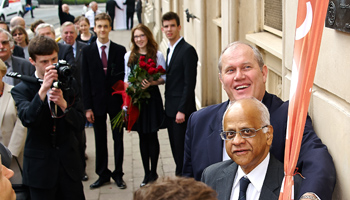
Prof André Roodt from the Department of Chemistry at the University of the Free State (UFS), co-unveiled a special plaque in Poznan, Poland, as president of the European Crystallographic Association, with prof Gautam Desiraju, president of the IUCr (front right) and others to commemorate the Nobel prize winner Max von Laue. (Photo's: Milosz Ruszkowski, Grzegorz Dutkiewicz) |
Prof André Roodt from the Department of Chemistry at the University of the Free State (UFS), co-unveiled a special plaque in Poznan, Poland, as president of the European Crystallographic Association, to commemorate the Nobel prize winner Max von Laue at a special Laue Symposium organised by prof Mariusz Jaskolski from the A. Mickiewicz University in Poznan.
Max von Laue, who spent his early childhood in Poznan, was the first scientist to diffract X-rays with a crystal.
2014 has been declared by the United Nations as the International Year of Crystallography, and it was recently officially opened at the UNESCO headquarters in Paris, France, by the Secretary-General of the UN, Ban Ki-moon. The International Year of Crystallography celebrates the centennial of the work of Max von Laue and the father and son, William Henry and William Laurence Bragg.
As part of the celebrations, Prof Roodt, president of the European Crystallographic Association, one of the three regional affiliates (Americas, Europe and Africa; Asia and Australasia) of the International Union of Crystallography (IUCr), was invited by the president of the IUCr, Prof Gautam Desiraju, to host one of the three world summits, wherein crystallography is to showcase its achievements and strategise for the future.
The summit and conference will take place on the Bloemfontein Campus of the UFS from 12 to 17 October 2014 and is titled: 'Crystallography as vehicle to promote science in Africa and beyond.' It is an ambitious meeting wherein it is anticipated to bring the French-, English- and Arab-speaking nations of Africa together to strategise how science can be expanded, and to offer possibilities for this as nestled in crystallography. Young and established scientists, and politicians associated with science and science management, are the target audience to be brought together in Bloemfontein.
Dr Thomas Auf der Heyde, acting Director General of the South African Department of Science and Technology (DST), has committed some R500 000 for this effort, while the International Union of Crystallography provided R170 000.
“Crystals and crystallography form an integrated part of our daily lives, form bones and teeth, to medicines and viruses, new catalysts, jewellery, colour pigments, chocolates, electronics, batteries, metal blades in airplane turbines, panels for solar energy and many more. In spite of this, unfortunately, not many people know much about X-ray crystallography, although it is probably one of the greatest innovations of the twentieth century. Determining the structure of the DNA was one of the most significant scientific events of the 20th century. It has helped understand how genetic messages are being passed on between cells inside our body – everything from the way instructions are sent to proteins to fight infections, to how life is reproduced.
“At the UFS, crystallography finds application in Chemistry, Physics, Biology, Mathematics, Geology, Engineering and the Medical fields. Crystallography is used by the Curiosity Rover, analysing the substances and minerals on Mars!
“The UFS’s Departments of Chemistry and Physics, in particular, have advanced instruments and important research thrusts wherein X-ray crystallography has formed a central part for more than 40 years.
“Crystallography has produced some 28 Nobel prize winners over the past 100 years and continues to provide the means for fundamental and applied research,” said Prof Roodt.