Biological expeditions to the unexplored central highlands of Angola between 2016 and 2019 led to the discovery of a new tiny, white-thumbed bat species from Eswatini by
Prof Peter John Taylor from the UFS Department of Zoology and Entomology and the Afromontane Research Unit (ARU), together with colleagues from the
University of Eswatini (UNESWA) and other collaborators.
The bat species, named Neoromicia hlandzeni or the Lowveld serotine bat – after the Lowveld of Eswatini (eHlandzeni) – is the first new animal species to be discovered in Eswatini and given a siSwati name. The Lowveld serotine bat is tiny at four grams, has a distinctive white thumb pad, and occurs in Eswatini, South Africa, Zimbabwe, and Mozambique.
Bats make up a quarter of all mammalian biodiversity. With modern technology and the exploration of previously inaccessible regions of Africa, the rate of discovery of both animal and plant species is accelerating.
According to Prof Taylor, the Lowveld serotine bat is a new species to science. The specimen from which the species was named was collected in the lowlands of Eswatini in 2005. “Later collections of bats from the highlands of Angola, undertaken by myself and students, revealed the fact that the highland and lowland forms were actually different species. Since there was already a name for the highland bat, we needed to find a new name for the lowland bat from Eswatini and South Africa, hence it is called the Lowveld serotine bat,” he said.
The importance of integrative taxonomy, local collaboration, and biodiversity surveys
Prof Taylor is a research fellow of the
National Geographic Okavango Wilderness Project, and the bat discovery took place during expeditions under the patronage of the Angolan government, the
Wild Bird Trust, and the National Geographic Okavango Wilderness Project. He said the aim of the expedition was to explore the plants and animals of a wilderness area (the source of the Okavango) that had not been explored before.
The discovery also led to their paper being published in the scientific journal, the Zoological Journal of the Linnean Society, this month.
The publication, titled Integrative taxonomic analysis of new collections from the central Angolan highlands resolves the taxonomy of African pipistrelloid bats on a continental scale, showcases the importance of integrative taxonomy, local collaboration, and biodiversity surveys, as the description of this exciting new species would not have been possible without comparative genetic and morphological material from new collections in the poorly sampled central highlands of Angola.
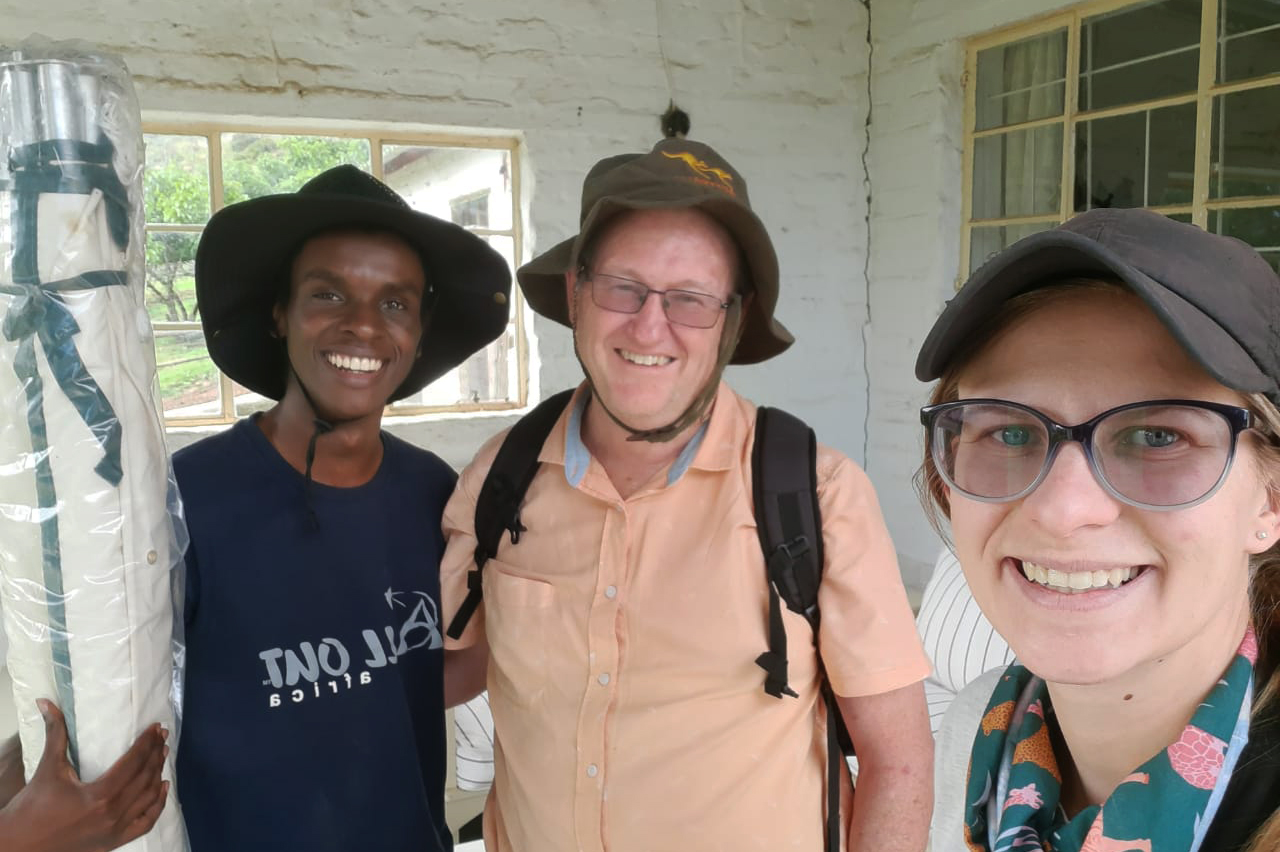
Prof Peter Taylor with his students, Veli Mdluli and Alexandra Howard, working on bat research. Howard was one of the co-authors of the paper. (Photo: Supplied)
Afromontane regions as hotspots of bat speciation, diversity, and micro-endemism
Although Prof Taylor is the first author to describe this new species, the work was done with a multidisciplinary team of colleagues, students, and collaborators from the UFS, UNESWA, the University of Pretoria, the University of Venda, and Stellenbosch University, as well as the Durban Natural Science Museum and the Ditsong National Museum of Natural History, with support from the Angolan government, the Wild Bird Trust, and the National Geographic Okavango Wilderness Project.
“Describing a new species is an arduous task that can take years from discovery to publication. All the enormous collective efforts have shown the importance of collaborative biodiversity exploration using old and modern technologies, as well as the African ownership of this discovery,” Prof Taylor said.
Three of Prof Taylor's previous and current PhD students – all of them South African women – were part of this discovery process and are co-authors of the paper. All 14 co-authors in the team are African. Prof Taylor said the discovery adds a new species to the total bat list of 125 species for Southern Africa – at number 126.