Latest News Archive

Please select Category, Year, and then Month to display items
Previous Archive
31 October 2025 | Story Martinette Brits | Photo Supplied
ASSAf
Prof Carlien Pohl-Albertyn (left) and Prof Serges Kamga from the University of the Free State have been elected to the Academy of Science of South Africa (ASSAf), recognising their excellence in research and academic leadership.

Two University of the Free State (UFS) academics have been elected to the Academy of Science of South Africa (ASSAf), joining the ranks of the nation’s most distinguished scholars. Prof Serges Kamga, Dean of the Faculty of Law, and Prof Carlien Pohl-Albertyn, NRF-SARChI Research Chair in Pathogenic Yeasts and Professor of Microbiology, were recently recognised for their outstanding contributions to research, scholarship, and the advancement of knowledge.

In addition, Dr Mutshidzi Mulondo, an academic in the Division of Public Health within the Faculty of Health Sciences who recently made history as the first academic from the UFS to be inaugurated to the prestigious Global Young Academy – a network institution of the United Nations Scientific Advisory Board – was selected to the South African Young Academy of Science (SAYAS) as one of the top young scholars recognised for engaged scholarship and scientific contribution. SAYAS provides early-career researchers with a platform to influence science, policy and innovation across South Africa and the continent.

Prof Vasu Reddy, Deputy Vice-Chancellor: Research, Innovation and Postgraduate Studies, who is also a member of the academy and a member of the ASSAf Council, says: “Membership in the Academy of Science of South Africa is a hallmark of scholarly distinction. It is to be entrusted with the stewardship of knowledge. More than this, it is an affirmation that one’s work resonates nationally and globally in advancing knowledge for societal good.”


Celebrating UFS excellence

Since its inauguration in 1996 by former President Nelson Mandela, ASSAf has championed the use of science for the benefit of society. Its mandate spans all fields of scientific enquiry, promoting scholarly excellence, evidence-based solutions to national challenges, and international collaboration. With these recent elections, 23 UFS staff members now hold membership of ASSAf, reflecting the university’s growing national and global research impact.

SAYAS, established under ASSAf, empowers young scientists to shape scientific dialogue, influence policy, and tackle pressing societal challenges. Its mission is to create a vibrant community of early-career researchers driving innovation, education, and sustainable development.

Prof Reddy also remarks: “ASSAf and SAYAS are platforms where excellence meets responsibility, purpose, and service. It is, in fact, a call to shape the scientific imagination of the nation, to mentor with purpose, and to lead with intellectual generosity. My heartfelt congratulations to our colleagues who have received recognition from the academy. You make the UFS proud.”


Prof Serges Kamga: Human rights and inclusive development

For Prof Serges Kamga, being elected to ASSAf is both an honour and a validation of his lifelong commitment to the advancement of human rights and social justice. “My election demonstrates that I am on the right track in terms of scientific knowledge and activity to remove barriers between people and obstacles to full development of their intellectual capacity,” he says.

His research focuses on the human right to development, socio-economic inclusion, and equality, particularly for vulnerable groups such as persons with disabilities. “I rely on scientific evidence to stress the need to build an equalitarian world, a world without barriers to the full development of human potential,” he explains. Personal experience in witnessing poverty and underdevelopment across Africa inspired him to ask: “If development is a human right inherent to all, why are we poor in Africa? Who pulls the strings of poverty nationally and globally, and why?”

Prof Kamga intends to use his ASSAf membership to strengthen interdisciplinary collaboration and foster responsible societal futures. “My engagement with colleagues will seek ways to break down artificial barriers between disciplines, institutions, and sectors to foster groundbreaking discoveries at the intersection of fields. Modern lawyers should bridge the gap between theory and practice to ensure relevance to their environments.” He also hopes to guide the next generation of legal scholars to combine strong theoretical foundations with practical relevance: “They should connect across disciplines, generate new knowledge, and advance innovative, sustainable solutions to society’s contemporary and future challenges.”


Prof Carlien Pohl-Albertyn: Exploring the frontiers of fungal biology

Prof Carlien Pohl-Albertyn describes her election as “a meaningful recognition of my contributions to the national research landscape”. Her research investigates bioactive lipids in pathogenic fungi, focusing on molecules such as oxylipins and prostaglandins that influence fungal virulence and host-pathogen interactions. “By exploring these pathways, I hope to uncover novel targets for antifungal therapies, especially in the context of rising antifungal resistance,” she says. Her work has already shown how polyunsaturated and marine-derived fatty acids can inhibit biofilm formation, a key virulence factor, in Candida species.

Her research also has public health significance through the South African Fryer Oil Initiative (SAFOI), which monitors the quality of frying oils nationwide. “My research on fungal lipids and edible oils is connected by a central theme: understanding how lipids influence health, whether through microbial pathogenicity or human nutrition,” she explains.

Mentorship is equally central to her work. “I foster collaboration and encourage open exchange of ideas, with shared credit and authorship as a non-negotiable principle. Students are supported to publish in reputable journals and present at both local and international conferences, and I actively connect them with global collaborators to help them see themselves as equals on the international stage. Over the years, I have had the privilege of mentoring a diverse group of students and postdocs (many of them first-generation scholars) who have gone on to lead in academia, industry, and government. Our current group reflects a rich diversity of cultures, languages, and identities, and I am committed to continuing the tradition of care and excellence that was instilled in me by my own mentors.”

Prof Pohl-Albertyn is optimistic about future discoveries in her field. “Advances in lipidomics and systems biology are allowing us to study bioactive lipids with increasing precision. Understanding how fungi adapt their lipid pathways in response to environmental pressures, such as climate change or antimicrobial exposure, could reveal new strategies to combat fungal infections and predict emerging pathogens.” She also hopes to use her ASSAf platform to advocate for greater awareness and investment in fungal disease research and to promote equitable access to research funding for African scientists.


Dr Mutshidzi Mulondo: Public mental health in a digital age

Dr Mutshidzi Mulondo’s research focuses on mental health, particularly the implementation of digital strategies for public mental health. Mental health, a silent pandemic of our generation, continues to receive limited attention. “My current research looks at digital public mental health strategies, allowing for holistic care and support, particularly in lower- and middle-income countries.” This research is an effort to advance public health strategies that prioritise mental health and health equity.

Dr Mulondo sees the academy as a platform to influence national scientific dialogue and shape policy through emerging efforts such as science diplomacy. “This opportunity allows me to impact policies, specifically in public health, for the betterment of people’s lives. Young scientists need more opportunities to interact with established scientists for intergenerational collaboration. This platform provides young scientists with mentorship as future national and global leaders. Furthermore, the platform provides young scientists with access to other leading scholars for interdisciplinary collaboration to address some of the wicked challenges of our generation.” 

Through SAYAS, Dr Mulondo hopes to contribute to programmes that support the growth of young scientists, increase public understanding of science, and foster sustainable development. “I look forward to participating in these efforts to better place our nation and continent.”


A growing legacy of scholarship

The election of Prof Kamga, Prof Pohl-Albertyn, and Dr Mulondo underscores the UFS’ commitment to nurturing excellence across disciplines – from law and the humanities to microbiology and public health. Through the work of ASSAf and SAYAS members, the UFS continues to shape the scientific and academic landscape of South Africa, supporting a vibrant, inclusive, and forward-looking research community. Prof Reddy also emphasises that “recognition by a national academy is a powerful endorsement of one’s scholarly journey. It signals that your voice matters in shaping the intellectual, innovation, and developmental landscape as we aspire to create responsible societal futures”.

News Archive

Graduates convene with global leaders at the UFS 2015 Winter Graduation ceremonies
2015-07-07

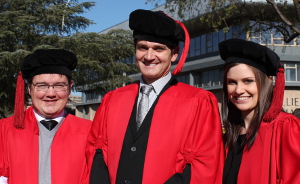
Dr Hendrik Auret, dr Gerhard Bosman en dr Madelein Stoffberg.
Foto: Leonie Bolleurs

Photo Gallery 

The University of the Free State’s 2015 Winter Graduations, which took place from 1-2 July 2015 on the Bloemfontein Campus offered several highlights. Three global leaders received honorary doctorates. A further 2 000 degrees and diplomas were conferred to graduates in the seven faculties of the university.

For the first time in the history of the UFS, three PhDs in Architecture were awarded simultaneously. Hendrik Auret, Gerhard Bosman, and Madelein Stoffberg’s outstanding achievements are a milestone in the university’s pursuit of academic excellence.

Furthermore, three PhDs were conferred on graduates from the Department of Consumer Science in the Faculty of Natural and Agricultural Sciences. Ismari van der Merwe, Natasha Cronje, and Gloria Seiphetlheng set a precedent when they walked across the Callie Human stage to collect their doctorates at the same graduation ceremony.

This year, the university produced 66 Doctors of Philosophy in various fields of study. Six of these PhDs were awarded in the Department of Physics. Three graduates in the Department of Soil- and Crop- and Climate Sciences received PhDs at the Winter Graduation. They are Tesha Mardamootoo, Elmarie Kotzé, and David Chemei.
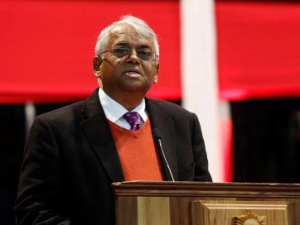
Dr John Samuel.
Photo: Johan Roux

Keynote speakers provide enlightenment to graduates

On Wednesday 1 July 2015, Dr John Samuel, SA’s leading education expert, addressed 707 diploma graduates from the Centre for Financial Planning Law and the School of Open Learning. For the graduates’ future reference, Samuel offered invaluable knowledge he had accumulated over the years as Chief Executive of the Nelson Mandela Foundation. “One of the lessons I have learnt was not only the importance of time, but it was in fact what being on time demonstrated,” he said. “Being on time was demonstrating respect, respect for the people you are meeting, and for the occasion.”

On the second day of graduation, Nataniël, South African singer, songwriter, and entertainer spoke to Master’s and doctoral graduates in the Faculties of Economic and Management Sciences, Humanities, Education, Health Sciences, Law, Theology, and Natural and Agricultural Sciences. His keynote spoke to the graduates’ sense of resolve in saying, “nothing is ever accidental. It is always with a purpose, it is your turn to make the world a better place.” He added that “it is important to strive for excellence and to be proud of what you are doing.”

Honorary doctorate recipients in a nutshell

Dr Samuel is one of the three exceptional global leaders to receive honorary doctorates from the university on 1 July 2015. His accolade was presented by the Faculty of Education. He has contributed to the Public Participation Education Network (PPEN) campaign as a founding member. He established the Centre for Education Policy Development, the Joint Working Group (for The National Party Government and the ANC), the National Education Conference, and the National Education and Training Forum. In addition, he made leadership contributions to the First Education and Training White Paper, the first Green Paper on Higher Education, and is the CEO of the Oprah Winfrey Leadership Academy for Girls. The WK Kellogg Foundation in the USA operates under his directorship.
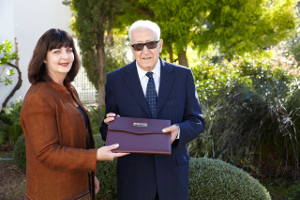
Professor Heidi Hudson, Director of the Centre for Africa Studies at the UFS and Dr Lakhdar Brahimi.
Photo: Mike Rose from Mike Rose Photography

Dr Lakhdar Brahimi received an honorary doctorate from the Centre for Africa Studies. Algerian-born Brahimi was first involved with the United Nations (UN) in 1992, and has since been deployed all over the world on peacekeeping missions. Amongst many other countries, he has worked as a mediator for South Africa, Haiti, Afghanistan, Iraq, Syria, Democratic Republic of Congo, Cameroon, Burundi, Angola, Liberia, Nigeria, Sudan, and Côte d’Ivoire on behalf of the UN. He also played a direct role in South Africa’s democratic transition as a special representative in 1993/4.

Dr Mercy Amba Oduyoye received an honorary doctorate from the Faculty of Theology. Dr Oduyoye is widely regarded as one of the most influential women theologians in Africa. She was the first black woman to receive a degree in Theology in 1965 from Cambridge University in the United Kingdom. She continues to shift the paradigm of gender in theology internationally as the director of the Institute of African Women in Religion and Culture at the Trinity Theology Seminary in Ghana.
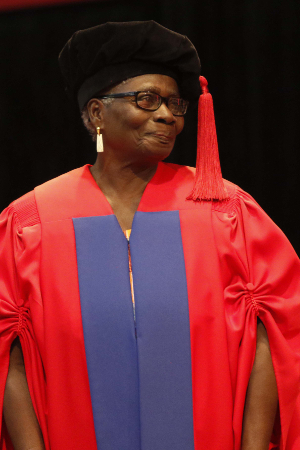
Dr Mercy Oduyoye.
Photo: Johan Roux

In closing the academic celebrations

Vice Rector: Academic, Dr Lis Lange, commended the class of 2014 for making their contribution to the educational system. Prof Jonathan Jansen, Vice Chancellor and Rector, also congratulated the graduates in closing.

“This is a day many have worked very hard towards, it is an enormous achievement as well as a development in the quality of research, and the courage to research,” he said in a vote of confidence.

Dr Khotso Mokhele, Chancellor of the UFS, applauded the university in light of the increased number of female graduates who completed their degrees with distinctions. The transcendence of demographics, both in terms of gender and race, on a postgraduate level, increases the hope of achieving gender equality in both the academic arena and South Africa.

More graduation news

A number of distinctions were also awarded during the two-day ceremony. For a list of these distinctions, follow this link.

We use cookies to make interactions with our websites and services easy and meaningful. To better understand how they are used, read more about the UFS cookie policy. By continuing to use this site you are giving us your consent to do this.

Accept