15 December 2025
|
Story Precious Shamase
|
Photo Kaleidoscope Studios
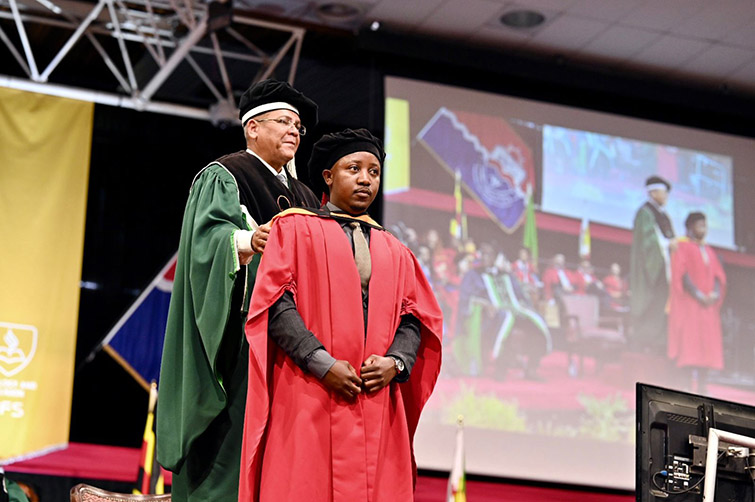 Dr Busane’s PhD, titled Managing isiZulu and Sesotho as Languages of Academy at the University of the Free State: A Language Management Approach, confronts the persistent inequities faced by African languages in academic spaces.
The University of the Free State (UFS) Qwaqwa Campus proudly celebrates the graduation of Dr Mthobisi Busane, Lecturer in the Department of African Languages, whose doctoral journey marks a historic first for his family and a significant contribution to the advancement of indigenous languages in higher education.
A journey rooted in legacy and aspiration
Dr Busane’s achievement carries profound personal meaning. He is the first in his family - not only among his siblings and cousins, but across generations - to obtain a postgraduate qualification. Coming from a background where most relatives, including his parents and their siblings, did not reach matric, his graduation represents a powerful story of progression and possibility.
He attributes the earliest spark of ambition to his grandfather, whom he fondly describes as an “organic intellectual” – a thinker who, despite not having formal schooling, ignited in him a deep respect for knowledge. This foundation inspired a path that has now reshaped the academic horizons of his family: his siblings and cousins are currently pursuing undergraduate studies, following a trail he has opened through determination and resilience.
Research that strengthens multilingualism
Dr Busane’s PhD, titled Managing isiZulu and Sesotho as Languages of Academy at the University of the Free State: A Language Management Approach, confronts the persistent inequities faced by African languages in academic spaces. His research responds to a critical gap – although the UFS embraces a multilingual language policy, African languages are not yet afforded full academic parity with English.
His work proposes practical, implementable strategies to strengthen isiZulu and Sesotho across academic platforms, fields of study, and institutional processes.
“The current issue at hand,” he notes, “is that previously marginalised languages such as isiZulu, Sesotho, and isiXhosa must be intellectualised to meet the requirements of languages used in education, the economy, and government.”
By highlighting structural barriers, including the dominance of English and the resulting devaluation of mother tongues, his study contributes meaningfully to the national effort to elevate indigenous languages to full academic and professional status.
Navigating the demands of a Doctorate
Supervised by Dr Hloniphani Ndebele and co-supervised by Prof Nogwaja Zulu, Dr Busane describes his defining breakthrough as the moment his supervisor encouraged him to begin editing after submitting his analysis chapter – clear evidence that he had conquered the most demanding stage of the research.
He credits foundational scholarship, such as Prof Nobuhle Hlongwa’s Ukuhlelwa Kolimi and Dr Ndebele’s work on language planning, for shaping his thinking. His journey also involved navigating financial pressures, heavy academic workloads, and many sleepless nights.
Reflecting on this experience, he shares advice for emerging scholars:
- Choose a supervisor who matches your energy.
- Work steadily – “two pages per day is enough.”
- Maintain balance by taking breaks and spending time with friends. “Studying is challenging,” he adds, “but if you look at it as a dream and a drug you should always take, it becomes easier to succeed. We are only speeding on a road, not on a journey.”
A milestone for His family, his campus, and the sector
Dr Busane’s graduation is both a personal triumph and a milestone for the Qwaqwa Campus community he serves. His story embodies the UFS commitment to enabling access, fostering success, and shaping knowledge that strengthens South Africa’s future.
Prof Jared McDonald, Assistant Dean of the Faculty of the Humanities, congratulates him on this outstanding achievement and looks forward to his continued role in advancing the development and management of African languages in higher education.