03 March 2026
|
Story Andre Damons
|
Photo Andre Damons
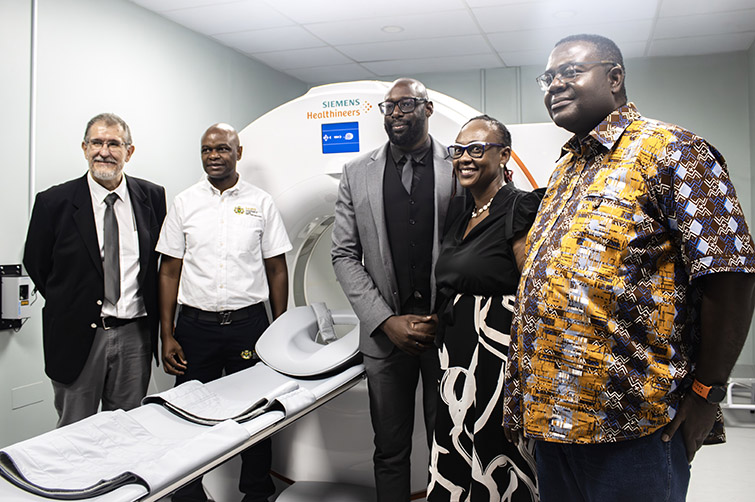 From left, Dr Gerrit Engelbrecht, Clinical Head: Nuclear Medicine; Ernest Mohlahlo, HOD: Free State Department of Health; Prof Osayande Evduamwan, nuclear medicine specialist at UFS and Universitas Academic Hospital; Prof Deliwe Rene Phetlhu, Dean of the UFS Faculty of Health Sciences, and Mr Kwame Kwakwa, Deputy Director: Finance at Universitas Academic Hospital.
The installation of a new digital Positron Emission Tomography-Computed Tomography (PET/CT) scanner at National Hospital marks a major leap forward for public healthcare in the Free State, enabling faster diagnoses, improved cancer management, and advanced specialist training.
Number of patients already imaged
Installed in August last year, the state-of-the-art scanner has already been used to image more than 300 patients – a clear indication of the urgent demand for advanced diagnostic imaging in the province and beyond. The system is one of only three fully digital PET/CT machines currently operational in South Africa.
According to Dr Gerrit Engelbrecht, Clinical Head of Nuclear Medicine at the UFS, the new digital platform dramatically improves both speed and precision. “With this fully digital machine, we can scan significantly more patients in a much shorter time. For referring doctors, it means streamlined diagnostic workups and quicker clinical decision-making. Ultimately, our goal is to improve patient outcomes and extend life expectancy, which is the Holy Grail.”
PET/CT technology combines metabolic and anatomical imaging, allowing clinicians to detect disease at a much earlier stage and with greater accuracy than conventional imaging methods. This has particular impact in oncology, where early and precise staging determines treatment direction.
Benefits of the machine
Prof Osayande Evbuomwan, nuclear medicine specialist at UFS and Universitas Academic Hospital, described the installation as a transformative milestone for the region’s healthcare landscape.
“This machine enhances our ability to detect disease and provide clarity to referral doctors,” he explained. “In oncology alone, PET/CT findings can change patient management in nearly 30% of cases. It helps oncologists decide whether surgery, chemotherapy, radiation therapy, or a combination is the most appropriate intervention.”
They are already seeing the benefits of the having such a machine which will encourage cutting-edge research, says Prof Evbuomwan. Beyond cancer care, the technology also supports improved diagnosis for certain neurological, cardiovascular and infective/inflammatory conditions .
Importantly, the scanner also unlocks new academic and training opportunities. For the first time, the department can train nuclear medicine registrars and radiographers locally.
Serving the people
According to Mr Mohlahlo, this is an investment that the Free State can be proud of. “The greatest winners of this investment are our patients. But at the same time, it is also going to create a conducive environment for our registrars to learn.” he said.
According to him, the hospital also sees patients from the Northern Cape and Lesotho and this machine will contribute to improving health care in southern South Africa.
Prof Phetlhu emphasised that the acquisition aligns with the university’s Strategic Plan 2023-2028, particularly its commitment to impactful, collaborative research that addresses societal challenges and leverages digital innovation.
“This equipment creates space for cutting-edge research with tangible community impact,” she said. “It is an exciting time – not only because we can now train registrars, but because we can advance research that directly benefits our communities. Our partnership with the provincial Department of Health is about serving people. Patients are now receiving state-of-the-art care with world-class technology.”