18 May 2026
|
Story Siqhamo Hlubi Jama
|
Photo Siqhamo Hlubi Jama
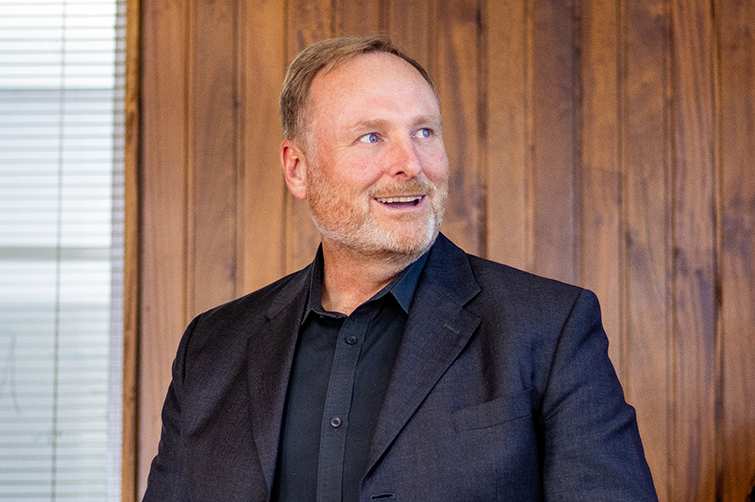 Dr John Endres, Chief Executive of the South African Institute of Race Relations, presenting the IRR Blueprint for Growth at the Africa Dialogue Series hosted by the University of the Free State.
South Africa faces a baffling economic paradox. The country desperately needs financial investment to create jobs and build infrastructure, yet local businesses are currently sitting on two trillion rand in unspent cash reserves. Why is this money not moving, and what will it take to unlock it?
These critical questions shaped the recent Africa Dialogue Series, co-hosted by the University of the Free State (UFS) and the South African Institute of Race Relations (IRR). Dr John Endres, Chief Executive of the IRR, delivered a presentation titled Taking the brakes off South Africa's economy: The IRR Blueprint for Growth. The session unpacked the hard numbers behind the country's stagnant economy and offered a practical guide to turning things around.
According to Prof Hussein Solomon, convenor of the Africa Dialogue Lecture Series, creating space for robust and open engagement on such issues is precisely why the platform was established. “The Africa Dialogue Lecture Series arose from a desperate need to create a neutral public space for people to engage on pressing topical issues,” he said.
The discussion directly supported the UFS commitment to driving responsible societal futures, highlighting that true social justice begins with a functioning, inclusive economy.
Understanding the missing trillion
To understand why South Africa is struggling, you must look at a metric called Gross Fixed Capital Formation. In simple terms, this is the money spent on physical, long-term assets like factories, machinery, roads, and power stations. When this number drops, building stops. When building stops, hiring stops.
Dr Endres pointed out that successful emerging markets reinvest about 30% of their Gross Domestic Product into these physical assets. South Africa falls dangerously short.
"Gross fixed capital formation in South Africa was 14.9% in 2023," Dr Endres explained. "In 2024, it drops to 14.5%. In 2025, it drops further to 13.7%."
To reach the 30% target set by the National Development Plan, South Africa needs to spend roughly R2 trillion a year. We currently spend half that, leaving a R1 trillion annual shortfall.
The crisis of confidence
The most frustrating aspect of this shortfall is that the capital already exists within the country. Dr Endres revealed the scale of unused private sector resources.
“South African corporates are sitting on cash reserves, effectively, of 1.8 trillion rand,” he said. “They’ve got a lot of money sitting in their bank accounts that they’re not using to invest in factories.”
If local companies have the funds to cover two years of the national investment gap, why are they holding back? The answer lies in a deep crisis of confidence. Businesses are reluctant to risk long-term capital in an environment marked by policy uncertainty and failing infrastructure.
This hesitation sends a powerful signal to foreign investors. When domestic firms are unwilling to invest, international capital reads the message clearly. The market is perceived as too risky.
Prof Solomon stressed that platforms like the Africa Dialogue Series play a vital role in interrogating these challenges openly. “Inviting speakers to present their views and be challenged is not endorsement,” he said. “No one who subscribes to academic freedom and free speech would support censoring others.”
The human cost of a stalled economy
Economic metrics can easily feel disconnected from everyday life, but the real-world consequences of low investment are devastating. Without new factories and businesses, the job market shrinks.
Dr Endres brought the conversation back to the human toll, specifically focusing on the youth. He noted that youth unemployment stood at a staggering 57% in the first quarter of 2025. Furthermore, almost 45% of all South Africans between the ages of 15 and 34 are not in employment, education, or training. Millions of young people are entirely locked out of the economy. Fixing the investment gap is not just about boosting corporate profits. It is about restoring dignity and providing a future for the next generation.
Unlocking the blueprint for growth
Despite the grim statistics, Dr Endres presented an optimistic path forward. If the government can implement specific, identifiable policies to improve the business environment, the financial floodgates will open. He cited estimates suggesting that a confident market could attract up to R10 trillion in global investment.
"You want a kind of situation where local and foreign investors are falling over themselves to get into South Africa as being the most attractive market," said Dr Endres. He stressed that such an influx of capital would be utterly transformative for the nation.
The driving force behind this change will not come from the top down. It must come from the citizens. Dr Endres ended on a hopeful note regarding the power of the South African electorate.
"They are moderate people. They are sensible people. They are not crazy," he said. "And I think for the political will to emerge and to be generated requires the pressure of ordinary South Africans expressed at the ballot box and through other mechanisms."
By hosting the Africa Dialogue Series, the UFS continues to create spaces where these crucial economic realities are broken down and understood. Empowering citizens with this knowledge is the first step toward building a wealthier and more responsible society.