19 December 2025
|
Story Leonie Bolleurs
|
Photo Supplied
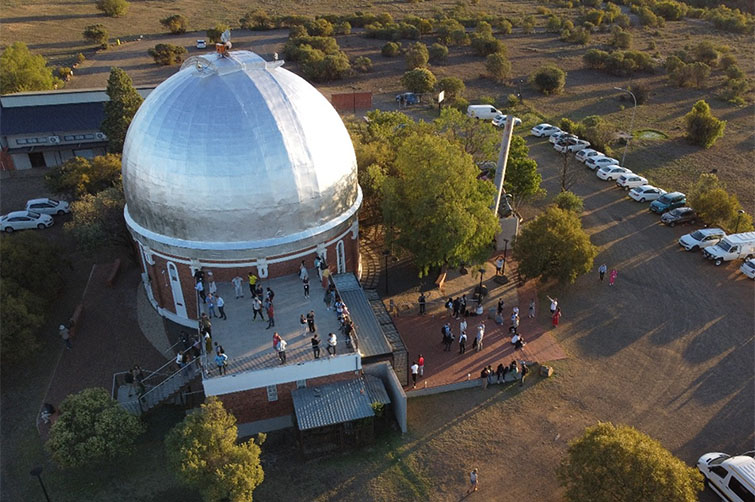 The refurbished planetarium dome has become a striking landmark on Naval Hill, visible from well beyond Bloemfontein.
Most people look up at the night sky and see a handful of stars. At the University of the Free State (UFS), those stars tell stories – stories about South Africa’s growing role in astronomy, astrophysics, and space science, our ability to compete on a global stage, and how people – from schoolchildren to community groups – are realising that these sciences are opportunities they can be part of.
Over the past year, the UFS Two Observatories Project, made up of the iconic
Naval Hill Planetarium and the historic
Boyden Observatory, has shown how investment in astronomy infrastructure, research capability, and science outreach can put central South Africa on the map as a Southern African hub for astrophysics and space science engagement. And the results speak for themselves.
According to the
Two observatories project report from 1 October 2024 to 30 September 2025, shared by the Director of the Naval Hill Planetarium,
Dr Mart-Mari Duvenhage, this project has recorded progress in many areas. The year was marked by major infrastructure upgrades, a significant increase in visitors, high-profile events, new research achievements, and the strengthening of astronomy education across age groups.
Funders from the corporate sector, civil society, and government have contributed to the Two Observatories for many years, enabling the development of the project; partnerships with organisations in the United States and in Europe continue to deepen and enrich the impact of the project. Locally, the Mangaung Metropolitan Municipality has been involved with the Naval Hill Planetarium since its establishment in 2013. Collectively, these relationships ensure the sustainability of the project and assist in unlocking new opportunities. A recent big boost came from the
Department of Science, Technology and Innovation (DSTI), which awarded a R3 million grant to upgrade the large 1,5-m research telescope at the Boyden Observatory and improve key elements of the Naval Hill Planetarium.
The university is steadily improving both facilities to keep pace with modern research demands. The university has initiated an upgrade project for the UFS-Boyden 1,5-m telescope with the goal of making it remotely controllable. Work at the Boyden Observatory also focused on improving the grounds through landscaping and paving and included the continued removal of invasive and alien plants. A new telescope for astrophotography was installed in one of the old telescope buildings by ASSA Bloemfontein member, Henk van Rooyen, adding fresh capability to the site.
The Naval Hill Planetarium received attention as well. Its exterior dome has been refurbished, giving it new visual appeal and turning it into a striking landmark once again. Inside, the planetarium now operates with an upgraded audio-visual system and has adopted the OpenSpace interactive data visualisation software, strengthening its role as a modern, accessible science communication facility.
More people, more impact
The numbers are impressive: approximately 20 200 visitors came through the doors of the two observatories, a 15,5% increase from the previous year. For many, the visit was not just entertainment – it was a first step into science.
The Naval Hill Planetarium plays a major role in education and science communication, offering shows that make scientific concepts easy to understand and exciting to explore. For many Free State primary schools, a planetarium visit is now part of the school calendar. Learners often return with their families, eager to relive the experience.
Weekly public shows, stargazing evenings at Boyden Observatory, special events, university classes, and community group visits filled a demanding calendar. A total of 307 events took place, including 222 lectures and planetarium shows. Around 18 200 visitors attended science education or communication programmes, while another 900 enjoyed music and arts events at the planetarium.
The observatories also contribute to UFS teaching and community learning. The Community Service module for science and maths education students includes practical sessions at Boyden, giving future teachers hands-on experience in bringing science to life for learners from disadvantaged schools.
Astronomy is not only about the future; it is also about preserving a rich scientific past. The Two Observatories Museum Project, led by curator
Dawid van Jaarsveldt, continued to make history accessible through careful restoration, research, and storytelling.
A major highlight this year was the new Photographic Plates Exhibit, which shares information about the extraordinary heritage of 287 541 photographic plates produced by Boyden Observatory’s telescopes between 1885 and 1986. These plates played a key role in the early days of modern astrophysics and were used by Harvard’s famous ‘women computers.’ The exhibit, displaying original instruments and examples of plates, has become a favourite stop for visitors.
A growing research powerhouse
The astrophysics research programme at the university continues to thrive, attracting students from across South Africa and abroad. Building on this growing interest, the team recorded high research outputs, presenting 19 talks at 6 conferences and publishing 8 peer-reviewed papers and conference proceedings during the report year.
Prof Pieter Meintjes from the
Department of Physics received major recognition when he was honoured with membership of the Academy of Science of South Africa (ASSAf) in October 2024. Another milestone was achieved when
Prof Matie Hoffman, also from the Department of Physics, together with collaborators from the University of Michigan and the South African Astronomical Observatory (SAAO), made what is believed to be the first academic satellite observations of a geostationary satellite from South Africa using the Lesedi Telescope at the SAAO.
The Naval Hill Planetarium attracted international attention by welcoming a delegation from the G20. This global visibility was strengthened even further when UFS planetarium presenter Leon Snyman was elected President of the African Planetarium Association in March 2025, solidifying South Africa’s leadership on the continent. Snyman was also elected to the Council of the International Planetarium Society in December 2025.
The next year will focus on completing the remote-control upgrade of the 1,5-metre UFS-Boyden telescope, expanding satellite-related observations, and growing science outreach even further. The planetarium’s seating and cove lights will be upgraded in early 2026.
Through strategic investment, committed partners, and a passion for sharing science, the University of the Free State is proving that world-class space science does not only happen in big cities – it also happens right here, under the wide skies of central South Africa.