28 December 2025
|
Story André Damons
|
Photo Kaleidoscope Studios
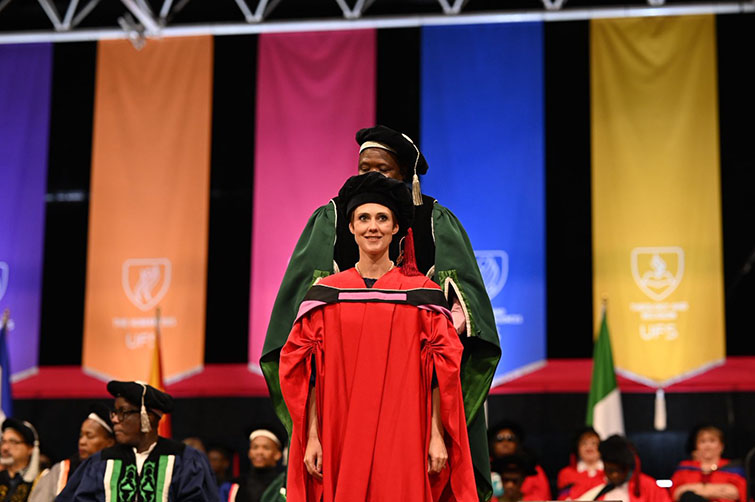 Dr Carina Haasbroek shortly after she graduated with a PhD in Dietetics from the University of the Free State.
Dr Carina Haasbroek’s own struggle with her eating habits in high school and her subsequent life-changing experience with a dietitian, not only made her realise how powerful and impactful dietetics as a profession can be, but it also led her to pursue a PhD in this field.
Dr Haasbroek graduated on Friday (12 December) during the University of the Free State’s (UFS) Faculty of Health Sciences’ December graduation ceremony. “I am incredibly proud and excited to be graduating with a PhD from the University of the Free State, a place that has been my academic home throughout my tertiary studies. The Department of Nutrition and Dietetics has truly become a second family to me, and I am deeply grateful to be part of it.
"I believe dietitians can change the world and am honoured to be part of a field with such a promising future. I firmly believe that good health begins in the womb, and as dietitians, we have a unique opportunity to positively influence the life of an unborn child. Healthy babies create healthier communities, ultimately contributing to a brighter future for South Africa. This belief inspired me to undertake this research,” she says.
Her research
Dr Haasbroek’s PhD study shed new light on the complex relationship between maternal diet, inflammation, and birth outcomes in South Africa. The research, conducted in a public health context, highlights the urgent need to rethink iron supplementation policies and strengthen nutrition support for pregnant women in low-resource settings. The study, titled Development of iron and dietary intake recommendations based on the dietary inflammatory potential of women attending the antenatal clinic at Pelonomi Regional Hospital, forms part of the larger Nutritional status of Expectant Mothers and their Newborn Infants (NuEMI) project.
Low-grade chronic inflammation, Dr Haasbroek explains, is increasingly recognised as a driver of poor pregnancy outcomes, especially in low- and middle-income countries (LMICs) undergoing rapid nutrition transitions. In these settings, traditional diets are being replaced by ultra-processed, energy-dense foods, resulting in a “triple burden” of malnutrition: undernutrition, micronutrient deficiencies, and rising rates of overweight, obesity, and diet-related non-communicable diseases.
Her promotor
About her promotor, Prof Corinna Walsh from the UFS Department of Nutrition and Dietetics, Dr Haasbroek says she has had a profound impact on her life. Prof Walsh’s guidance was always available. “Her remarkable character and unwavering support have played a major role in my personal growth and academic development. My journey has been both enlightening and humbling. I thoroughly enjoyed the research process, and learning something new every day was extremely rewarding.
“Of course, completing a PhD comes with challenges, but I was fortunate to have an excellent support system that helped me through it. Being involved in research is something I genuinely love, especially when working with my promoter, Prof Walsh, and co-promoters, Prof Louis van den Berg, Associate Professor in Department of Nutrition and Dietetics and Prof Gina Joubert (before her retirement she was from the Department of Biostatistics), who guided me with kindness and expertise.”
According to Dr Haasbroek, the study identifies several important strategies to improve maternal nutrition in South Africa. It supports prioritising multiple micronutrient supplementation, such as United Nations International Multiple Micronutrient Antenatal Preparation (UNIMMAP), instead of iron-folic acid alone, to better meet nutrient needs during pregnancy.
Hope for the research
“It also emphasises strengthening dietary guidance with affordable, culturally appropriate, anti-inflammatory food options. Community-based nutrition education, especially peer-led and low-literacy-friendly approaches, emerged as a promising way to improve maternal knowledge and practices. Additionally, the research highlights the importance of engaging community health workers and male partners to create more supportive household and antenatal environments,” she explains.
Ultimately, she continues, it highlights the importance of integrating nutrition interventions with broader social protection policies to address structural barriers to healthy eating during pregnancy. “I hope the findings will inform and improve the current maternal supplementation protocol, particularly in relation to iron status and overall maternal care. Enhancing the protocol could significantly reduce inflammation during pregnancy, resulting in improved health outcomes for both mothers and their babies.”
In congratulating Dr Haasbroek, Prof Walsh indicated that her work makes an important contribution to the understanding of maternal nutrition and inflammation, with real potential to inform policy and improve the health of pregnant women and their infants in South Africa. “It is a great privilege to congratulate Dr Carina Haasbroek on the successful completion of her PhD. Carina has shown exceptional commitment, resilience, and intellectual curiosity throughout her journey. She has been an outstanding student – dedicated, thoughtful, and always willing to go the extra mile. Watching her grow as a researcher and scholar has been deeply rewarding. I am immensely proud of her achievements and do not doubt that she will continue to make meaningful contributions to the field of dietetics,” concludes Prof Walsh.