15 December 2025
|
Story Andre Damons
|
Photo Morongwa Sefara
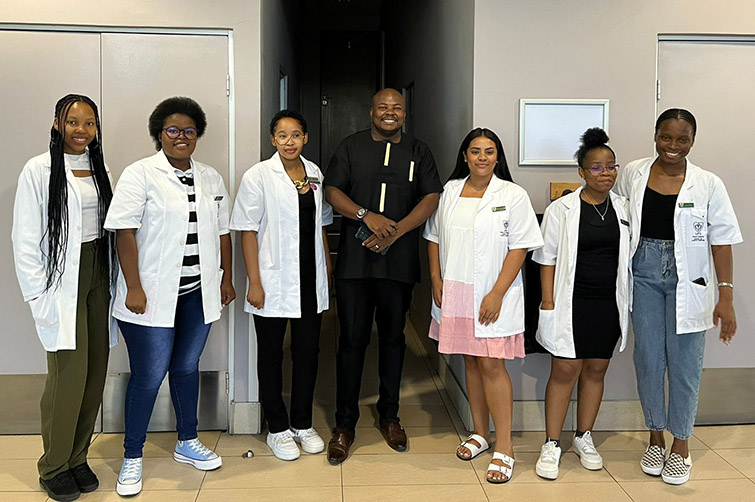 Mbali Chabeli, Zoleka Ngaka, Zandile Motaung, Dr Lehlohonolo Makhakhe, Brigitte-Jane Oliver, Maserame Motloung, and Ogechi Mokotedi. Zinhle Ncwane (in absentia).
A research study by a group of medical students at the University of the Free State (UFS) has successfully demonstrated a plausible link between certain types of skin cancers and people living with albinism.
The study was of a high standard
The researchers: Dr Lehlohonolo Makhakhe, Brigitte-Jane Oliver, Maserame Motloung, Zoleka Ngaka, Zandile Motaung, Mbali Chabeli, Zinhle Ncwane and Ogechi Mokotedi, evaluated all patients with this specific condition for the entire Free State province within South Africa and in Lesotho. This was conducted as a cross-sectional study, retrospectively observing files of all patients known to the clinic, or as referrals with OCA, from the beginning of January 2017 to the end of January 2019. The retrospective research was conducted as part of a research module for the university by students from the UFS Department of Dermatology, under the leadership of Dr Lehlohonolo Makhakhe, Senior Lecturer and Medical Specialist at the university. The research site being Universitas Academic Hospital.
“The study was of such high standards, that it was accepted for publication in the peer-reviewed international journal Dermatology Reports. It is uncommon for undergraduate research to be published, owing to the strict publishing standards.
“The group of medical students took a decision to put the spotlight on this skin condition through retrospective research that reiterated a plausible link between certain types of skin cancers and people living with albinism. The study was conducted as part of a research module for the university,” says Dr Makhakhe.
A total of 36 files were included in this study, with 11 (30.6%) being males and 25 (69.4%) being females. 32 (88.9%) had a history of active, past epidermal skin cancers or, at the very least, pre-malignant skin lesions, while the rest, 4 (11.1%), had no history of ever having any secondary pathology of the skin. The distribution of the pathology was notable in relation to sun exposure, with the face being mostly affected in 31 (96.9%) of cases assessed. OCA has been identified as a risk factor for solar keratosis, squamous cell carcinoma (SCC), and basal cell carcinoma (BCC).
“It was our aim to publish this work from the onset. We worked diligently as a group, meeting regularly with our study leader who was always keen to lend us a helping hand, ever so friendly, with an open-door policy,” said Oliver.
According to another researcher, Ncwane indicates: “Through our study, we have learned that people living with albinism have normal intelligence like all of us, however, due to eye-related complications, they tend not to do well in the mainstream schooling system. Without the aid of ophthalmologists (eye specialists), a significant number of them drop out of school along the way.”
Climate change negatively affects skin
Motaung had the honour of presenting the study findings to the rest of her classmates and esteemed panel of examiners where she highlighted all the key findings of the study. She further emphasised key preventive measures against development of skin cancers, which included sun avoidance, wearing of protective clothing and the proper use of adequate sunscreen, especially during daylight.
Dr Makhakhe also highlighted that patients living with albinism are challenged with a plethora of social ills and injustices, knowledge with regards to management of this condition must be emphasised at all times, this includes mandatory screening at appropriate medical centres for everyone living with albinism for signs of sunburn, a precursor to subsequent pre-malignant and cancerous skin lesions.
He indicated that skin cancers that were linked to albinism include basal cell carcinoma and squamous cell carcinoma which are both known for being locally infiltrating, or locally invasive, squamous cell can metastasise, while basal cell cancer almost exclusively causes local tissue destruction.
“Climate change negatively affects skin through increased UV radiation exposure, leading to conditions like premature skin aging, skin cancer, and flares of inflammatory conditions such as eczema and rosacea. Due to the link between the UV radiation and albinism, it would thus follow that the rate of skin cancer can potentially increase if the climate changes continue to increase.”
Dr Makhakhe thanked Johan Botes from the Research and Development Unit in the UFS School of Clinical Medicine, for his assistance and hard work in getting the article published.
- The article can be found here.