24 April 2026
|
Story Tshepo Tsotetsi
|
Photo Tshepo Tsotetsi
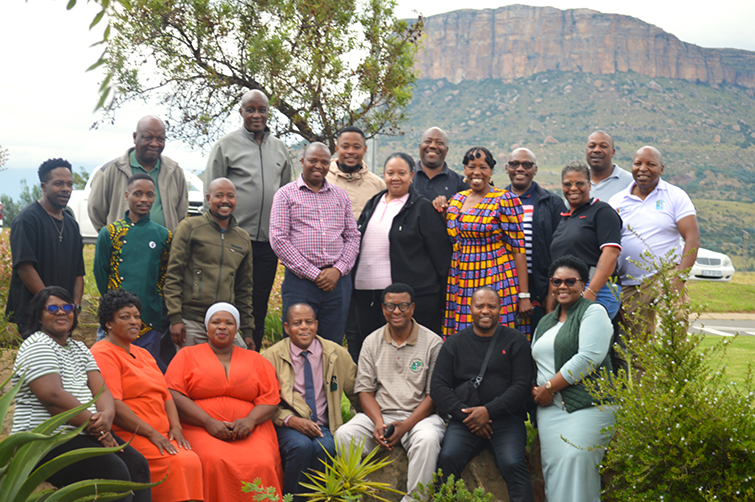 University of the Free State Qwaqwa Campus management with members of the royal houses.
At the University of the Free State’s (UFS) Qwaqwa Campus, learning this past week did not sit neatly within the usual boundaries of student life. In the Qwaqwa region, members of the Bakoena ba Mopeli, Makholokoe, Batlokoa ba Mokgalong, and Batlokoa ba Mota Royal Houses spent the week inside a Financial Management and Cost Accounting short learning programme offered through the UFS Business School.
The training is part of a working relationship between the university and the Free State House of Traditional Leaders in the Qwaqwa region, formalised through a Memorandum of Understanding signed in 2024. At the heart of that agreement is the simple idea that knowledge held within the university should not remain distant from the communities surrounding it, but should circulate back into society in practical ways.
For Qwaqwa Campus Principal Prof Prince Ngobeni, the engagement reflects how the university understands its role in its immediate environment, not only as a place of teaching and research but as a partner in community life.
“This partnership is grounded in the university’s commitment to building meaningful connections with communities in its region,” Prof Ngobeni said. “When we equip royal houses with relevant skills, particularly in financial management, it strengthens their ability to serve their communities in a more informed and responsible way.”
Learning that returns to the community
Morena (Chief) Ernest Moloi of the Makholokoe Royal House, who represents the participating royal houses, said the programme has practical value that will be taken back into community structures. “What we have learned here must be applied in our councils,” he said. “It is important because it affects how we manage resources and how effectively we are able to serve our communities.”
Morena Moloi added that the training highlights the importance of continuous learning for those in leadership roles. “Leaders must continue to build their knowledge so that they can adapt to changing circumstances. Without that, it becomes difficult to manage responsibilities in a way that truly benefits the people we serve.”
He added that engagement with universities helps make knowledge and research tangible. “When universities engage with royal houses in this way, knowledge becomes practical and accessible,” he said. “It helps connect academic learning with the realities of community life.”
Strengthening leadership through shared knowledge
Prof Cias Tsotetsi, Qwaqwa Campus Vice-Principal: Academic and Research, said the engagement reflects how universities and royal houses can work together in responding to changing social and governance realities.
“Traditional leadership is something that is inherited from birth, unlike political leadership,” he said. “Because communities and the socio-political space continue to evolve, it becomes important for royal houses to also engage with contemporary ways of thinking and practice from universities.”
He added that the relationship works in both directions. “In the same way, universities also benefit from the perspectives of royal houses,” Prof Tsotetsi said. “This ensures that our academic work remains relevant not only to students but also to those in leadership positions within communities.”
Dr Calvin Mudzingiri, Assistant Dean in the Faculty of Economic and Management Sciences, said the programme focuses on practical skills that can be applied directly within community leadership structures.
“The training equips participants with tools such as budgeting, bookkeeping and financial record-keeping,” he said. “These are essential skills for managing community resources and supporting sound decision-making within councils and trusts.”
He added that universities have a broader responsibility to contribute to society beyond only teaching students. “Universities should not operate in isolation,” Dr Mudzingiri said. “They must share knowledge in ways that strengthen the communities in which they are based.”
The engagement forms part of the university’s broader commitment to regional engagement and its vision of responsible societal futures, where knowledge is shared in ways that strengthen communities and support local leadership structures.