13 April 2026
|
Story Tshepo Tsotetsi
|
Photo Kaleidoscope Studios
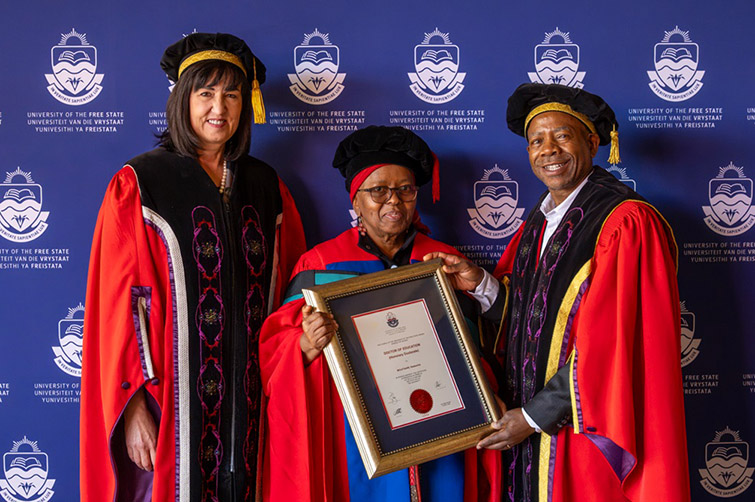 Pictured from the left: UFS Vice-Chancellor and Principal, Prof Hester C. Klopper; Prof Relebohile Moletsane; and UFS Chancellor, Prof Bonang Mohale.
For Prof Relebohile Moletsane, classrooms in rural South Africa have never been abstract spaces. They are places shaped by inequality, silence, and often – resilience.
On 11 April 2026, that work was recognised with an honorary Doctor of Education degree during the Faculty of Education’s graduation ceremony on the University of the Free State Qwaqwa Campus.
Over the years, her research has focused on how girls and young women experience schooling in contexts affected by gender-based violence and limited resources. Rather than observing from a distance, she has worked with communities, creating space for young people to speak about their own lives and question what education makes possible for them.
That approach has influenced how educators and policymakers engage with these realities, particularly in rural contexts where schooling is often overlooked.
UFS Chancellor, Prof Bonang Mohale, acknowledged the reach of her work and its role in shaping responses to some of the country’s most urgent challenges.
A message shaped by experience
In her acceptance address, Prof Moletsane spoke about responsibility, linking the recognition to the work that continues beyond the ceremony.
“I take your recognition seriously and treasure it with all the responsibility attached to it,” she said.
Her reflections moved between access and outcome. While more students are entering higher education, she noted, many still face limited opportunities after graduation, especially those from rural communities.
She returned to a point that has defined much of her work.
“Until South Africa acknowledges in policies and in practice that rural schools do matter and invests in quality education, the very notion of rural communities as national economic pillars will remain just talk,” she said.
Addressing the graduating teachers, she placed the focus on what happens next – in real classrooms.
“Ensure that no child is left behind, regardless of who they are, their social class, religion, or race.”
Beyond recognition
The honorary degree reflects the University of the Free State’s focus on Responsible Societal Futures. This includes work that connects teaching and research to the conditions people live in.
UFS Vice-Chancellor and Principal, Prof Hester C. Klopper, noted that Prof Moletsane’s work continues to challenge institutions to respond more directly to inequality, while preparing educators to work meaningfully in the communities they serve.
For Prof Moletsane, the recognition remains closely tied to the work ahead.
“To the graduating class: let this be proof that where you come from is not what holds you back; it is exactly what drives you to thrive,” she said.