27 August 2026
|
Story Dr Nontombi Velelo
|
Photo Andre Damons
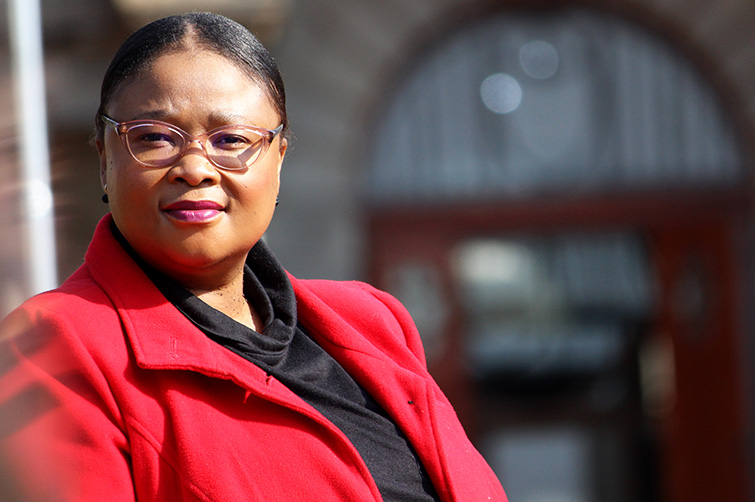 Dr Nontombi Velelo, Lecturer: Department of Sociology, University of the Free State.
Opinion article by Dr Nontombi Velelo, Lecturer: Department of Sociology, University of the Free State
Sustainable Development Goal 5 prioritises gender equality and the empowerment of women and children. The South African Constitution of 1996 reflects progressive laws on gender equality. The Bill of Rights Sections 9, 10, and 12 emphasise equality, human dignity, and the freedom and security of persons; however, women in South Africa are consistently confronted with challenges that violate these sections.
Building resilient economies for all women
This year’s commemoration emphasises “Building resilient economies for all women”. Though the government has attempted to make strides in women’s development and empowerment, the Department of Employment and Labour reported during the third term of 2025 that only 26.5% of women in South Africa occupy top management positions, and 43.5% are unskilled workers. This raises questions about women’s upward mobility, economic resilience, and the transformation agenda across various sectors of employment. March and March’s call for the repatriation of undocumented foreign nationals in the country showed the vulnerability of African women, as most women were left stranded with their children. Women in South Africa, particularly black women, find themselves undertaking precarious and informal work that often places them in a position of vulnerability and exploitation with low income.
Empowered women, empower the nation
President Cyril Ramaphosa's 2026 speech emphasised ‘Empowered women, empower the nation’. One could argue that the president’s speech is a true reflection of what we believe to be the strength of African women; however, it sheds light on the traditional notion of women as the ‘doing gender’. The keynote speech reminds me of Brenda Fassie’s song titled Good Black Woman, released in 1989. Though Brenda Fassie sang about what was happening at the time, it is as though she foresaw the dismissive attitude of some law enforcement officers when attending to the GBVF cases.
Early on Monday morning, police arrest my brother
For working, for a black community
Monday afternoon, I went to see my brother
Policemen, treated me like a donkey
I say to policemen – you got a bad attitude
Oh no, I’m no criminal
I’m a good black woman
The president is encouraging women to be ‘Empowering Women’ and ‘Good Patriots’. At the same time, the South African Police Service recorded 50 511 gender-based violence and femicide (GBVF) cases during the 2025/26 financial year. The question is, how do women empower the nation when South Africa is not safe for us? When will women empower the nation while they are being violated and killed in South Africa? Women and children continue to be victims of GBVF. In most cases, the perpetrators are not strangers but people who are familiar and have intimate relations with the victims. This illustrates that the safety of women in this country is compromised in various spaces, including the victims’ social environment, such as their family. Social media has been an instrumental platform for women to narrate their lived experiences related to GBV. Such a case is that of a young woman from the Eastern Cape who alleged that a neighbour had violated her and reported the case to local law enforcement. Knowing that her case had been dismissed, she self-harmed. Though she sought psychosocial assistance, seeing the person who violated her walking freely on the streets almost caused her to destroy her life. This illustrates that freedom of movement is yet to be attained by women in South Africa.
As we conclude this reflection on Women’s Month, the journey since 1956 reveals a complexity around the progress of women and persistent challenges confronting women in South Africa. While the employment landscape has evolved, the fundamental freedoms of movement, safety, and economic stability remain elusive for many, particularly black women. Building truly resilient economies and empowering the nation requires us to dismantle the systemic barriers that continue to impede women’s full participation and security.