30 September 2026
|
Story Siqhamo Hlubi Jama
|
Photo Supplied
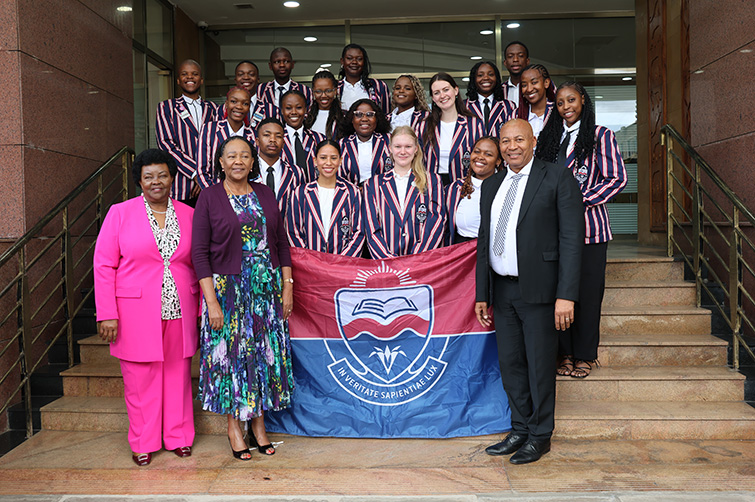 UFS student leaders and staff during engagements at the Co-operative University of Kenya as part of the 2026 Global Citizenship Developmental Programme, strengthening partnerships and promoting African-centred learning and leadership development.
Being a global citizen in Africa today means learning to see beyond the boundaries of one's own experience.
Through the
Global Citizenship Developmental Programme, student leaders are doing just that in Kenya, engaging with universities and public institutions to deepen their understanding of leadership, governance and development on the continent. The programme forms part of the
UFS Division of Student Affairs' commitment to developing globally competent graduates who are socially responsible and equipped to contribute meaningfully to society.
Now in its third year, the programme has expanded from partnerships in Southern Africa to East Africa through a collaboration with the Co-operative University of Kenya (CUK).
African universities learning from one another
At CUK, the UFS delegation engaged with university leadership on the role of higher education in responding to social and economic challenges across Africa.
Addressing the gathering, Dr Temba Hlasho emphasised the strong alignment between the two institutions’ missions and values. “Universities are catalysts for transformation, not ivory towers, but anchor institutions for community-driven economic models that empower grassroots populations.”
The delegation further highlighted the shared commitment to values such as solidarity, equity, democracy, sustainability, and Ubuntu. “Like CUK, we believe that cooperative values are universal values: solidarity, self-help, equity, democracy, and Ubuntu/Ujamaa.”
According to the delegation, both institutions recognise that African universities have a responsibility not only to produce graduates, but also to contribute meaningfully to solving challenges such as youth unemployment, food security, sustainable livelihoods, and inclusive growth.
Experiencing leadership beyond the classroom
The Global Citizenship Developmental Programme is intentionally designed as an experiential learning opportunity rather than a traditional study tour. Students are exposed to diverse learning environments that challenge them to think critically about leadership, citizenship, governance, and development in an interconnected Africa.
The programme itinerary included engagements with higher education institutions, industry partners, cultural heritage sites, and public institutions. One of the highlights was the visit to the Parliament of Kenya on 29 September 2026, where students engaged with the Senate Standing Committee on Education. The senators explained the role of Kenya’s Senate, including its responsibility to represent counties, participate in legislation and oversee the allocation of national revenue to counties. They also outlined the Education Committee’s work in areas ranging from basic and higher education to teacher training, research and equitable access to education across Kenya’s 47 counties.
The students then had an opportunity to put their own questions to the senators. They asked how Kenya balances national education policy with county-level delivery, how young people can participate in legislative processes, and how the country responds to out-of-school youth and transitions from secondary education to university and technical and vocational education and training. Student funding in Kenya and South Africa was another point of discussion.
For the students, the engagement offered a chance to move beyond textbook knowledge of governance and encounter the workings of a democratic institution directly. A further area of learning has centred on Kenya’s internationally recognised cooperative movement, which has demonstrated how collective entrepreneurship can support sustainable development and economic inclusion.
For many in the cohort, this was also their first engagement with East Africa. “This is not tourism. It is transformative learning.”
Creating Impact Beyond the Experience
The impact of the programme extends far beyond the international travel experience.
Participants move through a selection and preparation process before the international component, followed by a return-learning phase. Upon their return to the UFS, participants are expected to invest their learning in student life initiatives, mentorship programmes, volunteer activities, and broader campus development.
“This is the true purpose of global citizenship: to learn with humility, to share with generosity, and to grow together.”
Building sustainable partnerships across Africa
The programme is also creating opportunities for longer-term institutional relationships. During engagements in Nairobi, the UFS formally proposed a reciprocal exchange that would allow Kenyan students and staff members to experience the UFS and contribute to future collaborative initiatives, including research, student development, and community engagement projects.
“Let this be the beginning of a structured, sustainable, and mutually beneficial partnership – a Kenya-South Africa bridge built on cooperative principles.”
Through experiences such as these, the programme connects student leadership with the wider African context, giving students an opportunity to listen, question and reflect on the responsibilities that come with being active citizens.