28 August 2026
|
Story Siqhamo Hlubi Jama
|
Photo Supplied
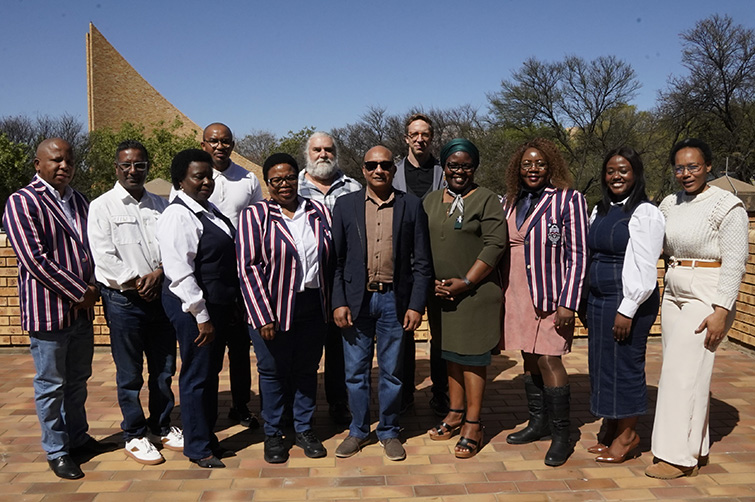 The panellists of the third Mind-Altering Book Talk with moderator Prof Rick de Villiers and Deputy Vice-Chancellor Prof Vasu Reddy at the VIP Lounge, South Campus, University of the Free State, 25 August 2026.
A boy who wept when a bird was shot and grew up to be cited by the scientist who taught him that being different is not the same as being less. A girl once labelled a ‘squabble’ who found her own reflection in a Botswana village 60 years after it was written. Six academics from the University of the Free State stood up and did what readers have always done best: turned book pages into shared meaning.
The occasion was the third instalment of the Mind-Altering Book Talk series, hosted by the UFS Library and Information Services. Six academics, one book each, and an audience of staff, students, and an online livestream spent an afternoon discovering what a single text can do to a life.
Prof Vasu Reddy, Deputy Vice-Chancellor: Research, Innovation and Postgraduate Studies, set the tone: books are catalysts for curiosity and transformed thinking, and a truly mind-altering book does not change what we know, but who we are becoming. Moderator Prof Rick de Villiers introduced the six speakers – four from Education, two from STEM – and the format: three speakers, questions, then three more.
The long way home
Dr Blandina Manditereza opened with The Alchemist by Paulo Coelho, a book her son recommended after abandoning law for music, then jewellery-making, then computer science. Retelling the shepherd boy's journey to treasure buried back where he started, she challenged academics chasing citation counts to ask who their research is really for – invoking Paulo Freire's warning against treating students as empty vessels rather than dialogue partners.
Different, not less
Dr Leon Kruger followed with Thinking in Pictures by Temple Grandin. Mocked as a boy for his empathy towards animals, he found in Grandin's phrase "different but not less" a new way to see his own sensitivity – not a flaw, but the foundation of a career studying animal stress. In what he called his circle-closing, his master's research was later cited in one of Grandin's publications.
Shedding old skin
Dr Lerato Ramphele closed the first round with Maru by Bessie Head. Dubbed a ‘coconut’ by peers and a ‘squabble’ within her own family, she recognised herself instantly in Margaret Cadmore, a Masarwa teacher whose talent counts for nothing in the face of her community's prejudice. She returned to one line: that prejudice is like a snake's old skin, shed only bit by bit – a process she said she is still in the middle of.
A lively Q&A followed on prejudice, animal grief, and living with difference.
Quiet leadership
Masabata Thakaso opened the second round with Magnet People by Roger Fritz, a book she first read at 16 and again 25 years later. One line – that magnet people never forget those who ‘held the ladder’ for them – returned her to her dying mother, who used her last strength to call and remind her that she would shine, rather than offer comfort. She closed with the book's toughest question: when you reach the mountaintop, who do you bring with you?
Building with what is at hand
Dr Seipati Baloyi-Mothibeli discovered The Savage Mind by Claude Lévi-Strauss while hunting for methodological texts during her master's degree. Its concept of bricolage – building value from whatever is at hand, rather than waiting for the ideal resources – has since become her own teaching philosophy.
A 49th law
Closing the programme, Moses Letsapa took a selective, critical approach to Robert Greene's The 48 Laws of Power, embracing the laws of restraint, self-worth, and bold action while rejecting the more manipulative ones outright. He proposed his own addition: Law 49 – use your power to empower others.
What comes next
The floor discussion that followed ranged from the bond between humans and animals to how to cultivate a love of reading in an age of short attention spans, with panellists pointing to storytelling, book clubs, and family reading rituals as low-cost, high-impact starting points.
In her closing remarks, Library and Information Services Director Jeannet Molopyane responded to each book in turn, promising that all six titles, in print and digital formats, would be added to the library's collections in the coming months. Event coordinator Kego Phuthi thanked the panel, the organising committee, and attendees, and hinted that a fourth instalment might already be on the calendar.
It was a note that Prof Reddy himself had struck at the outset, reminding the room that books do not simply help us understand the world we live in – they help us imagine how that world might be different.
For a university whose stated vision is to contribute meaningfully to responsible societal futures, this afternoon of shared reading was itself a small expression of that mission: six academics, six books, and a room reminded that shaping a better future so often starts with a story someone else once told.