24 February 2026
|
Story Leonie Bolleurs
|
Photo Supplied
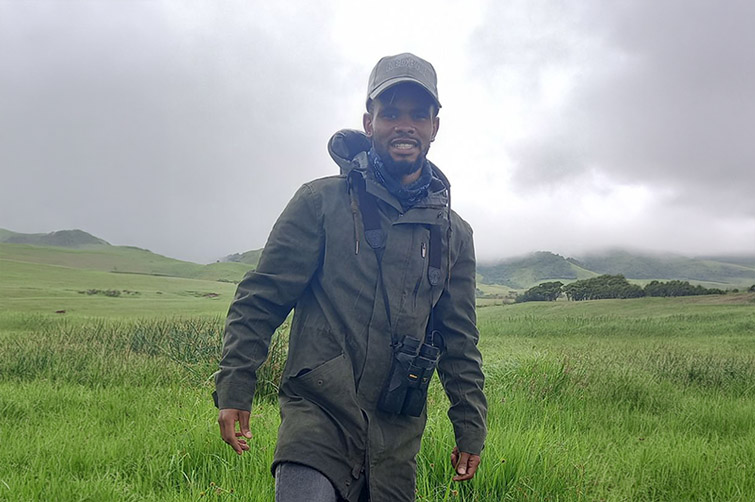 Toka Mosikidi conducting fieldwork in the wetland, where he used acoustic recorders to capture the dawn chorus of local bird species.
When most people are still tucked in bed, the wetlands are already alive with music. Just before sunrise, a symphony of birdsong fills the air, a natural orchestra that holds more meaning than most realise. For Toka Mosikidi, a PhD candidate in the Department of Zoology and Entomology on the UFS Qwaqwa Campus, this morning performance turns beautiful sound into valuable scientific data.
He studies what is known as the dawn chorus, when birdsong is most active around sunrise. “To humans it might sound like a bit of a cacophony,” he says, “but to the ‘real’ audience (females of the species), it is highly attractive and it’s important to still find the right mate among all those gentleman singers.” In the Southern Hemisphere, these early-morning serenades are most intense between September and February, forming part of the birds’ efforts to establish territories and attract mates.
He often programmed his equipment to start recording before sunrise, capturing the first calls as they broke the early morning silence. From his recordings, it became clear that different species join in at distinct moments; almost as if each was following its own cue in the early-morning performance.
By analysing hours of these recordings, Mosikidi and his team discovered how environmental factors shape when and how often birds begin singing at dawn. Temperature had the most consistent effect, with all three species – the African yellow warbler, lesser swamp warbler, and the little rush warbler – starting earlier on warmer mornings and later on colder ones. Humidity, wind, and rainfall produced species-specific responses: higher humidity advanced singing in the yellow warbler but delayed it in the swamp warbler; wind prompted earlier songs for the swamp and rush warblers; and rainfall delayed the yellow and rush warblers but advanced the swamp warbler’s onset.
Lunar brightness also played a role, as the swamp and rush warblers began singing later after full-moon nights, while the yellow warbler remained unaffected. “Across species, the earliest singing occurred in mid-breeding season and the latest toward its end,” he says. These patterns show how birds carefully adjust their behaviour to environmental and seasonal cues, offering valuable insight into how climate and habitat conditions shape daily patterns and wetland ecosystem health.
His research forms part of broader work in the Department of Zoology and Entomology under the guidance of Prof Aliza le Roux. That broader perspective opened the door to a bigger question: what can birds’ songs tell us about the wetlands they inhabit? Because birds are sensitive to their surroundings, changes in their songs can indicate problems in wetland ecosystems before they become visible. “Birdsong can act as a proxy for wetland health,” he explains. “When there’s less variety or intensity in their calls, it could mean that the environment is under stress from pollution, water changes, or habitat degradation.”
For Mosikidi, fieldwork has been both challenging and unforgettable. Working in remote wetlands meant long walks, wading through water to reach recording sites, and even losing equipment to a fire that swept through part of the area. Yet, these experiences strengthened his love for science. “We were among the few to use acoustic monitoring like this in such an environment,” he says. “It wasn’t easy, but it was incredibly rewarding.”
His work is helping to build a new way of listening to nature. One that could guide how we monitor and protect South Africa’s disappearing wetlands.