09 February 2026
|
Story Tshepo Tsotetsi
|
Photo Stephen Collett
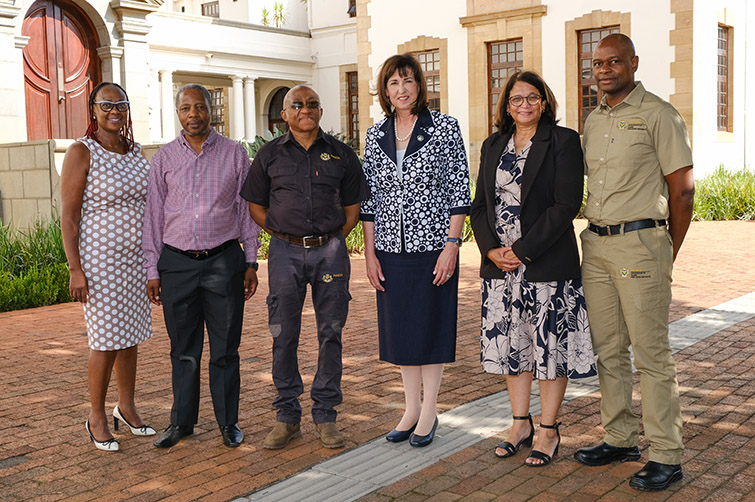 From left: Prof Deliwe Phetlhu, Dean of the Faculty of Health Sciences; Mzonakele Fikizolo, Free State Department of Health Deputy Director General: Corporate Services; Monyatso Mahlatsi; MEC for Health; Prof Hester C. Klopper, UFS Vice-Chancellor and Principal; Prof Anthea Rhoda, Deputy Vice-Chancellor: Academic; and Ernest Mohlahlo, Head of the Department of Health.
The University of the Free State (UFS) and the Free State Department of Health reaffirmed their strategic partnership during an engagement held on 5 February 2025 on the UFS Bloemfontein Campus. For the Department of Health, the event was led by the Member of the Executive Council (MEC) for Health, Monyatso Mahlatsi, and the Head of Department, Ernest Mohlahlo.
The meeting was also attended by UFS Vice-Chancellor and Principal Prof Hester C. Klopper, Deputy Vice-Chancellor: Academic Prof Anthea Rhoda, and the Dean of the Faculty of Health Sciences, Prof Deliwe Phetlhu, reflecting a shared commitment to strengthening collaboration between academia and provincial government.
At the centre of the engagement was a five-year Memorandum of Agreement (MOA) signed in 2023, which aligns the University’s core mandate of teaching and training with the Department of Health’s responsibility for service delivery. Through this partnership, UFS health sciences students gain access to public hospitals and clinics for essential clinical training, while the department benefits from academic expertise, shared specialised equipment, and a pipeline of skilled healthcare professionals. The collaboration highlights the importance of coordinated efforts between academic institutions and government in strengthening public health services and responding to the healthcare needs of communities across the Free State.
A shared responsibility for healthcare training and service delivery
Prof Klopper emphasised that the partnership is central to how the University fulfils its societal role. She noted that the MOA provides the framework through which the UFS is able to support quality healthcare training while contributing meaningfully to public service. “The agreement creates a clinical platform that underpins how we train future healthcare professionals,” she said, describing the partnership as a “win-win arrangement for both institutions”.
MEC Mahlatsi stressed that this collaboration reflects the reality that healthcare training and service delivery cannot function in isolation. “We need the University to produce capable and skilled professionals so that we are able to render healthcare services,” he said, adding that the department plays an equally important role by providing clinical environments where students can apply their training in practice.
Mahlatsi highlighted that the partnership has already yielded tangible benefits for the provincial health system. “We have consistently been able to access highly trained professionals who enter our system and contribute to service delivery.” He added that collaboration with the University has enabled the department to extend healthcare services to communities that may otherwise have been difficult to reach.
Prof Phetlhu underscored the importance of clinical exposure in producing graduates who are responsive to societal needs. “We cannot train professionals who are able to give back to the community without hands-on clinical experience,” she said, noting that while laboratories and simulations are important, they cannot replace learning within real healthcare settings.
Prof Phetlhu added that the effectiveness of the partnership directly influences its impact. “The better the partnership is structured and functions, the more efficient it becomes,” she said, “and ultimately, the greater the benefit for the communities we serve.”
Looking to the future, Mahlatsi emphasised the value of sustained collaboration between provincial government and institutions of higher learning in an evolving health landscape. “Diseases are changing, and new knowledge generated by universities is critical if we are to remain effective in managing illness,” he said, highlighting the role of academic research in strengthening public healthcare responses.