06 February 2026
|
Story Lunga Luthuli
|
Photo Stephen Collett
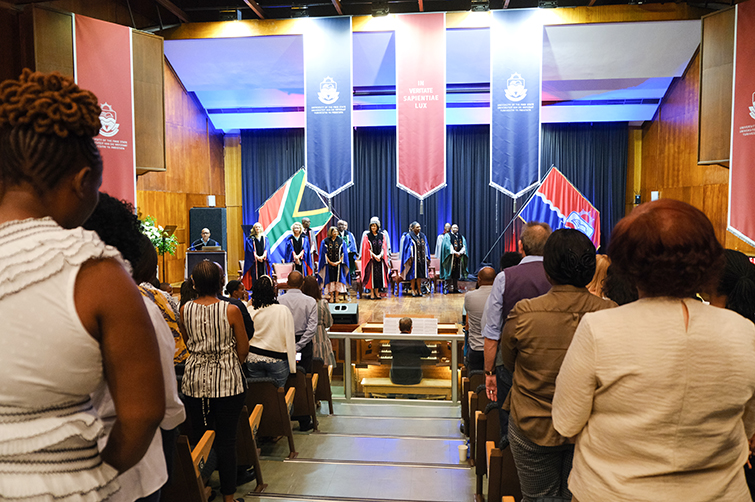 Advancing with Purpose: Shaping Responsible Societal Futures was the theme of the official opening address of the University of the Free State (UFS) presented by UFS Vice-Chancellor and Principal, Prof Hester C. Klopper, as she addressed staff members in the Odeion Auditorium on the Bloemfontein Campus on 6 February 2026.
Advancing with Purpose: Shaping Responsible Societal Futures was the theme of the official opening address of the University of the Free State (UFS) presented by Vice-Chancellor and Principal,
Prof Hester C. Klopper, as she addressed staff members in the Odeion Auditorium on the Bloemfontein Campus on 6 February 2026.
Reflecting on 2025 – her first year at the helm of the University of the Free State (UFS) – Prof Klopper quoted
Mary Catherine Bateson, acclaimed anthropologist and educator, who said: "We are not what we know, but what we are willing to learn."
Delivering her address to staff in the Odeion Auditorium on the Bloemfontein Campus and online, Prof Klopper also quoted
Alvin Toffler, a well-known futurist, who said: “The illiterate of the 21st Century will not be those who cannot read and write, but those who cannot learn, unlearn, and relearn.”
Prof Klopper said: “These two insights converge on a single, powerful conclusion: in the 21st Century, identity, capability, and leadership are defined less by accumulated knowledge than by adaptive learning capacity. Knowledge is paramount to what we do. But knowledge should never be an end in itself. It should always be an instrument that leads to improved lives for others.”
Purpose as a guiding principle
Starting the new academic year, Prof Klopper emphasised that it is an opportunity to reflect on lessons from the past while deliberately shaping the future. She reflected on the symbolism of the Sankofa bird, reminding the UFS community that progress requires learning from history while moving forward with intention.
“This year calls us to listen more closely to that heartbeat – to the purpose that drives each decision, each movement, and our collective direction,” she said.
She noted that universities have a responsibility to ensure that teaching, research, and innovation remain deeply connected to the needs of society, shaping graduates who are not only skilled but also socially conscious and committed to the common good.
“Knowledge should never be an end in itself,” she said. “It should always be an instrument that leads to improved lives for others.”
Celebrating achievements from 2025
Reflecting on the past year, Prof Klopper cited several milestones that demonstrated the UFS’ commitment to purposeful action. These included the recognition of 53 UFS students among the Top 500 in the
2025 GradStar Awards, world-first innovations in artificial intelligence-assisted cancer treatment planning, and the launch of the
Giraffe Research Programme and Infrastructure near Brandfort.
Operational achievements included the UFS being the only university to attain Platinum Status under the Good Financial Grant Practice accreditation, as well as progress with the institution’s first fully online registration process.
“These are just some of the examples proving that 2025 was a year of purposeful strides,” she said, “but it was also a year that revealed the urgency of the work still before us.”
Responding to a changing global and local context
Addressing the broader environment in which universities operate, Prof Klopper outlined the pressures of technological acceleration, shifting student demographics, and increasing geopolitical fragmentation.
“In the fractured and uncertain world of 2026, universities are being exposed to new risks and opportunities that were not envisaged even just a few years ago,” she said, adding that higher education institutions must adopt a ‘business unusual’ approach.
Locally, she noted the impact of constrained public funding, rising operational costs, and enrolment pressures, highlighting the need for financial sustainability and strategic planning.
Responsible societal futures as the UFS North Star
Central to Prof Klopper’s address was the university’s refined strategic focus on responsible societal futures, which she described as the UFS’ ‘North Star’.
“We refuse to be passive observers of change,” she said. “We choose to be active architects of better futures.”
Prof Klopper explained that this commitment informs the UFS’ approach to research, teaching and learning, engaged scholarship, and professional and support functions, with an emphasis on real-world impact, graduate readiness, community partnership, and operational excellence.
A call to collective action in 2026
As the UFS looks ahead to the new academic year, Prof Klopper called on staff and students to approach the year with courage, collaboration, and commitment. “We are building a legacy that will outlive any of us individually,” she said. “An institution that transforms lives for generations to come.”
Prof Klopper also highlighted the “importance of embedding the humanness in our programmes.”
What is required of the UFS community looking ahead to 2026 and beyond, Prof Klopper said: “It is courage in pursuit of excellence, it is time to build bridges rather than defending territories, and the commitment to students and communities depending on us for solutions.”
Prof Klopper challenged staff to “rediscover the purpose that brought you to this place”. She said, “Reconnect with that passion. What we do here matters; let us make that difference collectively.”
 Read the opening address