13 January 2026
|
Story Andre Damons
|
Photo Kaleidoscope Studios
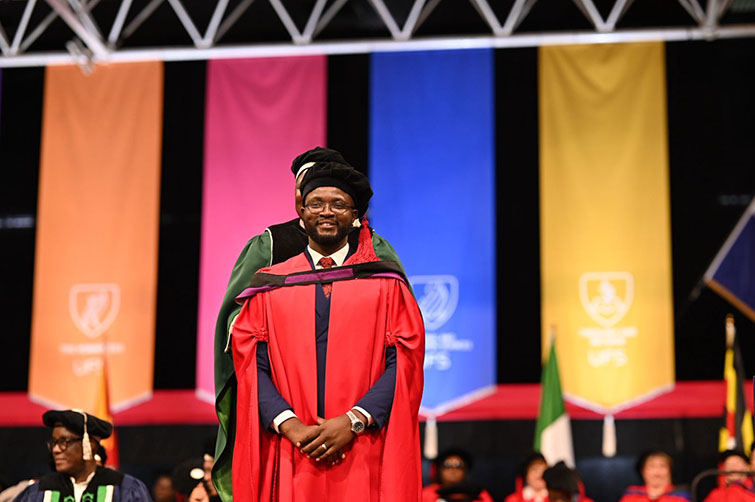 Dr Kennedy Chibesa after crossing the graduation stage at the University of the Free State’s Faculty of Health Sciences graduation ceremony.
With his PhD research, a graduate from the University of the Free State (UFS), hopes to contribute to solutions that address diarrheal diseases among children in low-resource settings.
Dr Kennedy Chibesa, who graduated on Friday (12 December) during the December graduation ceremonies with a PhD in Medical Virology, work is critical for improving vaccine performance and ultimately saving lives.
“Graduating with a PhD feels surreal, almost like a dream. There are moments when I still wake up thinking there’s a looming deadline, only to realise that this chapter is complete. If I could sum up my feelings in one word, it would be gratitude. First, gratitude to my Heavenly Father and the Lord Jesus for carrying me through this journey.
He experienced near mental breakdown when experiments failed and deadlines loomed, and moments of sheer joy when results exceeded expectations. What defined his experience, however, were the incredible people he met along the way.
Prof Martin Nyaga, Head of the UFS-NGS Unit and affiliated professor in the
Division of Virology, was his study Supervisor/PhD Mentor. Dr Chibesa is currently serving as the Molecular Biology Supervisor at CIDRZ Central Laboratory in Lusaka, Zambia. He is also an Affiliate Laboratory Member of UFS-NGS Unit, where his research interests align with the unit’s focus on viral genomics and systems biology.
“At CIDRZ, I had mentors like Michelo Simuyandi, a genius by all standards, a brilliant scientist and an exceptional human being, and colleagues who treated my PhD work as their own. At UFS-NGS, Dr Ayodeji E Ogunbayo (Dr Emms) embodied ubuntu and went above and beyond to make my stay in Bloemfontein enriching. These relationships turned this journey into a lifetime of friendships and collaborations.”
Reducing diarrheal disease
Dr Chibesa PhD thesis, titled Effects of the Gut Microbiome and Environmental Enteric Dysfunction on Immune Responses to the ETVAX® Vaccine: An Exploratory Study in Zambian Children, focused on understanding how gut health and immune systems in Zambian children influence their response to the oral ETVAX® vaccine, a promising candidate against ETEC diarrheal disease. “Diarrheal diseases remain a leading cause of illness and death among children in low-resource settings, including Zambia. I wanted to contribute to solutions that address this burden. This work is critical for improving vaccine performance and ultimately saving lives,” explains Dr Chibesa as to why he decided to undertake this research.
This research is important, and he hopes it will inform strategies to optimise oral vaccine performance in children from low-resource settings. This is because oral vaccines often show reduced Immunogenicity in such children compared to those in high-income countries. Factors such as gut microbiome composition, nutritional status, and environmental enteropathy play a role. Understanding these factors is key to improving vaccine immunogenicity and ensuring equitable protection for all children. Ultimately, he explains, he wants this work to contribute to reducing the diarrheal disease burden globally and to inspire further research in vaccine development and gut health.
Dr Chibesa says the guidance, patience, and commitment to excellence of his PhD mentor/supervisor, Prof Nyaga, pushed him to think critically and aim higher. Prof Nyaga was recommended to him by his other co-supervisor, Prof Roma Chilengi, the patron of the CIDRZ enterics group, and currently the Medical Advisor to the Zambian President as well as Director General of the Zambia National Public Health Institute.
Deep sense of care for humanity
“A recommendation from someone of his stature assured me that I would receive the support I needed to complete my PhD. Prof Nyaga’s work in establishing the UFS-NGS Unit is nothing short of remarkable. He has consistently demonstrated that excellence can make you a continental and even global leader in your field. Prof Nyaga goes above and beyond to make his team shine. He is not only a brilliant scientist but also a great leader and an all-weather mentor.
“What stood out most was his willingness to take me on despite the administrative hurdles involved in enrolling and registering at UFS. That meant the world to me. He accommodated me fully and equipped me with all the tools I needed to succeed. He created an environment where I could grow as an independent researcher while feeling supported. Prof Nyaga’s mentorship extended beyond academics - he modelled integrity and professionalism, qualities I aspire to carry forward. I am convinced that this PhD is just the beginning of great collaborations with him.”
Choosing a career in medical science comes from a deep sense of care for humanity for Dr Chibesa as he always felt a strong calling to improve the lives of Zambians, Africans, and contribute to global public health. “Pursuing a PhD and a career in medical sciences gave me the opportunity to turn that dream into reality. I have always been passionate about public health and infectious diseases because they disproportionately affect vulnerable populations.
“Working in this field allows me to combine science with impact, transforming research into practical interventions that improve health outcomes for communities that need them most.”