26 January 2026
|
Story Leonie Bolleurs
|
Photo Supplied
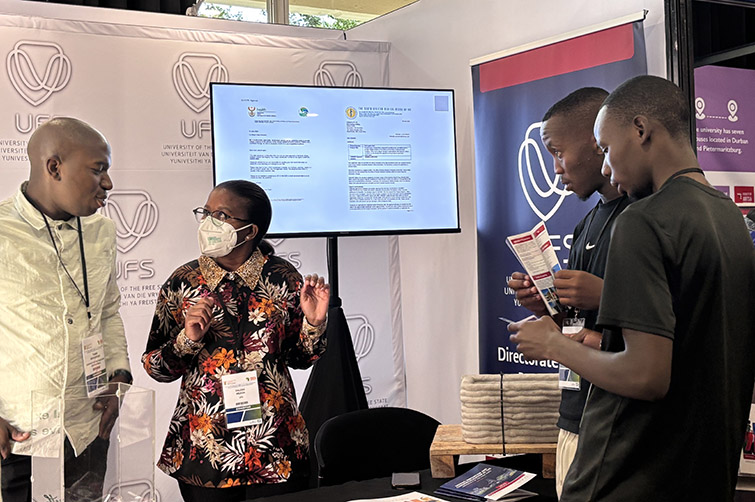 A group of delegates from the University of the Free State attended the Science Forum South Africa last year.
What does university research look like when it steps beyond laboratories and lecture halls and into public view? For the University of the Free State (UFS), the answer lies in spaces where ideas are shared, questions are asked, and partnerships begin.
This spirit was clearly visible at Science Forum South Africa, where a group of UFS delegates came together to share research that speaks to real needs and real possibilities. Hosted at the CSIR International Convention Centre in Pretoria, the forum offered both a rich conference programme and an active exhibition space. Alongside attending conference sessions and contributing presentations that placed UFS research within broader national and global conversations on science, technology, and society, a team from the university also engaged directly with the public, students, and industry partners at their exhibition space. At the UFS stall, Palesa Mgaga, Intellectual Property Officer in the Directorate Research Development (DRD), and Joyce Rwexwana, Marketing and Sales Officer in the Department of Pharmacology, shared research outputs designed to connect academia with industry and community needs. Mgaga explained that the stall aimed to position the UFS as a hub for impactful research, demonstrating how work across engineering, health sciences, and indigenous knowledge systems supports long-term, sustainable progress locally and globally.
A smarter way to build
She led conversations around one of the exhibition’s standout innovations – the green cement prototype developed by the UFS Department of Engineering Sciences (EnSci). Displayed as part of the broader DRD-supported showcase, the prototype sparked strong interest from visitors curious about greener construction options and how university research can shape everyday solutions. She noted that many visitors were keen to understand the real-world applications of the green cement prototype and its potential for use beyond the research environment.
The Department of Engineering Sciences’ green cement research offers a cleaner, smarter alternative to traditional cement. Instead of relying on energy-intensive processes that release large amounts of carbon dioxide, the team is exploring ways to turn industrial by-products such as fly ash and slag into strong, durable building materials. It is a simple idea with a big impact: taking waste that would normally end up in landfills and transforming it into something useful, affordable, and far kinder to the planet.
At the heart of this work is geopolymer technology, which replaces the high-heat production process of ordinary cement with a chemical reaction that uses significantly less energy. The result is a material that performs just as well as conventional concrete but carries a much smaller environmental footprint. Mgaga highlighted how this innovation could significantly reduce carbon emissions associated with Portland cement production, addressing pressing environmental concerns while contributing to sustainability in the construction industry. For a country such as South Africa, where construction is growing and waste from power stations is readily available, this kind of innovation has the potential to reshape how homes, roads, and cities are built.
According to Mgaga, the exhibition also highlighted the university’s strong capacity to translate research into practical solutions that respond to both global and local challenges. She believes that these efforts align closely with the UFS’ strategic goal of turning knowledge into impact, encouraging interdisciplinary engagement, and demonstrating how academic research can contribute meaningfully to societal advancement.
Research you can see, touch, and taste
The Department of Pharmacology used the exhibition as a platform to introduce visitors to both research and products they have developed. Rwexwana engaged directly with students, industry representatives, and community stakeholders.
Visitors were introduced to a range of products, including herbal teas and iced teas, pain relief creams, Phela supplements, and mouth sprays. The team also shared insights into research focused on diabetes, cancer, and Alzheimer’s disease.
“The information was well received, and several students expressed interest in learning about the process of creating health products,” Rwexwana comments. “They enquired about what steps to take if they chose to pursue this path.”
The exhibition also opened doors to potential partnerships beyond the academic space. “I also engaged with a number of traditional healers and companies that expressed interest in collaborating with us, and they will be reaching out soon,” she says.
Reflecting on the broader value of the forum, Rwexwana notes: “Participating in these exhibitions supports the UFS’ strategic goals by increasing its visibility, strengthening partnerships with industry and the community, and inspiring the next generation of researchers and innovators.”